
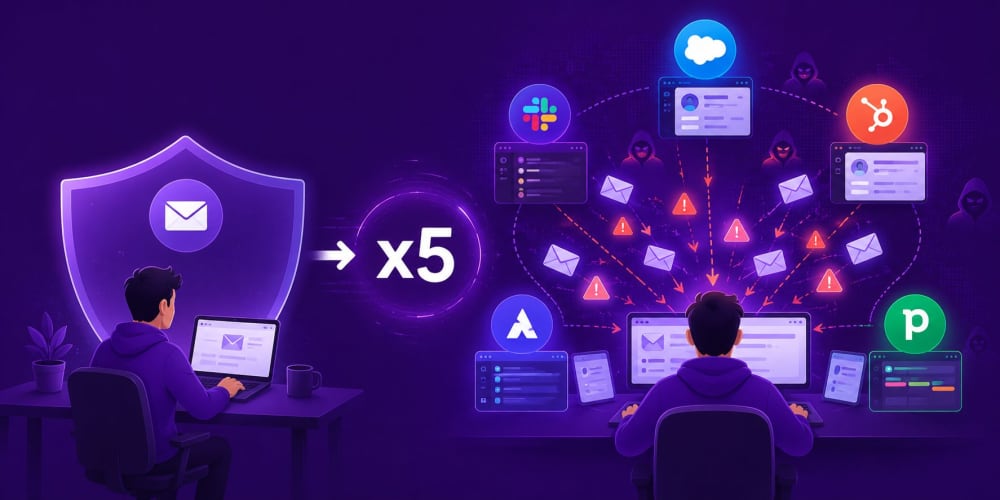
Entrepreneurs today rely on software more than ever before. A typical business owner may use one platform for email marketing, another for customer relationship management, one for project management, another for accounting, and a fifth for team communication. These software-as-a-service (SaaS) tools help businesses grow faster, automate repetitive tasks, and improve productivity. However, every new tool added to the stack creates another entry point that cybercriminals can target. While founders often focus on efficiency and scalability, many overlook the security risks that come with managing multiple connected platforms.
The challenge is that email sits at the center of almost every SaaS tool. Password resets, account invitations, user verification links, billing notices, support requests, and system alerts all flow through email. If a hacker gains access to a founder's inbox, they may gain access to every connected application as well. What starts as a single compromised email account can quickly become a company-wide security incident. For entrepreneurs managing multiple platforms, the attack surface expands with every new software subscription, creating risks that are often hidden until it is too late.
More Tools Mean More Paths for Attackers
Many entrepreneurs think of cybersecurity as a technical issue handled by IT professionals. In reality, most attacks begin with simple human mistakes. A founder receives a fake login request, clicks a phishing link, or unknowingly enters credentials into a fraudulent website. Once attackers gain access to one account, they begin searching for connected services, password reset opportunities, and administrative permissions that allow them to move deeper into the business.
The average startup can easily operate five to ten SaaS platforms before hiring its first security professional. Each platform stores sensitive information, including customer data, employee details, financial records, or business communications. More importantly, these tools often trust one another through integrations. A compromised email account can trigger password resets across multiple systems, giving attackers access to valuable information within minutes.
The convenience that makes SaaS tools attractive also creates vulnerabilities. Business owners frequently use the same email account as the primary administrator for every platform. This centralization simplifies management but creates a single point of failure. If that inbox becomes compromised, attackers may gain control of marketing systems, customer databases, payment platforms, and internal communications all at once.
As businesses continue adopting automation tools and artificial intelligence platforms, these risks become even more significant. More software connections mean more opportunities for unauthorized access if security practices fail to keep pace with growth.
Many companies building digital experiences have recognized this challenge. Itamar Haim, SEO Strategist, Elementor, believes business growth and security must evolve together.
"At Elementor, we work with businesses that depend on multiple digital tools to manage websites, marketing campaigns, customer interactions, and automation workflows. I have seen companies dramatically improve productivity by connecting platforms, but I have also seen how one weak security process can create unnecessary risk. We encourage teams to think about security from the start because every connected system expands the responsibility to protect user data. In my experience, the most successful businesses scale their security practices at the same pace they scale their technology."
His observation reflects a growing reality. Businesses are becoming more connected every year, and those connections create both opportunities and risks.
The Hidden Risk of Email-Based Authentication
Most SaaS platforms rely heavily on email-based authentication. When users forget passwords, they receive reset links through email. When new employees join a platform, invitation links arrive through email. When account ownership changes, confirmations are usually sent through email. While this process is convenient, it also makes email one of the most valuable targets for cybercriminals.
Consider a founder running an online business with five SaaS tools. If an attacker gains access to the founder's email account, they may not need to crack any additional passwords. Instead, they can request password resets across multiple services and take control of accounts one by one. The attacker does not need advanced technical skills. They simply exploit trust built into the recovery process.
The problem becomes even larger when businesses fail to implement multi-factor authentication. Without additional verification steps, a compromised email account often leads directly to compromised business systems. This chain reaction can result in data theft, financial losses, operational disruption, and reputational damage.
Small businesses are especially vulnerable because they often lack dedicated security teams. Entrepreneurs focus on growth, customer acquisition, and product development while security receives less attention. Unfortunately, attackers know this and frequently target smaller organizations because they are easier to penetrate than large enterprises with mature security programs.
The solution is not to avoid SaaS tools. Modern businesses depend on them. Instead, entrepreneurs must recognize that every new platform increases responsibility. Security practices must become part of daily operations rather than an afterthought.
Growth Creates Complexity and Complexity Creates Risk
As businesses grow, software ecosystems become increasingly complex. Teams add specialized tools for customer support, scheduling, analytics, payroll, collaboration, and automation. While each platform solves a specific problem, the growing network becomes harder to monitor and secure.
A business that starts with two software tools may eventually operate twenty. Employees join and leave. Access permissions change. New integrations are added. Old accounts remain active long after they are needed. Over time, forgotten accounts and unused permissions create security gaps that attackers can exploit.
This challenge extends beyond technology companies. Educational businesses, consulting firms, agencies, and professional services organizations all face similar risks as they adopt more software.
Sandro Kratz, Founder, Tutorbase, experienced this complexity firsthand while building software for tutoring and language centers.
"Before creating Tutorbase, my team and I managed multiple schools across Asia and relied on many different systems for scheduling, payroll, billing, and operations. We quickly realized that every new platform added administrative complexity and additional security responsibilities. When we built Tutorbase, our goal was not only to reduce administrative workload but also to simplify how sensitive information moved through the organization. Today, many of our users report reducing administrative work by around 50 percent, which also helps them maintain better oversight of their systems and access controls."
His experience highlights an important lesson. Complexity often creates risk. The more systems an organization manages, the more difficult it becomes to maintain visibility and control.
Entrepreneurs frequently underestimate the number of software relationships operating behind the scenes. One platform may connect to five others through integrations. A customer database may automatically share information with a marketing platform. An accounting system may communicate with payment processors. These connections improve efficiency but also create pathways attackers can exploit if security controls are weak.
Domain Security Is the Foundation of SaaS Security
One of the most overlooked aspects of SaaS security is domain management. Every email account, website, and cloud platform depends on domain infrastructure. If attackers gain control of a company's domain settings, they can redirect emails, intercept communications, and compromise multiple services simultaneously.
Many entrepreneurs focus on application-level security while neglecting the underlying systems that support their digital operations. Domain security, email authentication, DNS management, and access controls play a critical role in protecting modern businesses.
Alvin Poh, Founder, Singapore Domain Names, believes domain security should be treated as a business priority rather than a technical detail.
"Throughout my career building hosting and infrastructure businesses, I have seen entrepreneurs invest heavily in growth while overlooking foundational security measures. A secure domain and properly configured email infrastructure provide the first layer of protection for every connected SaaS platform. I always encourage business owners to review domain access controls, implement strong authentication policies, and regularly audit permissions because these simple steps can prevent far more costly problems later. Strong security starts with protecting the systems that everything else depends on."
His advice reflects a broader cybersecurity principle. Security is often strongest when businesses focus on fundamentals rather than chasing complex solutions. Strong passwords, multi-factor authentication, access reviews, and secure domain management can significantly reduce risk.
Security Must Scale Alongside Growth
Entrepreneurs naturally focus on growth. They look for tools that save time, automate processes, and improve customer experiences. SaaS platforms make this possible by giving businesses access to enterprise-level capabilities without enterprise-level budgets. Yet growth without security creates vulnerabilities that can undermine years of hard work.
The most successful founders understand that security is not a one-time project. It is an ongoing process that evolves alongside the business. As new software is added, security practices must adapt. As teams expand, access controls must be reviewed. As technology changes, risks must be reassessed.
Organizations that embrace this mindset are better positioned to protect customer trust, maintain operational continuity, and avoid costly incidents. They view cybersecurity not as a barrier to growth but as an essential component of sustainable success.
Conclusion
Every SaaS tool provides value, but every SaaS tool also expands the email attack surface. Entrepreneurs running five platforms are not simply managing five subscriptions. They are managing five potential entry points for cybercriminals. Because email serves as the gateway to most modern software systems, protecting it has become one of the most important responsibilities for business owners.
The experiences shared by Itamar Haim, Alvin Poh, and Sandro Kratz reinforce a common lesson: growth and security must advance together. Businesses that embrace digital tools while investing in strong security practices can enjoy the benefits of innovation without exposing themselves to unnecessary risk. As software ecosystems continue to grow, entrepreneurs who prioritize cybersecurity will be better prepared to protect their businesses, their customers, and their future.