
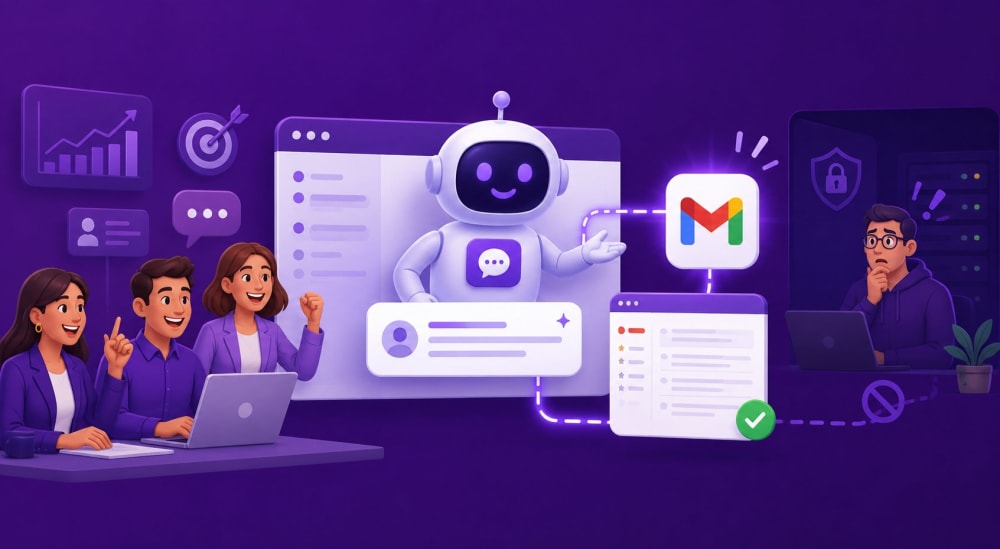
Artificial intelligence has become one of the fastest adopted technologies in business history. What once required months of planning and approval can now be implemented in a matter of minutes. A sales representative can discover a new AI chatbot during lunch, connect it to Gmail before the end of the day, and begin using it to draft emails, summarize conversations, and respond to customer inquiries immediately. While this speed creates exciting opportunities, it also introduces a growing challenge for organizations: technology adoption without oversight.
Many companies have strict processes for evaluating software. Information technology teams review security policies, legal departments examine data privacy concerns, and leadership evaluates costs and benefits before approving new tools. Yet AI is changing this process. Employees are finding solutions independently because many AI tools offer free trials, simple integrations, and immediate results. In some cases, teams are connecting AI platforms to email accounts, customer databases, and internal documents without informing IT departments. The result is a growing phenomenon often called "shadow AI," where technology enters an organization through employees rather than official channels.
The issue is not that employees are acting irresponsibly. In many cases, they are simply trying to work more efficiently. Sales professionals face increasing pressure to respond quickly, personalize communication, and manage larger pipelines. When an AI chatbot promises to save hours every week, it is easy to understand why someone would connect it to Gmail and begin using it immediately. The challenge arises when organizations lose visibility into what systems have access to company data, customer information, and sensitive business communications.
Why AI Adoption Is Moving Faster Than Company Policies
The pace of AI innovation has made it difficult for many organizations to keep up. Traditional software deployments often required technical expertise, training, and extensive implementation. Modern AI tools are designed differently. Many operate through simple browser interfaces and offer direct integrations with platforms employees already use every day.
A salesperson who receives hundreds of emails each week can immediately see the value of an AI assistant that drafts replies, prioritizes leads, and summarizes conversations. Instead of waiting weeks for approval, some employees decide to test these tools independently. From their perspective, the benefits are obvious. Response times improve, administrative work decreases, and customer interactions become more efficient.
However, the convenience of these tools can hide important considerations. Every integration requires permissions. Every permission grants access to data. Organizations may not realize that customer communications, pricing discussions, contract negotiations, or proprietary information are being processed by external systems. This creates questions about security, compliance, and long-term data governance.
The challenge is not unique to large corporations. Small and medium-sized businesses often face the same issue. In fact, smaller organizations may be more vulnerable because they typically have fewer resources dedicated to technology oversight. Employees often have greater freedom to adopt new tools, which increases the likelihood of unauthorized integrations.
As AI adoption accelerates, companies must find ways to balance innovation with responsibility. The goal should not be to block experimentation. Instead, organizations need frameworks that encourage innovation while maintaining visibility and control.
The growing demand for AI-powered customer interactions demonstrates why employees are embracing these tools so quickly. Many businesses manage thousands of customer inquiries every month, making automation increasingly attractive.
Vera Sun, CEO, Wonderchat, believes the rapid adoption of AI reflects a broader need for instant access to knowledge and faster customer support.
"At Wonderchat, we regularly see companies struggling with large volumes of technical questions that require fast and accurate responses. I worked with one organization that reduced first-response times by more than 70 percent after implementing an AI support agent trained on its documentation. The reason employees often adopt these tools independently is simple: they immediately solve real problems. My view is that organizations should focus on creating clear governance policies so teams can benefit from AI while maintaining transparency, security, and trust."
Her experience highlights an important reality. Employees are not adopting AI because it is trendy. They are adopting it because it solves operational challenges and improves performance.
The Hidden Risks Behind Unapproved AI Integrations
Although AI tools can improve productivity, unapproved integrations can introduce significant risks. One of the most common concerns involves data exposure. When an employee grants access to Gmail, the AI platform may receive information that extends far beyond the specific emails being analyzed.
Customer details, financial information, internal discussions, and strategic plans may all become accessible depending on the permissions granted. Even when AI providers maintain strong security standards, organizations need visibility into where data is stored, how it is processed, and who can access it.
Another concern involves consistency. If multiple employees adopt different AI tools independently, the organization may lose control over communication standards and workflows. One salesperson may use one chatbot while another uses a completely different platform. This creates fragmented processes and makes it difficult to maintain quality and compliance standards.
Technology leaders often describe this challenge as a visibility problem rather than a technology problem. Most organizations support innovation, but they need a clear understanding of which tools are being used and how those tools interact with company systems.
This concern extends beyond software and into the broader technology infrastructure that supports modern businesses. As organizations become increasingly dependent on interconnected systems, visibility becomes even more important.
Nick Christou, Founder, Laptop-LCD-Screen.co.uk, has spent decades building technology systems and automation platforms and believes oversight is critical when new tools are introduced.
"Throughout my career, I have seen businesses adopt technology because it solved an immediate problem, only to discover later that it created a larger operational challenge. When building large-scale eCommerce systems, we learned that every new integration needed to be evaluated not only for functionality but also for long-term compatibility and security. I believe AI tools should be treated the same way. Innovation works best when businesses understand exactly how information moves through their systems and maintain visibility over every connection."
His perspective reflects a lesson many organizations have learned repeatedly. The greatest risks often emerge not from the technology itself but from a lack of understanding about how that technology interacts with existing systems.
Building a Culture That Supports Both Innovation and Security
The solution to shadow AI is not banning AI. Organizations that attempt to restrict every new technology often find employees simply using those tools without approval. Instead, successful companies create environments where employees feel comfortable sharing new ideas and testing innovative solutions within defined guidelines.
Many forward-thinking organizations now establish AI review processes that move quickly enough to support experimentation while maintaining appropriate oversight. Employees can propose new tools, test them in controlled environments, and receive guidance from IT and security teams. This approach allows businesses to capture the benefits of innovation without sacrificing governance.
Training also plays an important role. Employees need to understand both the opportunities and the responsibilities associated with AI adoption. When workers understand why certain policies exist, they are more likely to follow them. Education transforms governance from an obstacle into a shared responsibility.
Leadership must also recognize that employee-driven innovation can be valuable. Many of today's most successful workplace technologies were first introduced by enthusiastic users who discovered practical applications before executives recognized their potential. The goal should be to channel that creativity effectively rather than suppress it.
As AI becomes increasingly integrated into everyday operations, infrastructure considerations will become even more important. Organizations need networks, cloud environments, and security frameworks capable of supporting growing AI workloads.
Jake Brander, President, Brander Group Inc., believes the future belongs to organizations that combine innovation with strong infrastructure planning.
"Over the years, I have watched businesses adopt transformative technologies faster than their infrastructure could support them. At Brander Group, we have helped organizations modernize networks, optimize cloud environments, and prepare for the demands of emerging technologies. The companies that achieve the greatest success are not necessarily the fastest adopters. They are the ones that build strong foundations, create clear governance processes, and ensure innovation scales responsibly across the organization."
His experience underscores an important principle. Technology adoption and infrastructure planning must evolve together. Organizations that invest in both are better positioned to capture the full value of AI.
Conclusion
The story of the AI chatbot connected to Gmail without IT approval is becoming increasingly common. Employees are discovering powerful tools that improve productivity, accelerate communication, and enhance customer experiences. Their enthusiasm reflects the enormous potential of artificial intelligence in the workplace.
At the same time, organizations must recognize that rapid adoption creates new responsibilities. Security, compliance, governance, and infrastructure planning cannot be treated as afterthoughts. The challenge is not preventing employees from using AI. The challenge is creating an environment where innovation and oversight work together.
Companies that succeed in this balance will gain a significant advantage. They will empower employees to experiment with new technologies while maintaining the visibility and control needed to protect their business. The lesson is clear: the future of AI is not about choosing between innovation and governance. It is about building systems that allow both to thrive side by side.