
A Corporate Hub for a Regional Resource
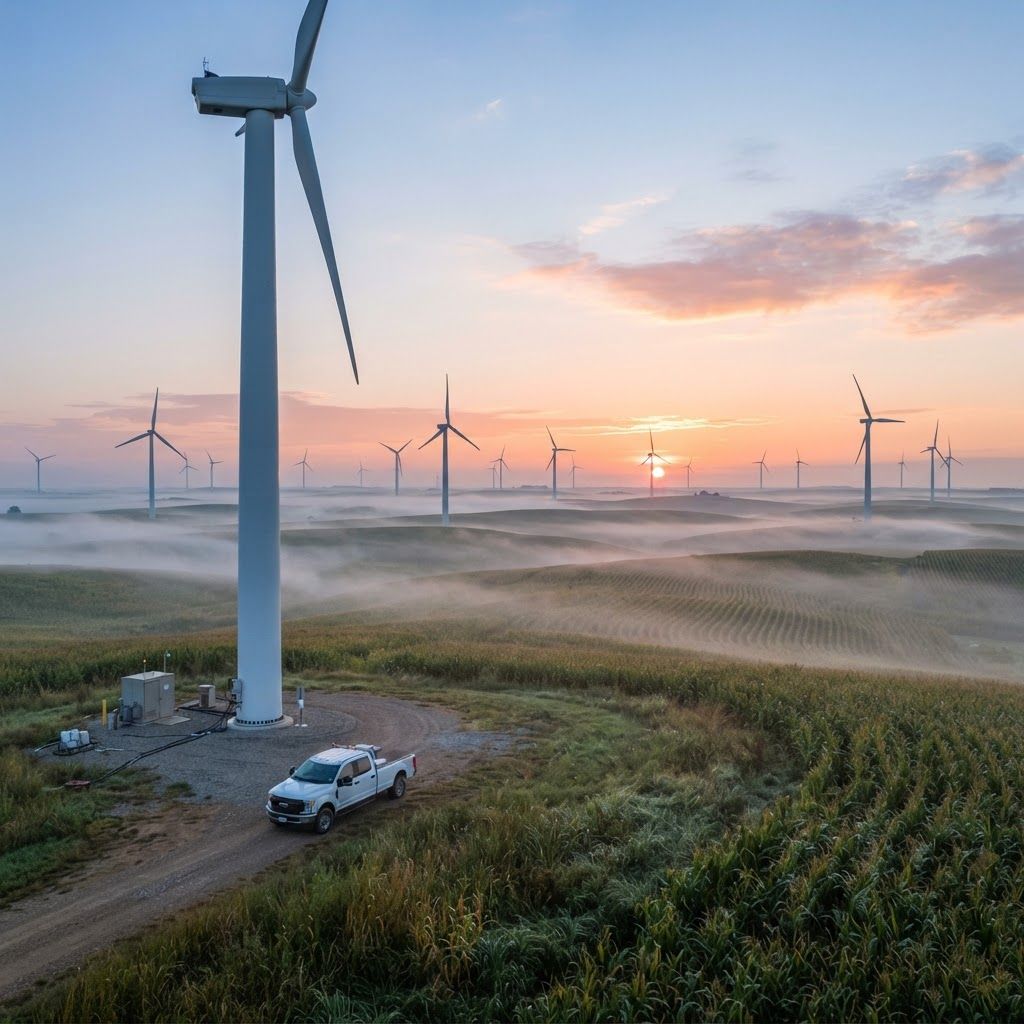
Wind energy is a rural land use with an urban business center. The turbines that supply the St. Louis region rise in northwest Missouri, central Illinois, Kansas, and Iowa, where sustained wind speeds and open agricultural land make projects viable. The financing, engineering, procurement, legal work, and long-term operations management, however, frequently run through metropolitan offices, and St. Louis plays a substantial role in that layer.
Ameren Missouri's wind purchases from large Missouri and Illinois facilities brought significant capacity into the regional supply mix, and those transactions pulled a broad set of local participants into the industry: transmission engineers, construction managers, heavy haul logistics providers, crane and rigging specialists, environmental consultants, land title and survey professionals, and utility-scale project finance teams. The result is a wind economy that is less visible than a turbine on the horizon but employs a considerable number of people across the metro.
How the Wind Industry Is Structured
Developers originate projects. They identify sites with strong wind resource and transmission access, negotiate land leases with farmers and ranchers, conduct wildlife and environmental studies, secure county permits, manage interconnection applications, and ultimately sell either the power or the project itself. Development is capital-intensive and long-dated, with five to eight years from concept to commercial operation being common.
Original equipment manufacturers supply turbines, blades, nacelles, and control systems, and increasingly bundle long-term service agreements. Engineering, procurement, and construction firms build the facilities, including foundations, roads, collection systems, substations, and turbine erection. Operations and maintenance providers keep them running, performing scheduled service, blade inspection, gearbox and bearing work, and troubleshooting across dispersed sites.
Surrounding these are the enablers: independent engineers who validate resource assessments for lenders, tax equity investors who monetize credits, insurance specialists who underwrite construction and operational risk, and law firms that handle land, permitting, and power purchase agreements. Several major regional firms based in St. Louis and Kansas City have built nationally recognized renewable energy practices on exactly this work.
What Distinguishes Strong Wind Companies
In development, the differentiators are queue position, land control quality, and community relationships. A project with signed leases covering a contiguous footprint, a favorable interconnection position, and genuine local support will outperform one with better wind and worse fundamentals. Developers who invest in transparent community engagement, decommissioning security, and fair road-use agreements encounter fewer delays and lower long-term cost.
In construction, safety record and schedule reliability dominate. Turbine erection involves extreme loads at height in variable weather, and contractors with mature safety systems and experienced crane crews finish faster with fewer incidents. In operations, the key metrics are availability, mean time to repair, and cost per megawatt-hour. The best operators use condition monitoring, oil analysis, drone and rope-access blade inspection, and predictive analytics to catch failures before they become catastrophic.
Trends Reshaping the Sector
Turbine technology has scaled dramatically, with longer blades and taller towers capturing better wind at lower cost per unit of energy. That scaling has also intensified logistics challenges, since oversized components must move by rail and road through communities that were never designed for them. Repowering has become a major activity as early projects reach mid-life, replacing nacelles and blades on existing foundations to raise output substantially with reduced permitting burden.
Transmission constraints remain the central bottleneck. Interregional lines that move Great Plains wind eastward have advanced slowly, and interconnection queues have grown long. Hybrid projects that pair wind with storage are increasingly common, smoothing output and improving capacity value. Meanwhile, blade recycling and end-of-life management have shifted from an afterthought to a competitive and regulatory consideration.
Guidance for Landowners
Farmers and rural landowners approached about a wind lease should treat the document as a multi-decade property encumbrance. Key terms include option and construction periods, per-turbine and per-acre compensation, escalation, setbacks from homes and structures, road construction and repair obligations, drainage tile repair standards, restrictions on future building, assignment rights, confidentiality provisions, and decommissioning security backed by a bond or letter of credit.
Independent legal review is essential, and it should come from counsel experienced in energy leases rather than general practice. Neighbors often benefit from coordinating so that a developer negotiates with an informed group rather than individually. Tax treatment of lease income, effects on crop insurance, and county assessment practices all deserve professional advice before signing.
Guidance for Energy Buyers
Corporate buyers pursuing wind supply should be clear about their objective. Physical delivery, financial hedges, and unbundled renewable energy certificates deliver very different accounting and risk outcomes. Virtual power purchase agreements expose the buyer to basis risk between the project node and the settlement hub, which can materially affect economics in constrained regions.
Evaluate counterparty strength, project stage, curtailment history in the relevant zone, and contract term flexibility. Insist on transparent reporting of generation and attribute retirement so sustainability claims withstand audit. Engage internal finance and accounting teams early, since these contracts often carry derivative accounting implications.
Looking Forward
Wind remains one of the lowest-cost sources of new energy across the central United States, and the St. Louis region will continue to serve as a commercial and engineering hub for projects across a wide territory. Growth will depend most on transmission expansion, storage pairing, and continued community partnership in host counties. For landowners, buyers, and professionals entering the field, the fundamentals reward patience, technical diligence, and careful contracting far more than enthusiasm alone.