
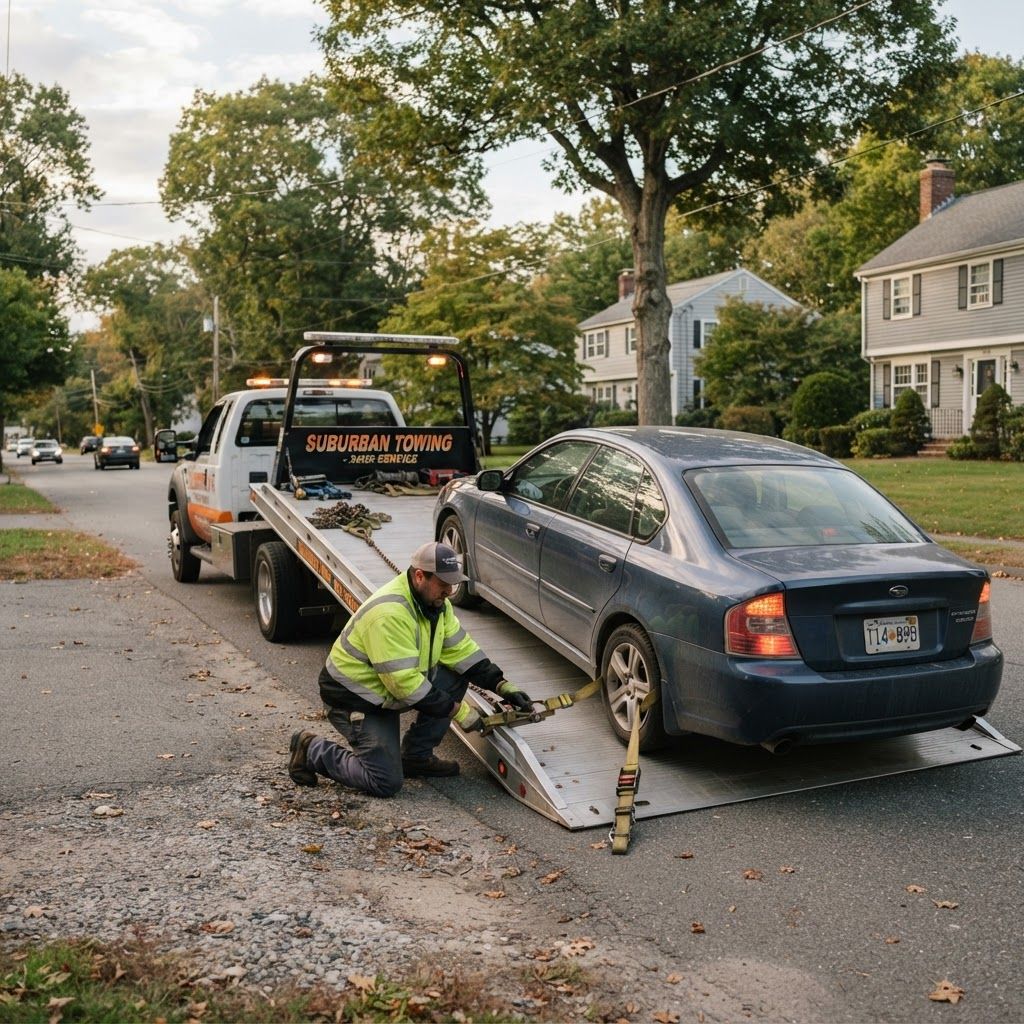
When a Tow Becomes Necessary
Roadside failures in North Hempstead have a distinct local character. Parkway breakdowns are the most stressful scenario, since shoulders on the Northern State and surrounding routes are narrow and traffic speeds are high. Winter cold snaps produce clusters of no-start calls from weakened batteries, particularly in vehicles used mainly for short suburban trips that never fully recharge. Summer heat brings cooling system failures on congested commutes. Village parking, especially in Great Neck and Manhasset business districts, generates a steady stream of lockouts and low-clearance recovery jobs.
Each of these situations calls for different equipment and expertise, which is why the towing market here is more segmented than most people realize. The provider best suited to a flat tire on a residential street is not necessarily the one you want recovering a low-slung sports car from a parkway shoulder at night.
Equipment Types and Why They Matter
Flatbed carriers load the entire vehicle onto a level deck. This is the safest method for all-wheel-drive vehicles, low-clearance cars, electric vehicles, and anything with a damaged drivetrain or suspension. Given the local vehicle mix, flatbed capability should be a baseline requirement, not a premium option.
Wheel-lift trucks raise one axle while the other rolls. They are faster to deploy and better suited to tight spaces such as parking garages, but they are inappropriate for all-wheel drive without dollies and can cause damage if used incorrectly.
Heavy-duty wreckers handle commercial vehicles, box trucks, and recovery from ditches or embankments. Winch capability and operator experience matter enormously in these situations. Enclosed transport serves collector, exotic, and high-value vehicles, protecting them from weather and road debris during transit. In a market with as many premium vehicles as this one, several local operators maintain enclosed capacity.
What to Verify Before You Need a Tow
Confirm licensing and insurance. Legitimate operators carry garage keepers liability coverage, which protects your vehicle while in their possession. Ask for proof rather than assuming it exists.
Ask about response time honestly. Any operator can claim thirty minutes. Better questions are how many trucks they run, whether dispatch is in house or through a broker network, and what their typical response is during a snow event when demand spikes. Broker networks subcontract to whoever is available, which introduces unpredictability in equipment and operator quality.
Understand pricing structure before authorizing service. Typical components include a hook-up fee, a per-mile rate, and potential surcharges for after-hours service, winching, dollies, or storage. Get the total estimated cost, and be aware that predatory operators sometimes quote only the hook-up fee.
Know your existing coverage. Many auto insurance policies include towing riders, most manufacturer warranties include roadside assistance for a period, several credit cards offer benefits, and membership organizations provide it as a core service. Using existing coverage is almost always cheaper than an ad hoc call, and it routes you to vetted providers.
The Ten Best Towing Services Serving North Hempstead
1. AAA Northeast is the most widely used roadside assistance provider in the region. Membership includes towing within tiered mileage limits, battery service, lockout assistance, fuel delivery, and tire changes. Its contractor network is vetted and its dispatch infrastructure is mature, which matters most during high-demand weather events.
2. Manufacturer roadside assistance programs attached to new vehicle warranties are frequently overlooked. These programs typically tow to the nearest franchise dealership at no cost during the coverage period, which is exactly where warranty work needs to happen anyway.
3. Established local independent towing operators serving Manhasset and Great Neck form the backbone of fast response in the town. Local operators know village street layouts, parking garage clearances, and parkway access points in a way that regional dispatch cannot replicate. For genuinely urgent situations, a nearby independent with its own trucks is often fastest.
4. Flatbed specialists covering the Northern State corridor focus on the highway calls that require the most care. Parkway recovery demands proper scene safety equipment, reflective signage, and operators trained to work adjacent to fast traffic.
5. Urgent.ly and comparable on-demand roadside platforms have changed the market by offering app-based dispatch with transparent upfront pricing and live tracking. For drivers without existing coverage, knowing the cost before the truck arrives eliminates the largest source of towing disputes.
6. Agero operates as a large roadside assistance network behind many insurance and manufacturer programs. Most drivers reach it indirectly through their policy, and its scale means broad coverage across Nassau County.
7. Heavy-duty and commercial recovery operators serving Long Island handle box trucks, delivery vehicles, and equipment transport. Local businesses running fleets should establish a relationship with one of these providers in advance rather than searching during a breakdown.
8. Enclosed and exotic vehicle transport specialists serve collectors and owners of high-value vehicles throughout the North Shore. Beyond weather protection, these operators use soft straps, wheel nets, and low-angle ramps that prevent the underbody damage flatbeds can cause on low-clearance cars.
9. Motorcycle recovery specialists represent a distinct capability. Towing a motorcycle requires either a proper chock and strap system on a flatbed or a dedicated motorcycle trailer. General operators sometimes improvise, and improvisation damages bikes.
10. Accident recovery and collision-linked towing operations coordinate directly with body shops and insurers. These providers handle scene cleanup, secure storage, and documentation for claims. Choosing one that communicates clearly about storage fees is important, because storage charges accumulate daily and are a common source of unpleasant surprises.
Preparing Before Something Goes Wrong
Store your coverage information where you can find it under stress, ideally in your phone and in the glove box. Note your policy number, the roadside assistance phone number, and the coverage mileage limit.
Keep basic safety equipment in the vehicle: a reflective triangle or flares, a high-visibility vest, a flashlight, and a phone charger. On a narrow parkway shoulder, visibility is the difference between an inconvenience and a serious incident.
Know where you want the vehicle towed before the truck arrives. If you have an established repair shop, the decision is easy. If not, the tow operator will suggest a destination, and that suggestion is not always made in your interest.
Roadside Safety Basics
If you break down on a parkway, move as far right as possible, turn on hazard lights, and in most cases stay in the vehicle with your seatbelt fastened while you wait. Standing outside a disabled vehicle on a narrow shoulder is considerably more dangerous than remaining inside. If the vehicle must be exited, do so on the side away from traffic and move well behind a barrier.
Choosing a towing provider is one of the few decisions best made when nothing is wrong. Drivers in North Hempstead who identify their coverage and a preferred local operator in advance consistently have shorter, cheaper, and less stressful experiences than those who make the choice on the shoulder of a busy road.