
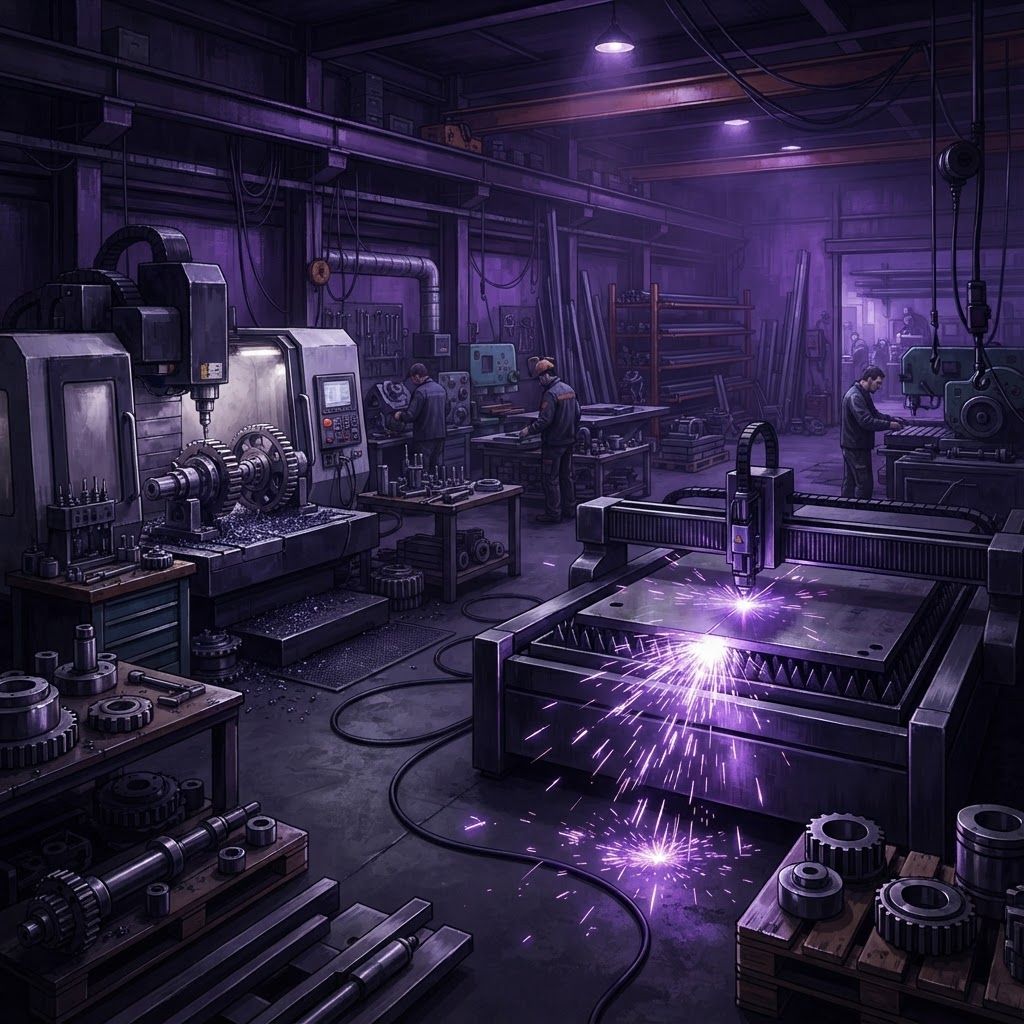
Why Metalworking Thrives in the Santa Clarita Valley
Santa Clarita's metalworking sector grew out of Southern California's aerospace legacy and has diversified into a broad industrial base. Machine shops here supply aerospace primes and their tier suppliers, medical device firms, semiconductor equipment builders, entertainment production companies, and the construction trades. The result is an unusually varied cluster: precision machining cells running five-axis work to thousandths of an inch operate a few miles from structural steel fabricators cutting beams for commercial buildings.
The valley's advantages are practical. Industrial zoning in Valencia, Rye Canyon, and the Santa Clarita Industrial Center accommodates heavy equipment, crane bays, and welding operations. Freeway access supports next-day delivery throughout the Los Angeles basin. And a workforce trained through regional community college and apprenticeship programs sustains the machinist and welder pipeline that shops depend on.
Understanding the Main Metalworking Disciplines
CNC machining removes material from solid stock using milling and turning centers, delivering the tightest tolerances and the best surface finishes. Sheet metal fabrication cuts, punches, bends, and welds flat stock into enclosures, brackets, panels, and ducting. Structural fabrication assembles beams, columns, and connection plates for buildings and heavy equipment. Welding and pipe fitting join components using processes such as TIG, MIG, and stick, each suited to different materials and quality requirements. Finishing operations — anodizing, powder coating, plating, passivation, and heat treatment — determine corrosion resistance and appearance, and are often subcontracted to specialized regional vendors.
Ten Metalworks Companies Serving Santa Clarita
1. Valencia Precision Machining — A multi-axis CNC machining house serving aerospace and medical customers, with capabilities in aluminum, titanium, and stainless alloys, supported by CMM inspection and documented first-article processes.
2. Santa Clarita Sheet Metal Works — Laser cutting, CNC press brake forming, and welded assembly of enclosures, chassis, and panels, with in-house hardware insertion and coordination of powder coating.
3. Rye Canyon Steel Fabricators — Structural steel detailing, fabrication, and erection for commercial and industrial projects, including moment frames, stairs, mezzanines, and equipment platforms.
4. Newhall Welding & Repair — A jobbing shop handling mobile welding, equipment repair, custom trailers, and heavy weldments, valued for fast response on breakdown and field repair work.
5. Canyon Country Architectural Metal — Ornamental and architectural metalwork: railings, gates, canopies, sunshades, and decorative screens in steel, aluminum, brass, and bronze, often working directly from architects' drawings.
6. Soledad Waterjet & Laser Cutting — Contract cutting services using fiber laser, waterjet, and plasma, ideal for customers who need profiled blanks in a range of materials and thicknesses without committing to full fabrication.
7. Placerita Turning & Screw Machining — High-volume turned components produced on CNC lathes and multi-spindle equipment, supplying fasteners, fittings, shafts, and bushings to industrial customers.
8. Bouquet Canyon Tube Bending — Mandrel tube bending, end forming, and tubular assembly for handrails, roll structures, exhaust systems, and equipment frames.
9. Golden Valley Metal Finishing — Powder coating, wet spray, and abrasive blasting services with capacity for large fabricated assemblies, offering color matching and specification-compliant coating thickness verification.
10. Sierra Highway Machine & Tool — Tooling, fixtures, jigs, and prototype machining for other manufacturers, plus reverse engineering and repair of legacy production equipment.
Quality, Certification, and Documentation
In metalworking, the certification landscape is meaningful. AS9100 is the baseline expectation for aerospace suppliers. ISO 9001 signals general quality management maturity. ISO 13485 applies to medical components. Structural steel fabricators may hold certification from recognized inspection programs, and welders working to code require documented qualification to the relevant procedure specification. Nadcap accreditation matters for special processes such as heat treating and non-destructive testing.
Beyond certificates, evaluate measurement capability. A shop with coordinate measuring machines, calibrated gauges, and a documented calibration schedule can prove conformance; a shop relying only on hand tools cannot support tight-tolerance work at scale. Ask to see an inspection report from a comparable job, and clarify what material certifications and traceability records will accompany delivery.
Technology Trends in Local Metalworking
Automation is arriving in mid-sized shops through pallet-changing machining centers, robotic press brake tending, and automated bar feeders that enable lights-out running. Fiber lasers have largely displaced older cutting technologies for thin and medium sheet, improving speed and edge quality. Additive manufacturing complements rather than replaces machining, producing conformal tooling and complex prototypes that are then finish-machined. Simulation software reduces scrap by validating toolpaths and forming sequences before metal is cut, and digital quoting systems have compressed response times from days to hours.
How to Select the Right Fabrication Partner
Match the shop to the work. Precision aerospace components belong in a certified machining environment, not in a general welding shop, and a custom stair railing belongs with an architectural fabricator rather than a production turning house. Provide complete drawings with tolerances, material specifications, finish requirements, and inspection expectations — incomplete information is the leading cause of rejected parts and disputed invoices.
Discuss capacity and scheduling frankly, and ask which operations are performed in house versus subcontracted, since outsourced finishing adds transit time. For ongoing production, consider a supplier that offers kanban or blanket order arrangements to smooth lead times. And visit the facility: shop organization, machine condition, and how carefully finished parts are protected before shipment reveal a great deal about the quality you can expect.
Santa Clarita's metalworking base is deep enough that nearly any requirement can be met locally. The differentiator is fit — pairing your tolerance, volume, and documentation needs with a shop genuinely built for them produces better parts, fewer surprises, and a supplier relationship that compounds in value over time.