
The Security Landscape in St. Louis
Security needs across the St. Louis metro are genuinely diverse. Downtown office towers require access control and lobby staffing. Warehouse and distribution facilities along the interstate corridors need perimeter monitoring and freight protection. Hospitals and clinics have regulatory obligations tied to patient safety and records. Residential neighborhoods want monitored alarms and camera coverage. And a growing number of local businesses have realized that digital threats now pose as much risk to continuity as break-ins.
Because Missouri regulates private security licensing and the City of St. Louis has its own requirements for guard companies operating within city limits, verifying credentials is an essential first step for any buyer. The ten companies below cover residential monitoring, commercial guarding, systems integration and cybersecurity, and each has a track record in the region.
1. ADT
ADT remains the most widely recognized name in monitored residential and small business security, with substantial local installation and service presence. Its advantage is monitoring infrastructure: redundant central stations, established police and fire dispatch relationships, and cellular backup that keeps systems live during outages. Modern offerings integrate cameras, smart locks, thermostats and video doorbells into one app. Contract terms are longer than some competitors, so buyers should read the agreement carefully.
2. Vector Security
Vector serves both residential and commercial clients across the region and is known for the quality of its custom commercial work, particularly in retail and multi-site business environments. Its commercial division handles intrusion detection, video surveillance, access control and fire systems as an integrated package, and it provides loss prevention analytics that retail operators use to identify shrink patterns rather than simply record incidents.
3. Whelan Security
Founded and headquartered in St. Louis, Whelan grew into one of the larger contract guarding firms in the country while retaining deep local roots. It staffs corporate campuses, healthcare facilities, higher education institutions and industrial sites. The company invests heavily in officer training, supervision structure and post orders documentation, which is what separates professional guarding from warm-body staffing. Its local presence means account managers are reachable and reassignments happen quickly.
4. Allied Universal
Allied Universal brings national scale to the St. Louis market, with capacity for large multi-site contracts, specialized officers and technology-enabled patrol. Its systems division can pair manned guarding with remote video monitoring, reducing labor cost on lower-risk shifts. For organizations needing consistent standards across facilities in multiple states, that scale and reporting consistency is the primary draw.
5. Securitas
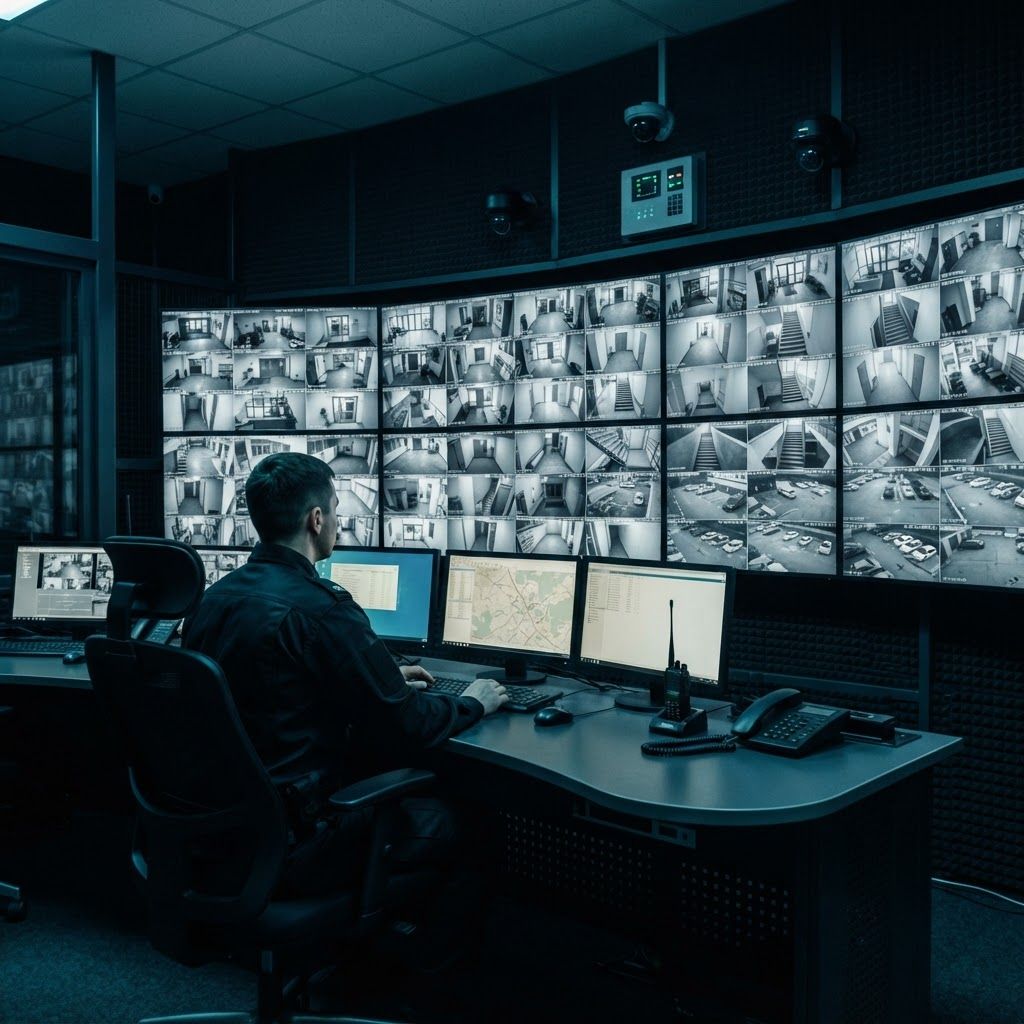
Securitas combines guarding with electronic monitoring and mobile patrol services and is a common choice for industrial, logistics and utility sites around the metro. Its remote video solutions center approach allows a monitoring operator to intervene by speaker during an intrusion attempt, which frequently resolves incidents before police arrive. The company's incident reporting platforms provide the documentation risk managers and insurers expect.
6. Alarm Tech Systems
This regional integrator focuses on commercial access control, video surveillance and alarm systems, with a reputation for design work that actually accounts for a building's traffic patterns and blind spots. Rather than selling a fixed package, its engineers conduct site surveys and specify camera placement, lens selection and credential policies accordingly. Clients often cite responsive service calls as the reason for long-term retention.
7. Guardian Alarm of St. Louis
Guardian serves small and mid-sized businesses along with residential customers, and its strength is the personal service model. Clients typically deal with the same technicians over years, which produces better system knowledge and faster troubleshooting. The company handles alarm monitoring, camera systems and access control, and it is a practical option for owners who want a local relationship rather than a national call center.
8. FRSecure
Cybersecurity belongs on any current list of security providers, and FRSecure serves many St. Louis organizations with information security assessments, penetration testing, incident response and compliance work. Its approach emphasizes risk assessment before tool purchasing, which suits mid-market companies that have been sold software without a strategy. For healthcare and financial clients, its familiarity with regulatory frameworks reduces audit friction.
9. Paragon Cyber Solutions
Working with businesses and public sector clients in the region, Paragon focuses on security program development, vulnerability management and employee awareness training. The training component matters more than many buyers expect, since a large share of breaches begin with phishing rather than technical exploitation. The firm also assists with security policy documentation required by insurers and enterprise customers.
10. Elite Protective Services
Elite handles event security, executive protection and specialized assignments including crowd management for concerts, festivals and private functions. Event work requires a different skill set than static guarding, emphasizing de-escalation, credential verification, medical coordination and evacuation planning. The company's experience with St. Louis venues and its relationships with local law enforcement make permitting and coordination smoother for organizers.
How to Evaluate a Security Provider
Verify licensing first. Missouri requires licensing for private security businesses and personnel, and the City of St. Louis imposes additional requirements for guards working in the city. Ask for proof of licensing, general liability coverage and workers compensation before signing anything.
For guarding contracts, ask specific operational questions. What is the officer turnover rate at comparable accounts? Who supervises overnight shifts? How are post orders written and updated? What is the response time when an officer calls out? For alarm and camera systems, ask about monitoring center redundancy, average dispatch time, false alarm handling, equipment ownership and what happens to the system if you change providers.
Trends in Regional Security
The market is shifting in several directions. Remote video monitoring with live intervention is displacing some overnight guard posts on cost grounds. Cloud-managed access control has made credential management simpler for multi-site operators. Analytics that detect loitering, line crossing or left-behind objects reduce the burden of reviewing footage after the fact. And the convergence of physical and cyber security means camera and access systems are now part of the network attack surface, requiring firmware discipline and network segmentation that older installations rarely had.
Final Thoughts
Choosing security in St. Louis is less about brand recognition than about matching the provider's core capability to your actual risk. A distribution center, a medical practice and a family home have entirely different exposure profiles. Start with a written risk assessment, insist on verified licensing and clear service commitments, and treat digital security as part of the same conversation rather than a separate problem.