
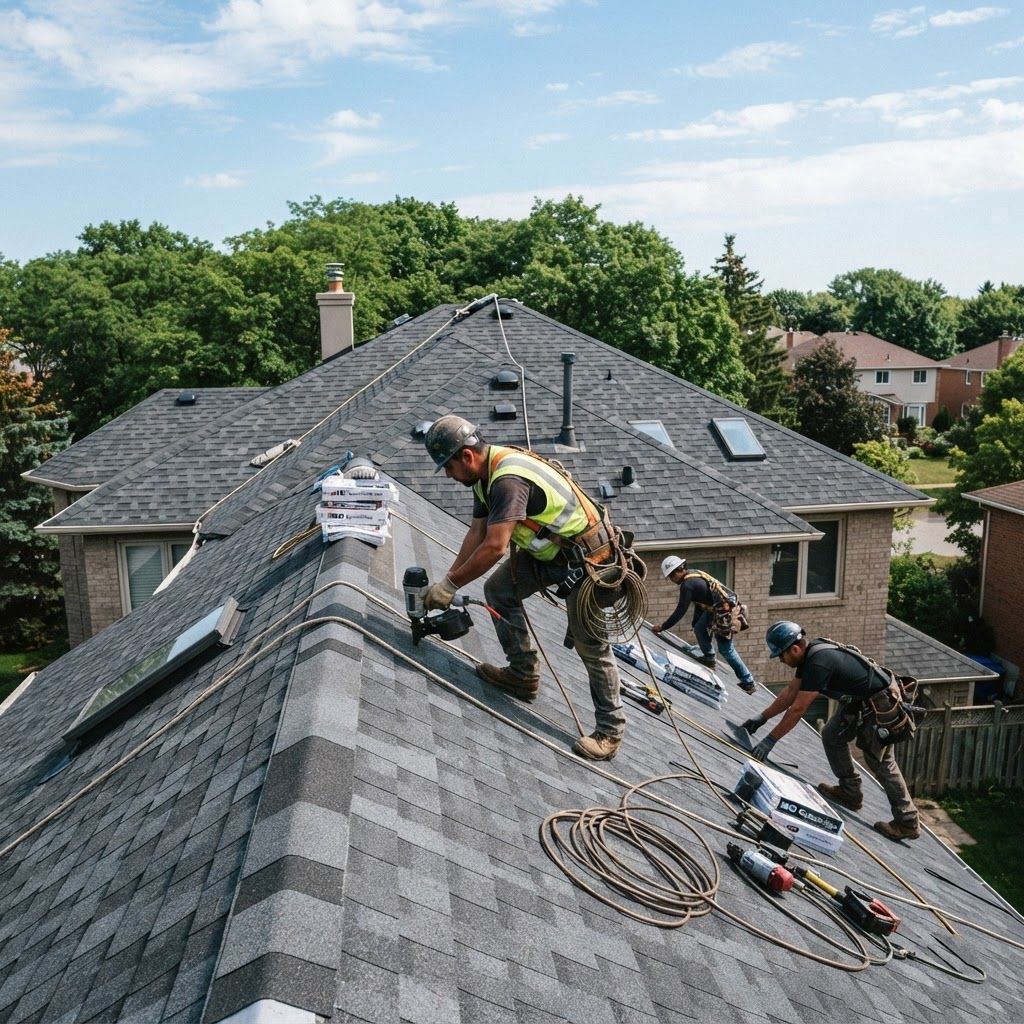
Why Roofing Is Demanding in St. Louis
Few climates test a roof the way the St. Louis region does. Spring and early summer bring severe thunderstorms with damaging hail and straight-line winds. Summer delivers sustained heat and humidity that accelerate shingle aging and drive attic temperatures high enough to shorten material life. Winter produces repeated freeze-thaw cycles and occasional ice damming at eaves. The result is that roofs here rarely reach the full theoretical life of their materials, and that installation quality determines the gap between a roof that lasts twenty years and one that fails in twelve.
The region's housing stock adds complexity. Steeply pitched older homes with multiple dormers and valleys, flat and low-slope roofs on city buildings and rear additions, slate and tile on historic properties, and simple gable roofs on newer suburban construction all require different competencies. A contractor excellent at suburban asphalt reroofs may be unqualified for a century-old slate roof or a low-slope membrane.
Understanding Roofing Materials
Architectural asphalt shingles dominate the residential market for good reason: reasonable cost, wide availability and acceptable performance. Within that category, impact-resistant shingles rated Class 4 are worth serious consideration in a hail-prone market, and many insurers offer premium credits that offset part of the added cost.
Standing seam metal offers long service life, excellent wind performance and low maintenance at a higher initial price. It performs particularly well on lower slopes where shingles are marginal. Synthetic slate and tile provide the appearance of natural materials at reduced weight and cost, relevant on older homes whose framing may not support genuine slate replacement.
For low-slope roofs common on city buildings and additions, single-ply membranes such as TPO and EPDM, along with modified bitumen systems, are standard. These require entirely different installation expertise from steep-slope work, including proper drainage design, flashing detail at parapets and correct termination.
Ten Leading Roofing Contractors
1. Kirberg Company is a long-established commercial and industrial roofing contractor in St. Louis with capability across low-slope membrane systems, sheet metal and large-scale reroofing programs.
2. Bone Dry Roofing operates in the metro area with residential and commercial services, offering both repair and full replacement along with attic ventilation and gutter work.
3. Frey Roofing has served the region for decades on residential and commercial roofing, with experience across shingle, metal and flat roof systems.
4. Bell Roof Company works throughout the St. Louis area on residential replacement and repair, including insurance-related storm damage work.
5. R. F. Meyer & Son is a family-operated contractor handling roofing, siding and gutters, with a project profile weighted toward established neighborhoods and older homes.
6. Wies Roofing serves commercial and institutional clients with membrane, metal and steep-slope systems, and maintains service divisions for maintenance and leak response.
7. Chesterfield Fence and Deck Roofing Division extends a well-known exterior contractor into roofing, offering coordinated exterior projects where roof, gutter and trim work overlap.
8. Hoffmann Brothers combines roofing with broader home service capability, useful when roof work intersects with ventilation, insulation or mechanical rooftop equipment.
9. Barbieri Roofing handles residential replacement and repair across the metro area with a mid-sized crew structure that keeps ownership involved in job oversight.
10. Rhoden Roofing and Exteriors works on residential roofing, storm restoration and exterior components, with familiarity in insurance claim documentation.
Evaluating a Roofing Contractor
Verify insurance before anything else. Request certificates for general liability and workers compensation directly from the insurer or agent, not photocopies from the contractor. Roofing carries genuine injury risk, and an uninsured crew injured on your property creates exposure for you.
Ask about manufacturer certification. Major shingle manufacturers certify contractors who meet training and installation standards, and those certifications unlock enhanced system warranties that cover workmanship in addition to materials. A standard material warranty covers manufacturing defects only, which is rarely the actual failure mode.
Confirm who performs the work. Some companies subcontract entirely to rotating crews. Subcontracting is not disqualifying, but you should know whether the crew on your roof has any ongoing relationship with the company warranting the installation.
Storm Damage and Insurance Claims
After significant hail or wind events, out-of-area contractors arrive in the region in volume. Some are legitimate; many are not. Be cautious with any contractor who appears unsolicited, pressures immediate signature, offers to absorb your deductible, or asks you to assign your insurance benefits to them. Deductible absorption is improper and can jeopardize your claim.
The sound process is straightforward. Document damage with photographs and dates. Contact your insurer to open a claim. Have a reputable local contractor perform an independent inspection and provide a detailed line-item estimate. Be present for the adjuster's inspection with your contractor if possible. Compare the adjuster's scope to the contractor's estimate and address discrepancies in writing with supporting documentation.
Details That Determine Roof Life
Ventilation is the most frequently neglected factor. Balanced intake at soffits and exhaust at ridge keeps attic temperature and moisture in check, extending shingle life and reducing ice damming. Many older St. Louis homes have exhaust ventilation with no functional intake, which accomplishes little.
Ice and water barrier at eaves and valleys, proper step flashing at wall intersections rather than surface caulking, new pipe boots rather than reused ones, and correct nailing pattern and placement all separate durable installations from ones that fail early. Ask specifically about each in writing. Also confirm full tear-off versus overlay: overlays cost less initially, conceal deck problems and shorten service life.
Final Perspective
Roofing in St. Louis rewards diligence. Get three detailed written proposals that specify materials by manufacturer and line, tear-off scope, underlayment, flashing, ventilation and warranty terms. Verify insurance and manufacturer certification independently. Consider impact-resistant shingles given local hail frequency, and confirm the insurance credit before deciding. Choose the contractor whose proposal is most specific rather than the one whose price is lowest, because on roofs the details you cannot see later are the ones that matter most.