
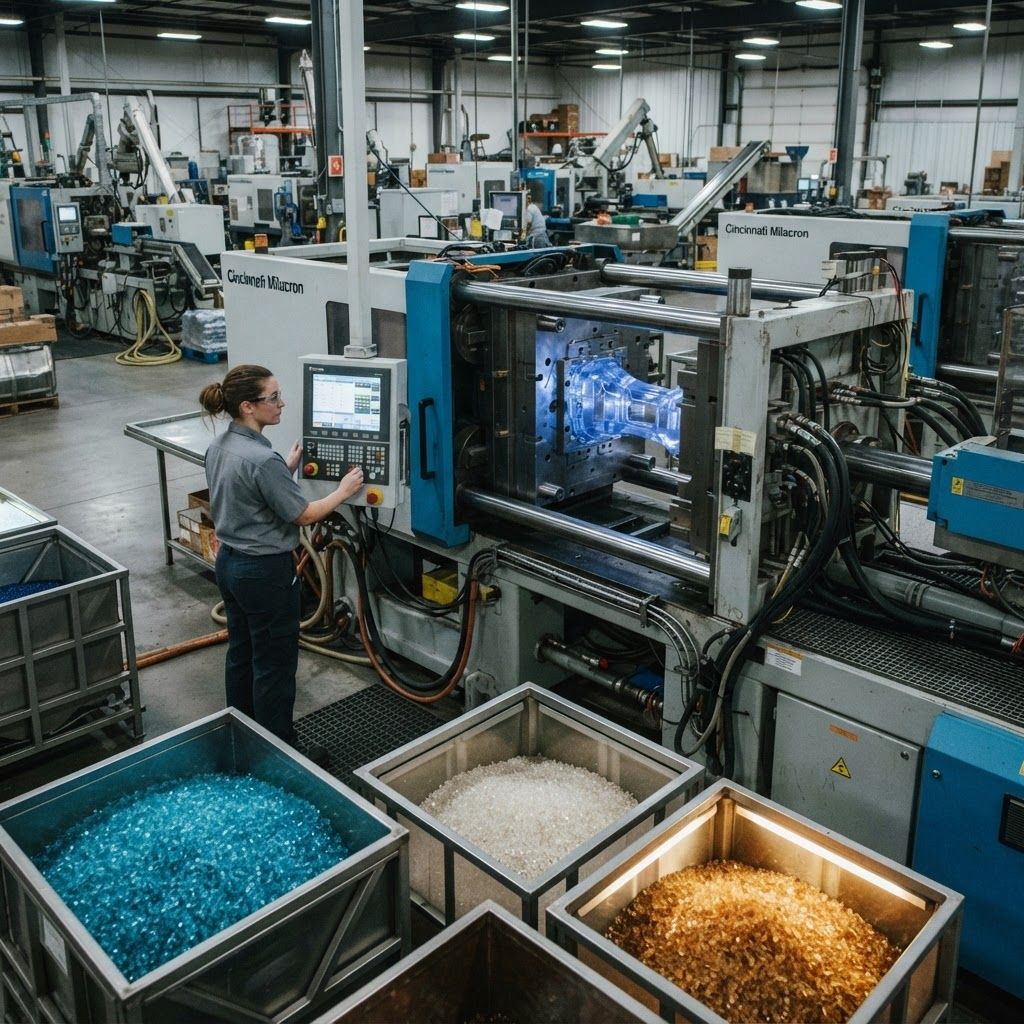
A Plastics Sector Built on Diverse Demand
Plastics manufacturing follows its customers, and St. Louis has an unusually broad customer mix. Medical device companies, automotive assembly and tier suppliers, food and beverage producers, agricultural equipment manufacturers, consumer products firms, and industrial equipment builders all need molded and extruded components, and all have operations in or near the metro. That diversity has produced a resilient plastics industry that is not dependent on any single end market.
The region also benefits from resin logistics. Rail access to Gulf Coast polymer production, barge capability on the Mississippi, and interstate connections make material delivery efficient. Combined with competitive utility costs and available industrial land, the metro offers strong fundamentals for processes that consume significant energy and material volume.
Understanding the Core Processes
Injection molding dominates by volume and part count. Molten resin is injected into a steel tool under high pressure, producing precise, repeatable parts at cycle times measured in seconds. It suits complex geometry and high volumes, but tooling is expensive, which makes design validation before tool cutting critical.
Blow molding produces hollow parts, primarily bottles, containers, tanks, and ducting. Extrusion blow molding and injection stretch blow molding serve different product requirements, with the latter dominating clear beverage packaging. Extrusion produces continuous profiles, sheet, film, tubing, and pipe, and it is the process behind much of the packaging and construction plastics supply.
Thermoforming heats sheet and forms it over a tool using vacuum or pressure. Tooling costs far less than injection molds, making it economical for larger parts at moderate volumes, such as equipment housings, trays, and medical packaging. Rotational molding creates large hollow parts like tanks and playground equipment with low tooling cost and long cycle times.
Beyond primary processing, the sector includes compounding and color concentrate production, machining of plastic stock, thermoset molding, urethane casting, additive manufacturing for prototypes and low-volume production, and value-added services such as ultrasonic welding, pad printing, decorating, assembly, and packaging.
What Distinguishes a Strong Plastics Manufacturer
Process control is the core competency. Leading molders run scientific molding practices: they establish process windows through designed experiments, monitor cavity pressure, use closed-loop temperature and hydraulic control, document process sheets tied to specific tools and machines, and validate rather than adjust by operator feel. This discipline is what allows tight tolerance parts to run consistently across shifts and months.
Quality systems must match the market. ISO 9001 is baseline; ISO 13485 is required for medical devices; IATF 16949 for automotive; food contact compliance and often third-party food safety certification for packaging. Cleanroom capability, validation documentation including installation, operational, and performance qualification, and full material traceability distinguish suppliers serving regulated industries.
Tooling capability is a major differentiator. Molders with in-house tool rooms can perform maintenance, repairs, and modifications quickly rather than shipping a mold out for weeks. Preventive mold maintenance programs based on cycle counts extend tool life significantly and prevent the flash, sticking, and dimensional drift that plague neglected tooling.
Engineering support during design is where the best partners earn their position. Design for manufacturability review addressing wall thickness uniformity, draft angles, gate location, knit line placement, shrinkage prediction, and material selection prevents costly tool rework. Mold flow simulation before cutting steel is now standard practice among capable suppliers.
Trends Shaping the Industry
Sustainability has moved to the center of plastics strategy. Post-consumer recycled content requirements, design for recyclability, lightweighting to reduce material use, mono-material packaging structures, and chemical recycling development all influence current programs. Bio-based and compostable resins have found application in specific niches while facing performance and infrastructure limits in others. Manufacturers who can process recycled content consistently, managing the variability that comes with it, hold a real competitive advantage.
Medical and life science demand continues to grow, driving cleanroom investment and validation capability. Automotive electrification has changed part mix, increasing demand for high-temperature and flame-retardant materials in battery and electrical applications while reducing certain under-hood components.
Automation has expanded well beyond part removal robots to include automated inspection with vision systems, in-line assembly cells, automated packing, and lights-out operation for stable high-volume programs. Digital monitoring across the press fleet enables real-time scrap and uptime visibility that supports genuine continuous improvement.
How to Choose a Plastics Partner
Match capability to volume and complexity. A precision medical molder is unlikely to be the right choice for a large industrial container, and a high-volume commodity shop rarely suits a validated device component. Ask directly about press tonnage range, shot size capability, typical run quantities, and the materials the shop processes routinely.
Audit thoroughly. Review process documentation for an existing program, examine the tool room and mold storage conditions, check calibration and gauge control, and look at how nonconforming material is segregated. Ask for capability data on critical dimensions from a comparable part.
Negotiate clearly on tooling ownership and location, resin price adjustment mechanisms tied to published indices, regrind policy, minimum order quantities, lead times, and end-of-life obligations. Clarify who bears responsibility for tool maintenance costs and at what cycle intervals, as this is a frequent source of friction.
Optimizing Total Cost
Piece price is only one lever. Cycle time improvements, yield gains, material substitution, part consolidation, and packaging optimization often deliver larger savings. Collaborative annual reviews where the molder proposes cost reduction ideas and shares in the benefit align incentives far better than unilateral price pressure.
The Regional Outlook
The St. Louis plastics industry is well positioned. Diverse end markets, strong logistics, available industrial capacity, and a workforce with process expertise support continued growth, particularly in medical, packaging, and electrification-driven applications. Suppliers who invest in recycled content processing, automation, and validated quality systems will lead, and buyers who engage them early in product design will capture the greatest value.