
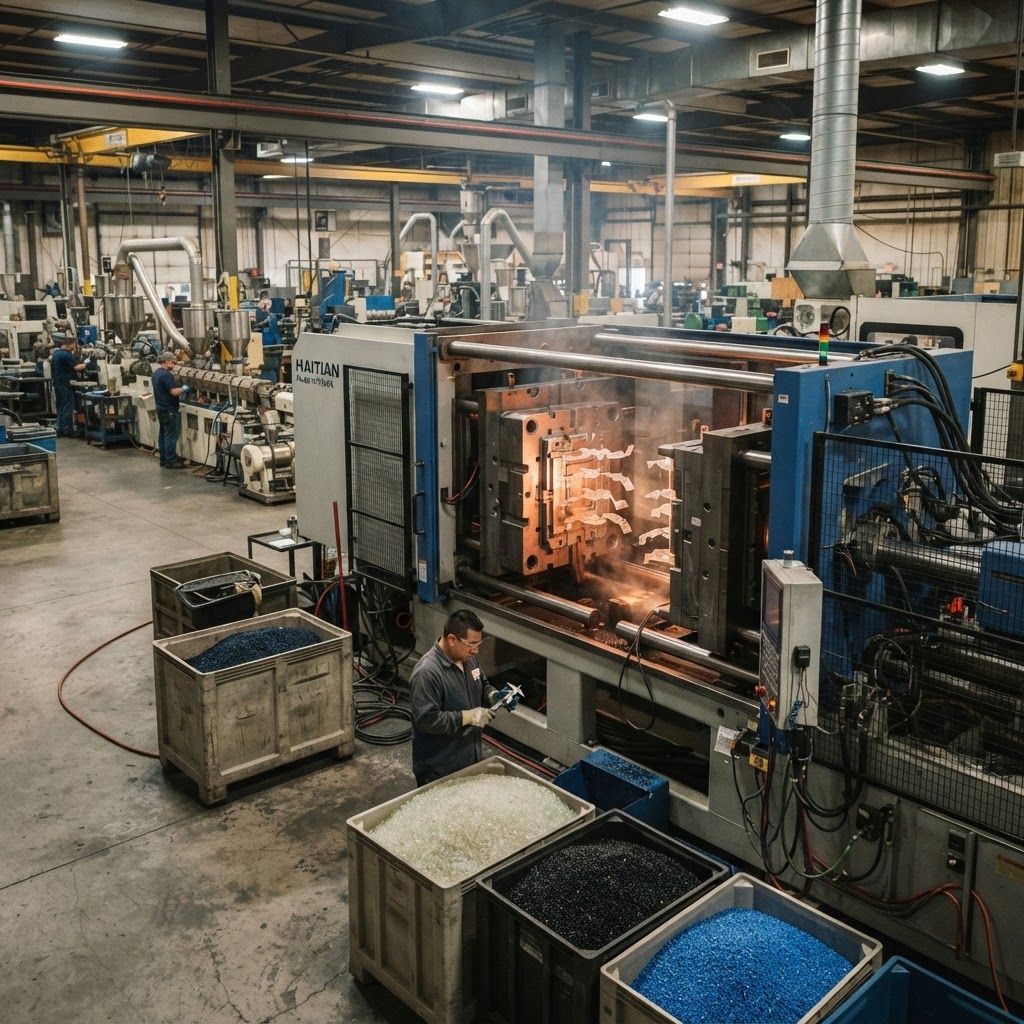
Plastics manufacturing is one of Buffalo's more resilient industrial sectors. While heavier industries contracted through the late twentieth century, plastics processors adapted by moving toward engineered components, medical devices and custom packaging where technical capability outweighs labor cost. The result is a cluster of molders, extruders and thermoformers serving customers throughout the Northeast, the Midwest and southern Ontario.
Understanding the Main Processes
Choosing a supplier begins with understanding process fit. Injection molding suits high-volume precision parts and carries significant tooling cost, making it economical above certain quantities. Extrusion produces continuous profiles, sheet and tubing. Thermoforming shapes heated sheet over a mold, with tooling far cheaper than injection molds, which makes it ideal for large parts and lower volumes. Rotational molding creates hollow, seamless containers and tanks. Matching the process to volume and geometry determines project economics more than any hourly rate.
Ten Leading Plastic Manufacturers
Niagara Molding Technologies handles tight-tolerance injection molding for medical and instrumentation customers. Cleanroom capability, validated processes and full lot traceability support regulated applications, and the in-house tool room lets the company respond quickly when a mold needs adjustment.
Queen City Plastics serves as a broad-capability custom molder across consumer, industrial and automotive markets. A wide press tonnage range means the company can quote both small components and large structural parts, and secondary operations including assembly, printing and packaging are performed on site.
Erie Polymer Extrusions produces custom profiles, tubing and sheet. Extrusion rewards process discipline, and the firm has invested in in-line measurement to hold dimensional consistency across long runs, which matters greatly to customers who fabricate downstream.
Buffalo Thermoform Industries specializes in heavy-gauge thermoforming for equipment enclosures, transportation components and material handling trays. Low tooling cost makes the process attractive for manufacturers with modest annual volumes who cannot justify injection molds.
Lakeshore Injection Molding focuses on insert and overmolding, combining metal components or multiple resins into single parts. This capability eliminates assembly steps for customers and reduces failure points in finished products.
Frontier Packaging Plastics manufactures containers, closures and blister packaging for food, personal care and industrial customers. Food-contact compliance and rapid changeover between formats define the operation, supporting brands that manage many stock keeping units.
Cataract Rotational Molding produces tanks, bins and large hollow parts. Seamless construction and impact resistance suit agricultural, marine and municipal applications, and the process handles very large parts economically at low volumes.
Harborview Compounding supplies custom resin compounds, color concentrates and additive packages to processors. Growing demand for recycled content has made compounders essential, since blending post-consumer material to meet performance specifications requires real formulation expertise.
Lackawanna Plastic Products combines molding with fabrication, machining and welding of plastic stock. This hybrid capability serves customers needing prototypes, low-volume parts or repairs where tooling would be uneconomical.
Cheektowaga Precision Plastics concentrates on small, high-precision components for electronics and instrumentation. Micro-molding, tight tolerances and automated inspection support customers who cannot tolerate dimensional drift across production lots.
The Recycled Content Transformation
The most significant change in plastics manufacturing is the shift toward circularity. Brand owners have committed to recycled content targets, and packaging regulations in several states now mandate minimum percentages. This creates genuine technical challenges, because post-consumer resin varies in melt flow, color and contamination in ways virgin material does not.
Buffalo processors have responded by investing in compounding expertise, improved filtration and more sophisticated process control. Design for recyclability has become part of early engineering conversations, with material selection, part consolidation and label choices evaluated for end-of-life recoverability. Lightweighting also continues, reducing both material cost and shipping weight while maintaining structural performance through better ribbing and simulation-driven design.
Choosing the Right Plastics Partner
Discuss tooling ownership and cost early, since molds represent substantial capital and the terms governing who owns and stores them affect flexibility for years. Confirm the supplier's material sourcing strength as well, because resin availability and pricing volatility can disrupt production more than any capacity constraint.
Evaluate engineering support seriously. A molder who reviews part geometry and suggests changes to draft angles, wall thickness or gate location before tooling is cut prevents expensive rework. Quality systems matter too, so verify relevant certifications, inspection methods and the process for handling nonconforming parts. Finally, ask about secondary operations, since a supplier who can assemble, decorate and package reduces handling and shortens the overall supply chain.
Getting From Prototype to Production
Many projects stall in the gap between a working prototype and a production part, and experienced processors manage that transition deliberately. Additive manufacturing or machined samples validate form and fit inexpensively, but they do not predict how a molded part will behave, because material properties and internal stresses differ substantially between processes.
The practical path usually involves a bridge stage, using aluminum tooling or thermoforming to produce hundreds of parts for testing and early market validation before committing to hardened steel molds. That intermediate step costs money but routinely prevents far more expensive mistakes, since design changes discovered after production tooling is cut are painful to absorb. Buffalo processors who offer both prototype and production capability guide customers through this sequence rather than pushing them toward tooling prematurely.
Final Thoughts
Buffalo's plastic manufacturers have earned their position through technical adaptation rather than low cost. With expertise spanning every major process, growing capability in recycled materials and engineering support that improves designs before tooling commitments, the region's processors are well matched to companies that value reliability and proximity in their supply base.