
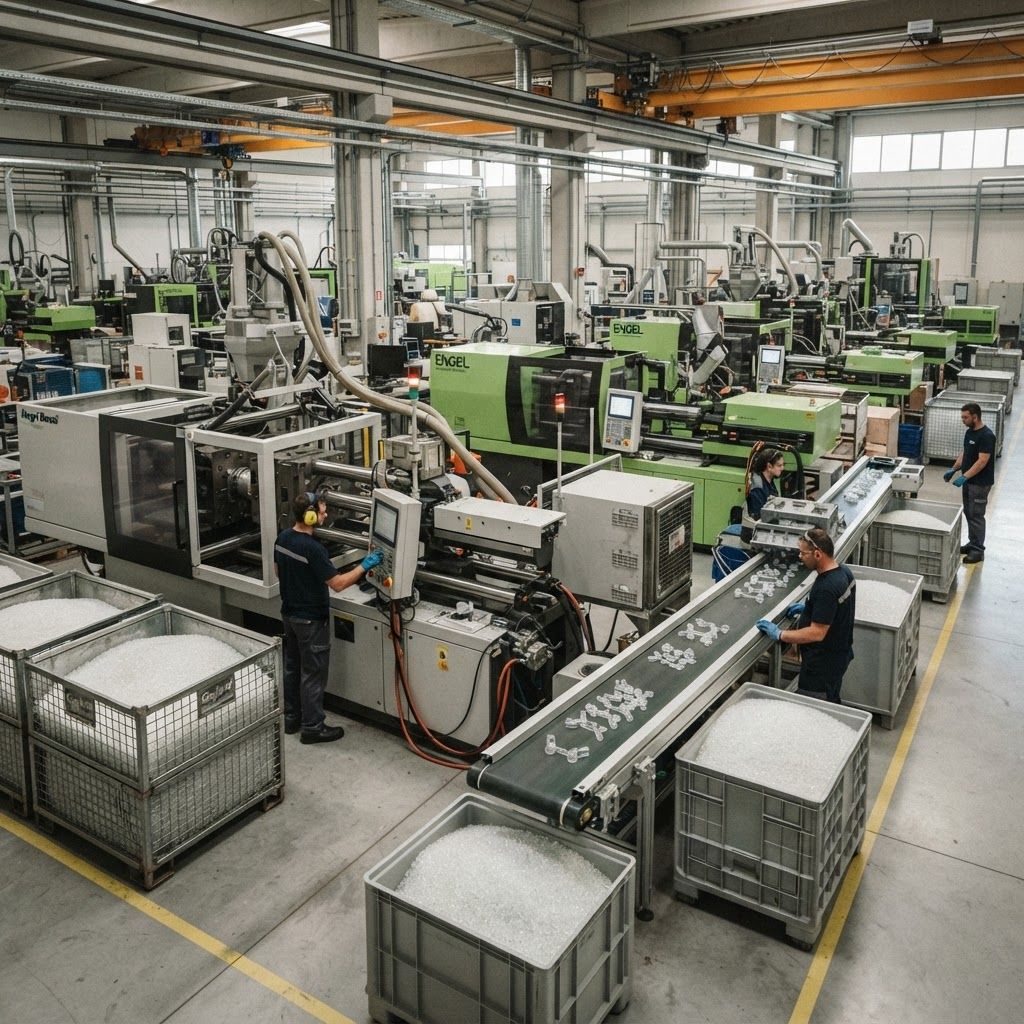
Plastics Manufacturing in the Treasure Valley
Plastic manufacturing rarely gets attention, yet it underpins an enormous share of modern products. In Boise City, plastics processors serve a diverse customer base: agricultural equipment makers needing durable tanks and guards, electronics manufacturers requiring precise enclosures and trays, medical device companies specifying biocompatible components, food processors using conveyor components and containers, and construction suppliers buying pipe, sheet, and profile.
The local sector spans multiple processes. Injection molding delivers high-volume precision parts. Thermoforming suits large, thin-walled parts at moderate volumes with lower tooling cost. Extrusion produces continuous profiles, tubing, and sheet. Rotational molding handles large hollow tanks. Computer-numerical-control machining of engineering plastics serves prototypes and low-volume industrial parts. Fabrication shops weld and form sheet into tanks, guards, and enclosures. Each process has a distinct economic sweet spot, and choosing correctly saves far more money than negotiating price.
What Makes a Plastic Manufacturer Reliable
Material knowledge is the foundation. A competent supplier will discuss resin selection in terms of mechanical properties, chemical resistance, temperature range, ultraviolet stability, and regulatory requirements rather than simply quoting the cheapest option. They will explain how part geometry affects moldability, warpage, and cycle time.
Process control follows. Look for documented process parameters, scientific molding practices, dimensional inspection with calibrated equipment, and traceability of resin lots. Tooling capability and maintenance discipline matter too, because a neglected mold produces flash, short shots, and cosmetic defects that no amount of inspection can fix. Finally, evaluate engineering support: manufacturers who review designs before tooling save customers from expensive mold revisions.
Top 10 Best Plastic Manufacturers in Boise City
1. Treasure Valley Plastics
A custom injection molder serving industrial and consumer customers, Treasure Valley Plastics operates a range of press tonnages and provides design-for-manufacturability review, tooling management, and secondary operations such as pad printing and assembly. Its reputation rests on dimensional consistency and disciplined preventive mold maintenance.
2. Snake River Injection Molding
Snake River Injection Molding focuses on technical parts in engineering resins, including glass-filled and high-temperature materials. Differentiators include scientific molding methodology, documented process windows, and in-house metrology that supports customers with tight tolerance requirements and formal qualification programs.
3. Foothills Thermoforming
Specializing in heavy-gauge and thin-gauge thermoforming, Foothills Thermoforming produces equipment enclosures, trays, covers, and packaging. Lower tooling costs make it a strong fit for moderate volumes and larger parts, and the shop supports trimming, machining, and assembly to deliver finished components rather than raw formed sheet.
4. Capital City Extrusions
Capital City Extrusions manufactures custom profiles, tubing, and sheet for construction, agriculture, and industrial customers. Strengths include die design support, tight dimensional control on continuous runs, and material expertise across rigid and flexible compounds, plus the ability to co-extrude for color or protective layers.
5. Gem State Rotational Molding
Producing large hollow parts such as water tanks, chemical containers, agricultural components, and equipment housings, Gem State Rotational Molding builds products with uniform wall thickness and excellent impact resistance. Ultraviolet-stabilized formulations and molded-in fittings suit the outdoor and agricultural applications that dominate its order book.
6. Sawtooth Precision Plastics
Sawtooth Precision Plastics machines engineering plastics including acetal, nylon, polycarbonate, and fluoropolymers for prototypes, fixtures, wear components, and low-volume production. Machinists understand how these materials move during cutting, and the shop delivers tolerances that plastic fabricators without machining expertise cannot match.
7. Riverbend Plastic Fabrication
This fabricator welds, bends, and machines sheet plastics into tanks, fume hoods, machine guards, sinks, and containment structures. Chemical processors and laboratories rely on the shop's understanding of chemical compatibility and its welding quality, which determines whether a tank holds for a decade or leaks in a year.
8. Boise Medical Plastics
Boise Medical Plastics manufactures components for medical and laboratory devices under controlled conditions, with attention to biocompatible resins, documented process validation, and cleanliness. Traceability records and change control discipline support customers navigating regulatory submissions and audits.
9. Sagebrush Recycled Polymers
Sagebrush Recycled Polymers reprocesses post-industrial plastic waste into usable resin and manufactures products from recycled content, including lumber substitutes, pallets, and site products. Its differentiators are consistent material testing on recycled feedstock and transparent reporting on recycled percentage, which helps customers substantiate sustainability claims.
10. Northwest Packaging Plastics
Northwest Packaging Plastics produces containers, closures, clamshells, and protective packaging for food, agricultural, and consumer goods customers. The company supports food contact compliance documentation, offers lightweighting analysis to reduce material use, and provides design work that improves shipping density and shelf presentation.
Trends Shaping the Plastics Industry
Sustainability is reshaping specifications, with growing use of recycled content, mono-material designs that simplify recycling, and lightweighting to cut both material cost and emissions. Regulatory scrutiny of single-use packaging is pushing innovation in reusable formats. On the technical side, higher-performance engineering resins are replacing metal in applications where corrosion resistance and weight matter. Automation of part removal, inspection, and packaging is improving consistency. And nearshoring continues to favor regional molders for programs where responsiveness outweighs the lowest possible piece price.
How to Choose the Right Plastics Partner
Begin by matching process to volume and geometry, and be open to guidance, since the right process choice can cut project cost dramatically. Share the functional requirements, not just a drawing, so the supplier can suggest better resins or features. Clarify tooling ownership, maintenance responsibility, and storage terms in writing. Ask about inspection frequency, capability studies, and how nonconforming parts are handled. Request sample parts from a comparable program and measure them. Finally, discuss capacity and lead times honestly, including what happens when your forecast doubles.
Final Thoughts
Boise City's plastics manufacturers cover nearly every major process and serve industries from agriculture to medical devices. That breadth means the right partner is usually available locally, provided the buyer understands which process fits the part. Invest time upfront in material and process selection, choose a supplier with genuine engineering depth, and production will be far less eventful.