
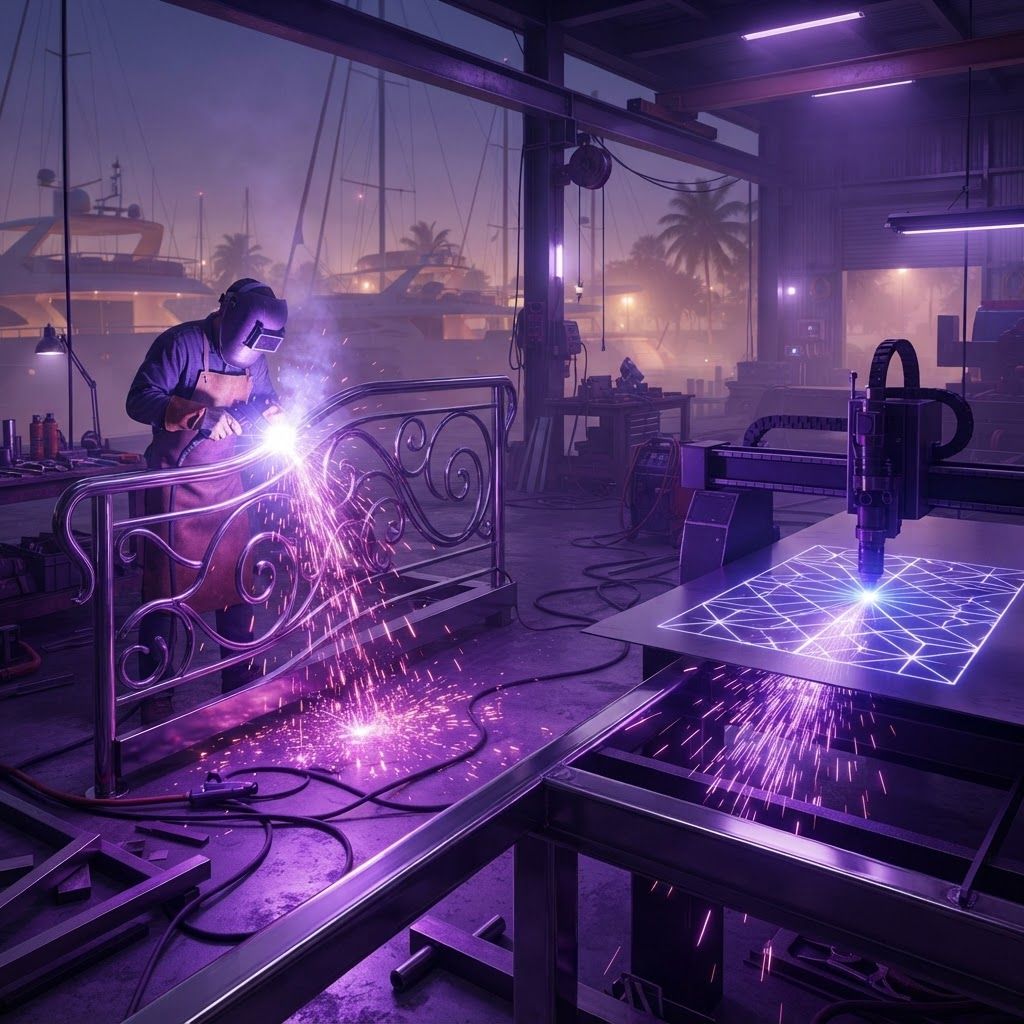
Metalworking Where Salt Air Sets the Standard
Metalworking in Fort Lauderdale is defined by a single environmental fact: salt. Anything fabricated here will be attacked continuously by chloride-laden air, and that reality dictates material selection, welding procedure, finishing, and design detail. Shops that understand this thrive. Shops that treat South Florida like an inland market produce work that corrodes within a season.
The customer base is broad. Yacht builders and refit yards need stainless rails, hardtops, davits, and exhaust systems. Architects specify decorative railings, gates, screens, and canopies. Construction requires structural steel, stairs, and miscellaneous metals. Industrial customers need tanks, frames, and equipment. Each demands different expertise, and the strongest shops specialize rather than claim everything.
Ten Metalworks Companies in the Region
1. Marine stainless fabricators concentrated near the Dania Cutoff Canal and along Marina Mile build tuna towers, hardtops, railings, and custom hardware. Mirror-polished welds are the visual signature, and consistent penetration with correct filler metal is the engineering substance beneath it.
2. Architectural metal fabricators produce railings, gates, sunshades, decorative screens, and entry features for residential and commercial projects. Design collaboration with architects is a core capability rather than an add-on.
3. Structural steel fabricators and erectors supply beams, columns, joists, and connections for commercial construction, working from detailed shop drawings and delivering with certified welding procedures.
4. Aluminum fabrication specialists build boat components, awnings, docks, and lightweight structures. Aluminum welding demands different skill from steel, and shops that do both well are less common than they claim.
5. Precision sheet metal shops operate laser cutting, punching, and press brake equipment to produce enclosures, panels, brackets, and chassis for equipment manufacturers throughout South Florida.
6. Ornamental ironworks continue a traditional craft, forging and fabricating gates, balconies, and decorative elements for the region's Mediterranean and contemporary architecture.
7. Tank and pressure vessel fabricators manufacture storage tanks, process vessels, and piping systems for water treatment, marine, and industrial applications under code-qualified procedures.
8. Mobile welding and repair services perform on-site work at marinas, construction sites, and industrial facilities where equipment cannot be transported, a segment where responsiveness is the entire value proposition.
9. Metal finishing companies provide polishing, passivation, anodizing, powder coating, and galvanizing. Finishing determines corrosion life as much as base metal selection, and few fabricators perform it all in-house.
10. Custom machine and weldment shops combine machining with fabrication to produce equipment frames, marine hardware, and industrial assemblies where both precision and structure are required.
Material Selection Against Corrosion
Stainless steel is not a single material, and the distinction matters enormously here. Type 304 stainless performs adequately in many environments but pits and stains in coastal salt exposure. Type 316, with added molybdenum, resists chloride attack substantially better and is the appropriate baseline for marine and coastal architectural work. Duplex grades offer higher strength and corrosion resistance for demanding applications.
Passivation after fabrication is essential and frequently skipped. Welding and grinding leave free iron and heat tint on the surface, which becomes the initiation point for rust streaking on otherwise correct stainless. Proper pickling and passivation removes that contamination and restores the protective oxide layer.
Galvanic corrosion is the other persistent failure mode. When dissimilar metals contact in the presence of salt water, the less noble metal corrodes rapidly. Isolating aluminum from stainless with appropriate insulating washers and bushings prevents a failure that otherwise appears within months.
For carbon steel, hot-dip galvanizing followed by a quality coating system remains the durable approach. Paint alone over prepared steel will not survive long-term coastal exposure.
Welding Quality and Certification
Weld quality is invisible to most buyers, which makes certification meaningful. Shops with welders qualified to recognized procedures and with documented welding procedure specifications produce consistent results. Structural work generally requires it; marine and architectural work often should.
Process selection matters too. Gas tungsten arc welding produces the cleanest results on thin stainless and aluminum and is standard for visible marine work. Gas metal arc welding is faster for heavier sections. Back purging with inert gas on stainless tube prevents interior oxidation that would otherwise become a corrosion site invisible from outside.
Technology in Modern Fabrication
Fiber laser cutting has largely replaced plasma for sheet work, delivering cleaner edges and tighter tolerances with less secondary finishing. Computer-controlled press brakes with offline programming reduce setup time and improve bend accuracy. Three-dimensional modeling allows complex assemblies to be verified digitally before any material is cut, which is particularly valuable for marine work fitted to curved surfaces.
Three-dimensional scanning has become a practical tool for retrofit work. Capturing an existing boat deck or building facade digitally and designing to that scan eliminates the iterative template-and-adjust cycle that traditionally consumed days.
Choosing a Metalworks Partner
Inspect finished work in person, ideally installations several years old in coastal exposure. Look at weld appearance, the absence of rust streaking, and how dissimilar metals are joined.
Ask which stainless grade a shop uses by default and why. A fabricator who reflexively answers 316 for coastal work, and can explain when 304 is acceptable, is demonstrating the exact judgment that determines whether your project lasts.
Confirm whether finishing is performed in-house or subcontracted, and who is responsible if a finish fails. Finally, discuss lead time realistically. Quality fabrication takes time, and a shop quoting an implausibly fast turnaround on complex stainless work is likely planning to compromise somewhere you will eventually see.