
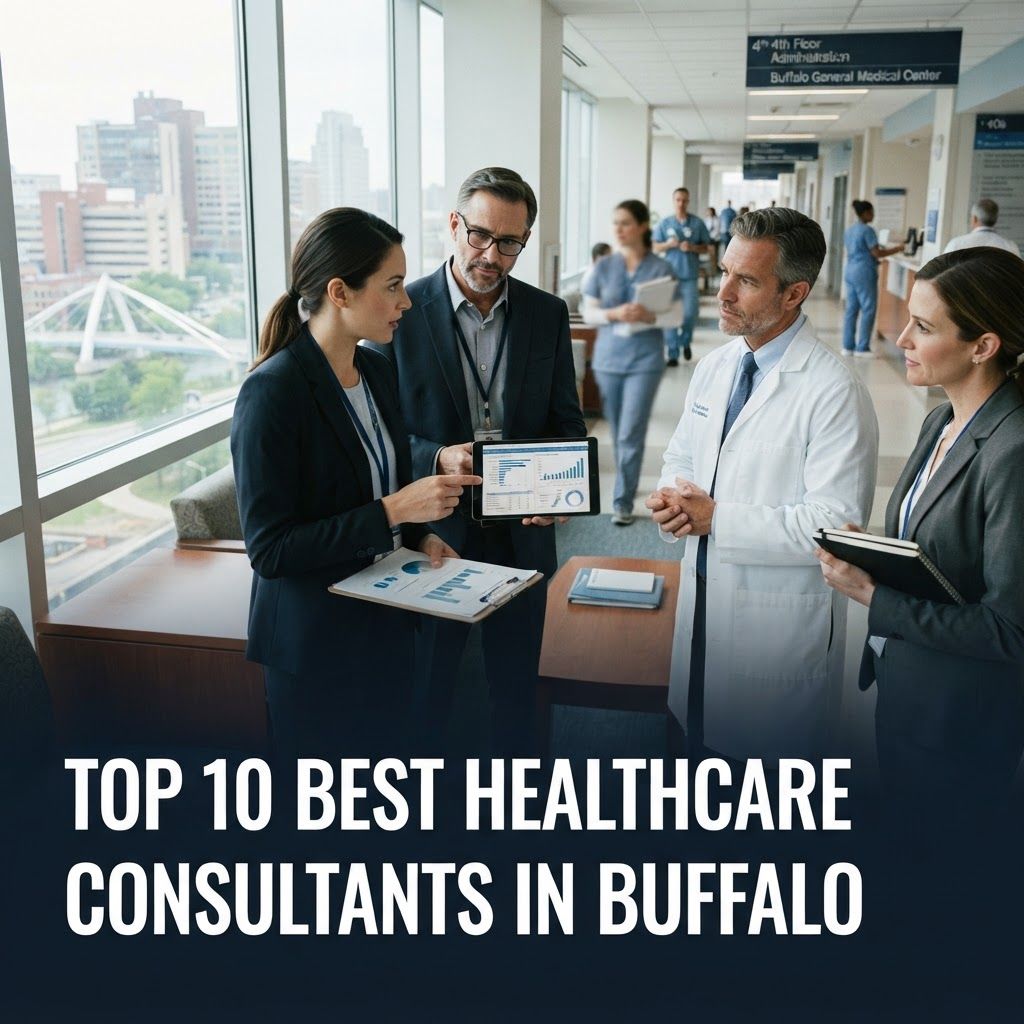
A Healthcare Economy That Anchors the Region
Healthcare is Buffalo's largest employment sector, and the concentration is remarkable. The Buffalo Niagara Medical Campus brings together major hospitals, research institutes, a medical school, and a growing cluster of life sciences companies within a compact downtown footprint. Surrounding it are large health systems, independent physician groups, federally qualified health centers, long-term care operators, behavioral health providers, and regional insurers. This density produces steady demand for healthcare consultants who understand both clinical operations and the byzantine economics of American healthcare.
What distinguishes the Buffalo market is the coexistence of large integrated systems and a stubbornly independent physician community. Consultants must be fluent in enterprise-scale problems — service line strategy, capital planning, system integration — and in the far more granular concerns of a six-physician orthopedic practice deciding whether to remain independent.
Revenue Cycle and Reimbursement Advisory
Revenue cycle management remains the most frequently purchased healthcare consulting service. Denial rates have risen across commercial payers, prior authorization requirements have expanded, and staffing shortages in billing departments have created backlogs that directly threaten cash flow. Consultants in this space conduct charge capture audits, analyze denial patterns by payer and code, redesign front-end registration and eligibility verification, and renegotiate payer contracts using claims data to support rate arguments.
For New York providers specifically, Medicaid managed care and value-based payment arrangements add complexity. Consultants help practices and systems understand risk-based contracts, build the quality reporting infrastructure required to earn incentive payments, and model whether upside-only or two-sided risk arrangements make financial sense given their patient population.
Regulatory Compliance and Risk
Healthcare compliance consulting covers a demanding regulatory landscape. HIPAA privacy and security requirements, the Stark Law's physician self-referral prohibitions, the federal Anti-Kickback Statute, the False Claims Act, OSHA requirements, CLIA laboratory standards, DEA controlled substance obligations, and New York State Department of Health regulations all apply simultaneously to many organizations.
Consultants build compliance programs with the seven elements federal guidance expects: written standards, a designated compliance officer, training, reporting mechanisms, auditing, enforcement, and corrective action. They conduct mock surveys ahead of Joint Commission or Department of Health visits, perform coding audits that identify both underbilling and overbilling exposure, and lead breach response when protected health information is compromised.
Clinical Operations, Quality, and Technology
Operational consulting focuses on throughput and access. Emergency department length of stay, operating room utilization, clinic scheduling templates, patient access call center performance, and care transition processes are all common engagement targets. Consultants working here typically apply Lean or Six Sigma methods and rely heavily on data extracted from electronic health record systems.
Quality and patient safety advisory addresses hospital-acquired conditions, readmission reduction, medication safety, and the reporting requirements that drive both public quality scores and reimbursement penalties. Because Medicare's value-based programs tie payment to performance, quality improvement has become a direct financial matter rather than a purely clinical one.
Health information technology consulting is a substantial local specialty. Electronic health record optimization — particularly for Epic, Cerner, and athenahealth environments — clinical documentation improvement, interoperability work under federal information blocking rules, telehealth platform deployment, and increasingly the governance of artificial intelligence tools in clinical settings all fall into this category.
Organizations Active in the Buffalo Healthcare Advisory Market
Several regional institutions and firms shape this landscape. Kaleida Health, Catholic Health, and Erie County Medical Center are the dominant provider systems, and their scale drives much of the consulting demand in the region. Roswell Park Comprehensive Cancer Center and the Jacobs School of Medicine and Biomedical Sciences at the University at Buffalo anchor the research and academic side.
On the advisory side, Freed Maxick and The Bonadio Group maintain healthcare practices serving Western New York providers with reimbursement, cost reporting, valuation, and compliance services. Law firms including Phillips Lytle, Hodgson Russ, and Bond, Schoeneck & King operate healthcare regulatory practices that frequently function as advisory partners. Independent Health, Highmark Blue Cross Blue Shield of Western New York, and Univera Healthcare shape payer dynamics that consultants must understand to be useful. The Buffalo Niagara Medical Campus organization itself supports life sciences companies navigating commercialization, while incubators in the area assist digital health startups with regulatory strategy and market entry.
Life Sciences and Digital Health Consulting
Buffalo's research institutions generate intellectual property that becomes companies, and those companies need specialized consulting: FDA regulatory pathway strategy, clinical trial design and management, quality system implementation under 21 CFR Part 820, reimbursement strategy and coding for novel devices, and market access planning. Consultants in this niche are fewer but highly specialized, often working with startups from seed stage through commercialization.
Evaluating a Healthcare Consultant
Industry-specific credentials carry real weight here. Look for certifications such as FACHE for executives, CHC for compliance professionals, CPC or CCS for coding specialists, CHFP or FHFMA for financial professionals, and RHIA for health information management. Verify that the consultant has worked with organizations of your type — a hospital consultant does not automatically understand independent practice economics.
Ask for quantified outcomes. Days in accounts receivable reduced, denial rate improvement, operating room turnover time, readmission rate change, or documented audit findings resolved are the kinds of metrics that separate real experience from a polished pitch. Confirm the consultant will sign a business associate agreement before touching protected health information, and understand exactly how they will handle and store your data.
What Is Coming Next
Workforce shortages remain the defining constraint across Western New York healthcare, pushing consultants toward retention strategy, care model redesign that shifts work to advanced practice providers, and international recruitment support. Artificial intelligence is entering clinical documentation, imaging, and revenue cycle work, creating demand for governance frameworks that address bias, validation, and clinical accountability. Site-of-care shifts continue moving procedures to ambulatory settings, driving strategy and capital planning engagements. And behavioral health integration into primary care is expanding, requiring both clinical redesign and reimbursement expertise.
Getting the Engagement Right
Healthcare consulting delivers the most value when leadership commits to implementation rather than assessment. Reports identifying twenty opportunities rarely change performance; a focused engagement that fixes three processes and trains the staff who own them usually does. Choose a consultant who insists on measurable baselines, who works alongside your teams rather than around them, and who understands the specific regulatory and payer environment that governs Western New York providers.