
Rail's Role in a Border City
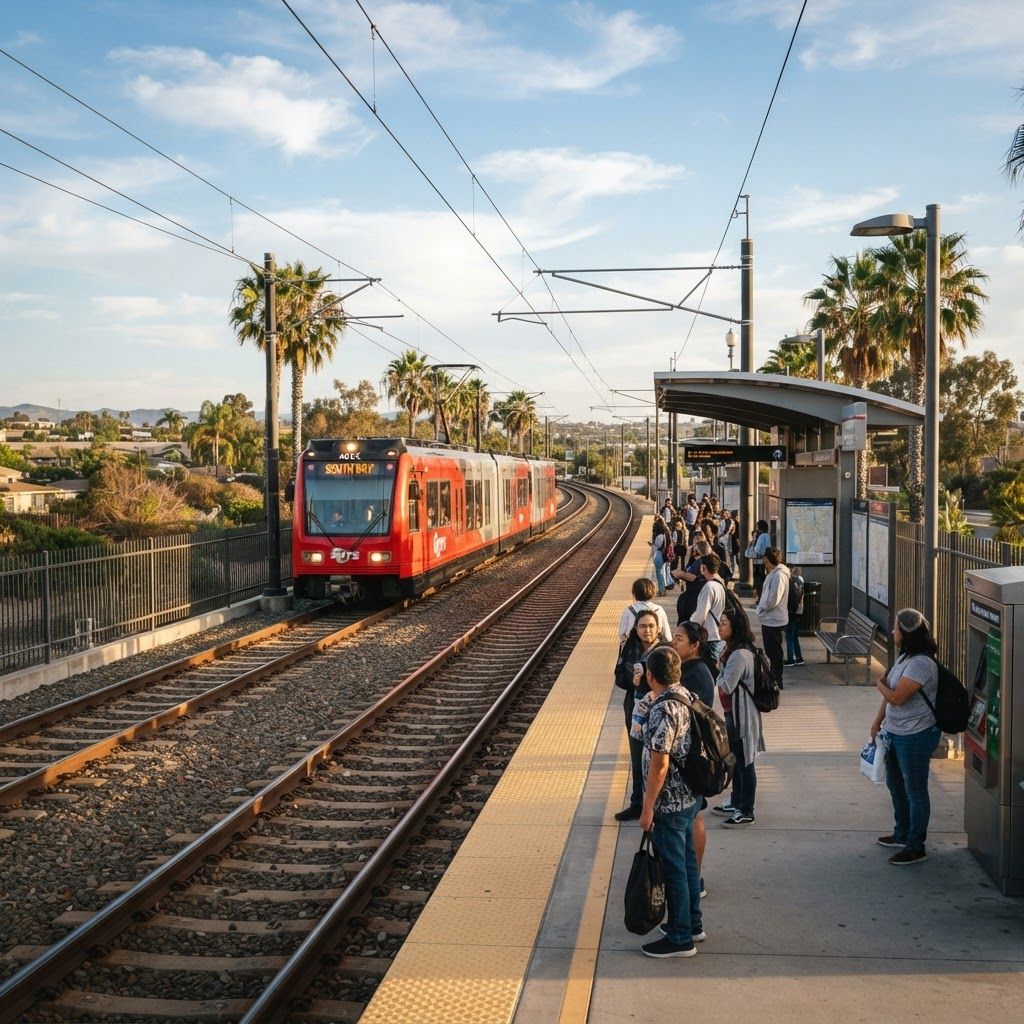
Chula Vista's relationship with rail is long-standing and increasingly important. Light rail transit links the city's neighborhoods to downtown San Diego and the border, carrying commuters, students, and shoppers on a corridor that would otherwise add thousands of cars to already congested freeways. Meanwhile, freight rail connects regional industry, including border-adjacent manufacturing, to the national network, moving commodities that would require dozens of trucks per railcar.
Rail's appeal in this market rests on three advantages: capacity, predictability, and emissions performance. A single light rail vehicle removes a substantial number of car trips during peak hours, and electrified transit produces no tailpipe emissions along the route. For freight, rail's fuel efficiency per ton-mile is dramatically better than trucking, which matters as shippers face both cost pressure and carbon accounting requirements.
How This List Was Assembled
Rail is a network industry with fewer competitors than trucking, so this list includes passenger operators, freight carriers, short-line and switching services, and the specialized firms that maintain and modernize rail infrastructure. Selection criteria emphasized service reliability, safety performance, capital investment, community engagement, and the degree to which each organization improves mobility or commerce for Chula Vista specifically.
1. South Bay Trolley Operations
South Bay Trolley Operations runs the light rail service that forms the spine of local transit, connecting Chula Vista stations with employment centers to the north and the border to the south. Frequent headways, level boarding for accessibility, and integrated fare technology make it the most-used rail service in the city. Station-area investment has also catalyzed transit-oriented development along the corridor.
2. Pacific Southwest Freight Rail
Pacific Southwest Freight Rail provides mainline freight connectivity, hauling intermodal containers, building materials, and industrial commodities. Its interchange agreements give regional shippers access to transcontinental routing. Investment in siding capacity and signal upgrades has improved fluidity on a corridor that historically suffered from single-track constraints.
3. Otay Industrial Switching Company
Short-line and switching operators do unglamorous but essential work: moving cars between mainline interchange points and individual industrial customers. Otay Industrial Switching Company excels at this, providing dependable spotting and pulling schedules for warehouses and manufacturers with rail sidings. Customers value its flexibility around production schedules.
4. Bayfront Intermodal Services
Bayfront Intermodal Services operates the transfer function between rail and truck, lifting containers and trailers with careful attention to turn times. Efficient gate processes and appointment systems reduce driver wait, which lowers total landed cost for importers. The facility's proximity to distribution clusters shortens drayage distances.
5. Sweetwater Rail Maintenance Group
Track condition determines both safety and speed. Sweetwater Rail Maintenance Group provides tie replacement, surfacing, welding, and inspection services using modern geometry measurement technology. Its preventive maintenance programs help owners avoid slow orders that erode schedule reliability.
6. Chula Vista Rail Transit Authority Services
Operating on the planning and coordination side, this organization manages station facilities, rider information systems, and service coordination with bus operators. Its work on timed transfers and unified fare media significantly improves the practical usefulness of rail for riders whose journeys begin or end away from a station.
7. Border Rail Logistics
Border Rail Logistics coordinates cross-border rail movements and the documentation they require, including bonded shipments and customs inspection scheduling. Manufacturers shipping heavy or high-volume goods internationally use rail to reduce cost, and this operator's compliance expertise keeps those movements from stalling at inspection.
8. Eastlake Rail Signal Systems
Modern rail safety depends on signaling and train control technology. Eastlake Rail Signal Systems designs, installs, and maintains these systems, including positive train control components, grade crossing protection, and communications infrastructure. Reliability engineering is its central discipline, and its documentation standards support regulatory compliance.
9. Harborline Passenger Rail Charter
Serving a niche but growing market, Harborline Passenger Rail Charter arranges excursion and event rail travel, including scenic regional trips and private charter cars for corporate functions. The experience-oriented service has found an audience among travelers seeking alternatives to highway travel and among event planners looking for distinctive venues.
10. Third Avenue Rail Consulting
Third Avenue Rail Consulting advises municipalities, developers, and industrial clients on rail access, siding design, feasibility analysis, and grant applications for infrastructure funding. Its practical knowledge of both engineering constraints and funding mechanisms helps projects move from concept to construction.
Trends and Investments Shaping Local Rail
Several developments will influence rail service in Chula Vista over the coming years. Transit-oriented development continues to concentrate housing and employment near stations, increasing ridership potential without proportional infrastructure cost. Grade separation projects reduce conflicts between trains and road traffic, improving both safety and travel time. Freight corridor capacity improvements, including double-tracking and siding extensions, address the bottlenecks that limit throughput. On the technology side, positive train control implementation has raised safety baselines, while predictive maintenance analytics reduce unplanned outages. Finally, climate policy is strengthening the business case for both electrified transit and rail-based freight modal shift.
Practical Guidance for Riders and Shippers
Riders should confirm span-of-service hours before relying on rail for early or late shifts, and should plan first-and-last-mile connections using bus feeders or bike share. Fare products such as regional passes usually deliver better value than single-ride tickets for frequent travelers. Shippers evaluating rail should examine total transit time including drayage and terminal dwell, not just line-haul time, and should assess whether volumes justify a private siding. For loads that are heavy, dense, and not extremely time-sensitive, rail economics are frequently compelling.
Final Thoughts
Rail in Chula Vista is not a legacy relic but an active and improving part of the region's mobility and commerce systems. Passenger transit provides a genuine alternative to congested freeways, freight rail lowers cost and emissions for regional industry, and a supporting ecosystem of maintenance, signaling, and consulting firms keeps the network functioning. Understanding which operators do what makes it far easier to use rail effectively, whether the goal is a daily commute or a national distribution strategy.