
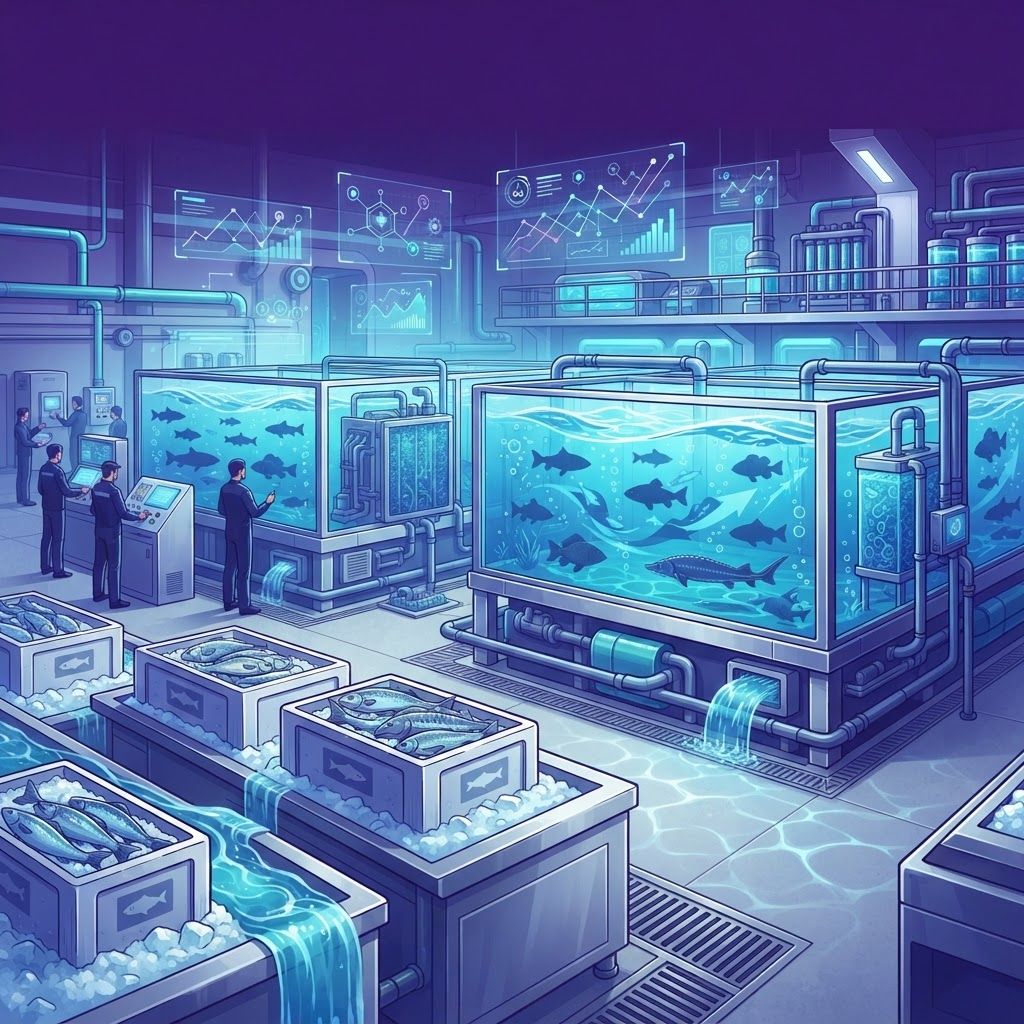
A fishery industry in the Texas Panhandle sounds improbable. There is no coastline, few natural lakes, and a semi-arid climate. Yet Amarillo supports a genuine cluster of fishery-related businesses, and the reasons are logical once examined. Recirculating aquaculture systems make fish farming possible almost anywhere with reliable water and power. Seafood distribution requires cold chain infrastructure and highway access, both of which Amarillo has in abundance. And the region's many stock ponds, reservoirs, and recreational waters create demand for fingerlings, aeration equipment, and pond management services.
How Inland Fishery Business Works
The sector divides into distinct activities. Seafood distribution brings marine and freshwater product into the region for restaurants, grocers, and institutions, relying entirely on cold chain discipline. Aquaculture production raises fish locally in tanks or ponds, most commonly tilapia, catfish, and trout depending on temperature management. Stocking and pond management supplies fingerlings and services for recreational and agricultural water bodies. Equipment supply covers aeration, filtration, pumps, and monitoring systems. Processing and value-added operations handle filleting, portioning, and packaging.
The Top 10 Fishery Companies in Amarillo
1. Panhandle Seafood Distributors
Panhandle Seafood Distributors brings fresh and frozen seafood into the region for restaurants, hotels, and grocers. Their cold chain management, including temperature logging from receipt through delivery, is the core of their value in a market where product travels a long way before arriving.
2. Amarillo Aquaculture Farms
Amarillo Aquaculture Farms operates recirculating systems producing tilapia and catfish for regional markets. Water reuse, biological filtration, and careful oxygen management let them raise fish with a fraction of the water an open-pond operation would consume, which matters enormously in this climate.
3. High Plains Fish Hatchery
High Plains Fish Hatchery produces fingerlings for stocking ponds, lakes, and private waters across the region. Their species selection guidance, matching fish to water temperature, depth, and forage availability, prevents the stocking failures that frustrate landowners.
4. Route 66 Frozen Seafood Wholesale
Route 66 Frozen Seafood Wholesale specializes in frozen product, including shrimp, fillets, and prepared seafood items for foodservice and retail. Individually quick-frozen handling preserves texture far better than slower freezing, and their storage discipline maintains that quality through distribution.
5. Yellow City Pond Management Services
Yellow City Pond Management Services provides water quality testing, aquatic vegetation control, aeration design, and fish population assessment. Landowners maintaining recreational or livestock water bodies rely on their diagnostic work to correct problems before fish kills occur.
6. Canyon Trout and Specialty Aquaculture
Canyon Trout and Specialty Aquaculture raises cold-water species using chilled recirculating systems, serving restaurants seeking distinctive local product. Maintaining low water temperatures in a hot climate is technically demanding, and their engineering approach reflects genuine expertise.
7. Llano Estacado Aquaculture Equipment
Llano Estacado Aquaculture Equipment supplies pumps, blowers, filtration media, tanks, monitoring probes, and feeding systems. Equipment failure in a recirculating system can kill a crop within hours, so their parts availability and rapid service response are critical rather than convenient.
8. Bison Fish Processing Company
Bison Fish Processing Company handles filleting, portioning, packaging, and freezing for producers and distributors. Their food safety documentation and traceability support customers who must meet institutional and retail requirements.
9. Palo Duro Bait and Tackle Wholesale
Palo Duro Bait and Tackle Wholesale supplies live and prepared bait, tackle, and fishing supplies to retailers and marinas across the region. Live bait logistics are surprisingly complex, requiring aeration and temperature control throughout distribution.
10. Tri-State Fisheries Consulting
Tri-State Fisheries Consulting provides technical advisory services for aquaculture startups, water body management, and regulatory compliance. Their feasibility analysis work saves prospective producers from the substantial capital losses that follow poorly planned system design.
Cold Chain: The Non-Negotiable Requirement
For any inland seafood business, temperature control is the entire operation. Fresh fish quality degrades rapidly above proper holding temperatures, and the degradation is irreversible. Serious distributors monitor temperature continuously during transport, maintain calibrated equipment, and document readings for each delivery.
Buyers should ask direct questions: what temperature is product held at during transit, how is it monitored, what happens when a reading falls out of range, and can records be provided? A distributor who answers precisely is managing risk. One who deflects is passing that risk to your kitchen and your customers.
Trends in Inland Aquaculture
Several developments are expanding what is possible. Recirculating aquaculture system technology has improved substantially, with better biological filtration, oxygen management, and automated monitoring reducing both labor and mortality risk. Water efficiency continues to improve, which is essential for viability in water-constrained regions.
Interest in local food sourcing has created market opportunity for regionally raised fish, allowing producers to command premiums that offset higher production costs relative to imported product. Integration with agriculture is also being explored, using nutrient-rich aquaculture water for crop production in combined systems. On the distribution side, traceability expectations have risen sharply, with buyers wanting species verification and origin documentation.
Considerations for Entering the Sector
Aquaculture is capital intensive and technically demanding. Water source quality and reliability must be verified before any other planning. Energy cost is a major operating expense, since pumps, aeration, and temperature control run continuously. Species selection should follow from your realistic temperature management capability rather than from market price alone.
Market access deserves attention before production begins. Securing restaurant or distributor commitments in advance prevents the common failure of raising fish with nowhere to sell them. Finally, regulatory requirements for permits, species restrictions, and water discharge must be understood early, as retrofitting compliance is expensive.
Final Thoughts
Amarillo's fishery sector demonstrates that geography is less limiting than it appears. Between seafood distribution serving the region's restaurants, recirculating aquaculture producing fish locally, hatcheries supporting recreational waters, and equipment and consulting businesses supporting both, the industry is genuinely diversified. For buyers, cold chain verification is the essential discipline. For prospective producers, water, energy, and market access determine viability long before biology does.