
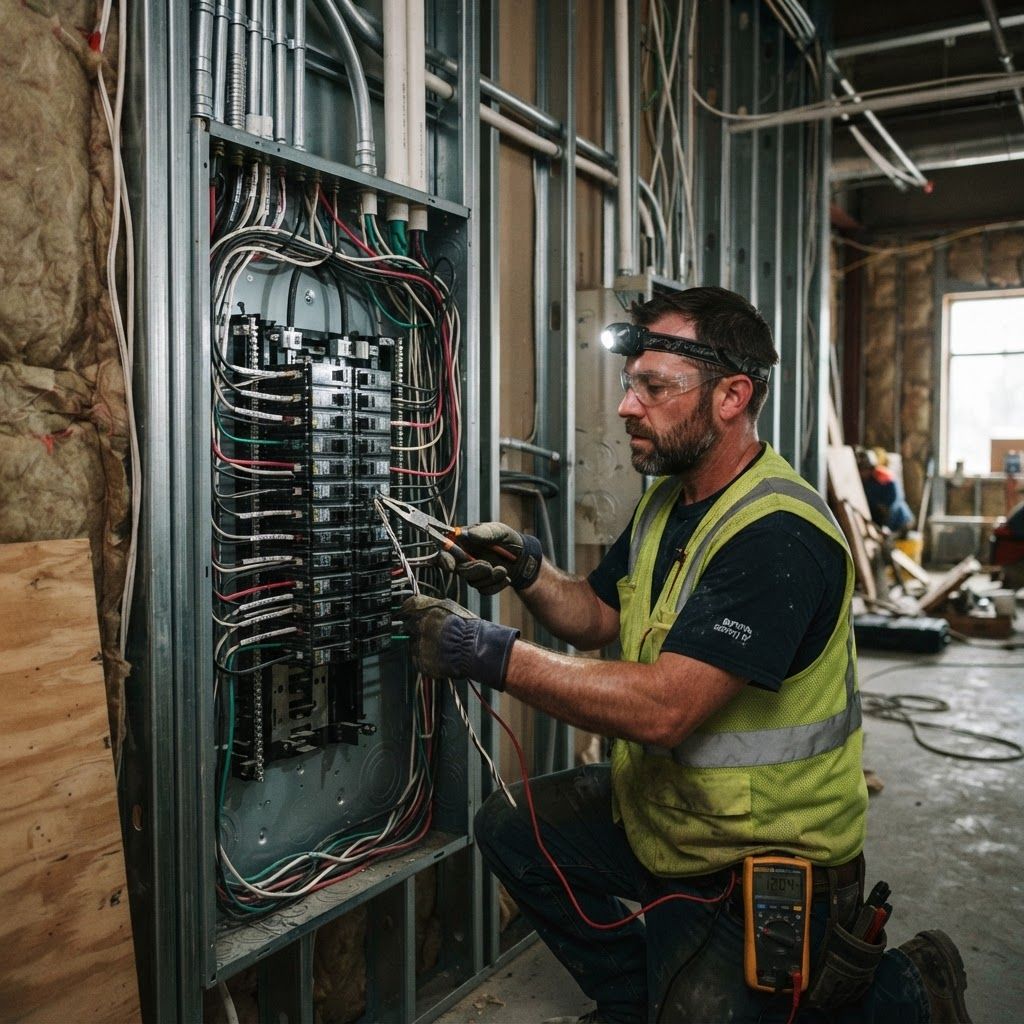
An Electrical Market Shaped by Age and Change
Electrical contracting in Buffalo sits at the intersection of two forces. On one side is the city's remarkable inventory of pre-war housing, much of it originally wired for a few lightbulbs and little else. Knob-and-tube runs, sixty-amp services, ungrounded two-prong receptacles and fuse panels are still found in occupied homes across the East Side, Black Rock, Riverside and parts of South Buffalo. On the other side is a rapid increase in electrical load: heat pumps, induction ranges, home offices, electric vehicle chargers and rooftop solar. The gap between a century-old service and a modern household demand curve is where most of the region's electrical work now lives.
Commercial demand is climbing too. Adaptive reuse of Buffalo's industrial and warehouse stock into apartments, breweries, offices and medical space requires complete electrical infrastructure, often within buildings that have no usable existing distribution at all.
The Ten Contractors Leading the Market
Queen City Electric is one of the most recognized names in Western New York residential electrical work, with a specialty in full-service upgrades. Replacing a sixty or one-hundred-amp service with a two-hundred-amp panel involves utility coordination, meter relocation, grounding electrode work and municipal inspection, and the firm manages that entire sequence for the homeowner.
Erie Electrical Contractors serves the commercial and institutional market, working on schools, medical offices and multi-tenant buildings across the Buffalo Niagara region. Their strength is design-build coordination with mechanical trades, which matters on projects where electrical infrastructure must support new HVAC and controls systems simultaneously.
Heritage Wiring Specialists focuses on historic homes, methodically removing knob-and-tube and cloth-insulated wiring while preserving plaster walls, original trim and hardwood floors. This is patient, labor-intensive work using attic and basement access with strategic fishing rather than wholesale demolition, and few firms do it as carefully.
Northtowns Electric Company covers Amherst, Williamsville and Clarence with residential service, generator installation and standby power systems. Buffalo's exposure to severe winter storms and outage events has made whole-home standby generators a genuine market, and the firm handles gas connection, transfer switch installation and load calculation as an integrated package.
Buffalo Solar and Electric combines licensed electrical contracting with photovoltaic design, interconnection paperwork and battery storage. New York State incentive programs have made residential solar viable even at Buffalo's latitude, and having a single licensed electrical firm handle both array and service-panel side work simplifies approval.
Southtowns Electrical Services serves Hamburg, Orchard Park and West Seneca with a residential troubleshooting reputation. Intermittent faults, nuisance breaker trips and shared neutral problems require diagnostic skill rather than parts swapping, and the company has built its business on solving problems other contractors left unresolved.
Cornerstone Industrial Electric works on manufacturing and warehouse facilities, handling three-phase distribution, motor controls, variable frequency drives and switchgear maintenance. Buffalo retains a meaningful industrial base, and plant electrical reliability is a production issue rather than a convenience issue.
Elmwood Lighting and Electric specializes in lighting design and retrofit for restaurants, retail and hospitality along Elmwood and Hertel avenues. Their work blends LED conversion for operating cost reduction with layered decorative lighting that supports the atmosphere these businesses depend on.
Genesee EV and Charging Systems has concentrated on electric vehicle charging infrastructure for homes, workplaces and multifamily properties. Level two residential installation requires load calculation and often a service upgrade, and commercial charging adds site design, conduit routing and network management considerations.
Cheektowaga Electrical Repair rounds out the list with dependable small-job residential and light commercial service: fixture replacement, receptacle and switch work, code corrections for real estate transactions and panel labeling. Their responsiveness on small scopes fills a real gap in the market.
Safety Issues Specific to Older Buffalo Homes
Several conditions recur in the region's older stock and deserve professional evaluation. Federal Pacific and certain vintage panels have documented breaker reliability concerns and are commonly recommended for replacement. Aluminum branch wiring installed in the mid-twentieth century requires proper connectors at terminations. Ungrounded receptacles in kitchens, bathrooms and basements should be brought up to current requirements with ground-fault protection. Overloaded circuits serving modern kitchen appliance loads on original wiring are a frequent and underestimated hazard.
How to Choose an Electrical Contractor
Verify licensing and insurance first, then ask how the contractor handles permits and inspection. Legitimate electrical work in Buffalo and the surrounding municipalities is permitted and inspected, and a contractor who proposes skipping that step is signaling how they approach the rest of the job. Request a written scope that identifies circuit counts, panel specifications, wire gauge and device types rather than a single lump-sum figure. For larger projects, ask for a load calculation rather than a rule-of-thumb estimate of service capacity.
Trends Driving Demand
Electrification is the defining trend. Heat pump adoption in Western New York has accelerated as cold-climate models have improved, and each installation adds substantial electrical load. Induction cooking is following. Home battery storage is emerging as an outage-resilience product rather than purely an energy-cost play. Together these shifts mean that the two-hundred-amp service upgrade has become the foundational project in Buffalo residential electrical work, and contractors who can execute it cleanly with utility coordination are in sustained demand.
Conclusion
Buffalo's electrical contractors operate between a historic building stock and a rapidly electrifying future. The ten firms above have distinguished themselves by handling that tension competently, whether through careful historic rewiring, reliable industrial service, or the service upgrades and charging infrastructure that modern households require. Choosing a licensed, permit-compliant contractor with genuine diagnostic ability is the practical safeguard for any property owner in the region.