
Buying Computers in St. Louis
St. Louis has quietly become a substantial technology market. Large employers in healthcare, financial services, agriculture technology, logistics and defense all run significant IT operations, and the region's growing startup community around the Cortex Innovation Community has added demand for high-performance workstations and developer machines. That mix means local buyers are not limited to consumer retail shelves. Business channel partners, refurbishers and custom builders all operate here, and the right brand often depends less on marketing claims than on which support model fits your situation.
The brands below are evaluated on build quality, warranty and service availability in the region, performance per dollar, and how well they suit the specific workloads common among St. Louis buyers, from hospital administrative fleets to engineering and design workstations.
1. Dell
Dell remains the default choice for a large share of St. Louis businesses, and for good reason. Its Latitude and OptiPlex lines are designed for fleet management, with standardized components, long product lifecycles and predictable driver support that IT departments depend on. ProSupport service contracts include next business day onsite repair across the metro, which matters enormously for organizations that cannot ship a machine away for two weeks. For consumers, the XPS line offers strong displays and solid build quality, while Alienware covers gaming.
2. Lenovo
Lenovo's ThinkPad series has the strongest reputation for durability and keyboard quality in the business laptop category, and it is widely deployed among local professional services firms and universities. The chassis designs tolerate travel well, parts availability is excellent, and service manuals make in-house repair straightforward. The ThinkStation workstation line handles engineering and data analysis workloads, and the consumer-facing IdeaPad and Legion families cover budget and gaming needs respectively.
3. Apple
Apple has gained substantial ground in St. Louis creative agencies, architecture firms, medical practices and software development teams. The Apple silicon transition delivered exceptional performance per watt, making MacBook Pro machines genuinely capable for video editing, audio production and compilation-heavy development work while running quiet and cool. Local service is available through the Apple Store at the Galleria and several authorized providers. The tradeoff remains limited upgradeability and a higher entry price.
4. HP
HP's EliteBook and ProBook lines compete directly with Dell and Lenovo in the commercial space, and HP has a particularly strong position in organizations that also standardize on its printing and imaging hardware. The Z workstation series is well regarded for certified performance with CAD and simulation software, which suits engineering firms in the region. HP's consumer Envy and Pavilion lines offer good value, though quality varies more across the range than in its business tier.
5. ASUS
ASUS appeals to buyers who prioritize hardware specification per dollar. Its ROG gaming line is popular with students and enthusiasts, the ProArt series targets content creators with color-accurate displays, and the Zenbook family offers thin-and-light options at competitive prices. ASUS also has a strong reputation for motherboards, which is why many local custom builders use them as a foundation. Warranty service is typically depot-based rather than onsite.
6. Microsoft Surface
Surface devices have found a natural place in St. Louis organizations already committed to Microsoft 365 and Azure environments. The tablet-laptop hybrid form factor works well for field staff, clinical documentation, sales presentations and classroom use. Integration with Windows management tooling is seamless, and the pen input is genuinely useful for annotation-heavy workflows. Repairability has improved in recent generations but remains behind traditional business laptops.
7. Acer
Acer competes primarily on price and delivers reasonable value in the entry and mid-range segments. For households needing basic productivity machines, students on tight budgets or organizations deploying single-purpose kiosks and thin clients, Acer keeps total cost low. The Predator gaming line and Swift ultraportables offer more capable options, and Chromebook models are common in local school districts because of low management overhead.
8. MSI
MSI focuses on gaming and creator hardware with aggressive cooling designs and high refresh rate displays. Its laptops tend to prioritize sustained performance over thinness, which suits users running long rendering or compilation jobs. MSI components are also a staple among St. Louis system builders assembling custom desktops for video production and simulation work.
9. Framework
Framework has attracted a small but committed following among St. Louis developers and IT professionals who value repairability. The modular design allows users to replace ports, memory, storage, battery and even the mainboard, extending useful life well beyond typical laptop lifespans. For organizations with sustainability commitments or technically capable staff, the reduced electronic waste and lower long-term cost are compelling, though the ecosystem is smaller than mainstream brands.
10. Local Custom Builders
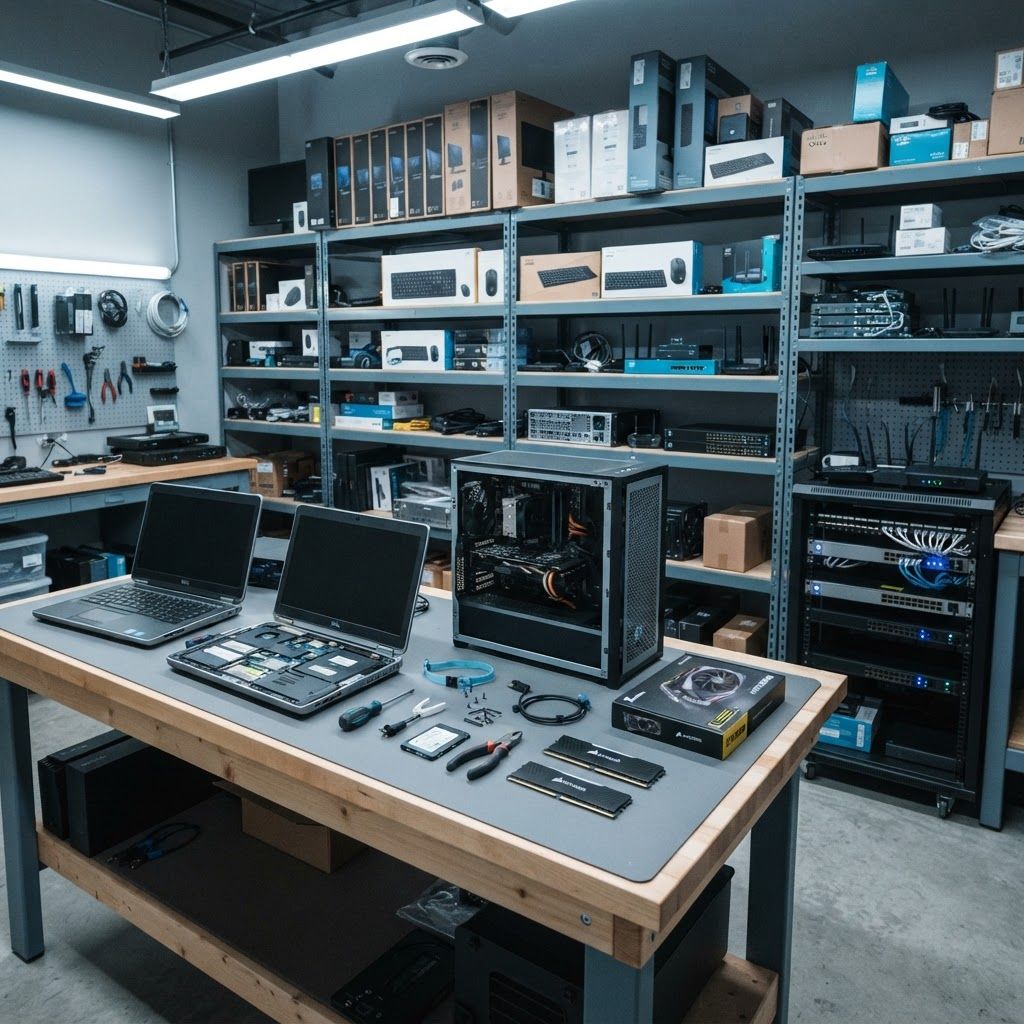
Independent St. Louis system builders and IT shops deserve a place on this list. They assemble desktops and workstations to specification, often at lower cost than equivalent prebuilt machines, and they provide the kind of direct human support that national call centers cannot match. For small businesses, video production studios and gaming enthusiasts, a locally built machine with a known technician a short drive away is frequently the most practical option available.
How to Choose the Right Brand
Start with the workload rather than the brand. Office productivity and browsing need very little compute, and money is better spent on display quality, memory and an SSD. Creative work benefits from strong single-core performance, color-accurate screens and fast storage. Engineering, data science and simulation require certified graphics, ample memory and sustained thermal performance under load.
Support model matters as much as specifications for business buyers. Onsite next business day service, spare parts availability and predictable product lifecycles reduce downtime cost far more than a modest performance advantage. For home buyers, the calculation shifts toward warranty length and whether local repair is available without shipping the device away.
Trends Affecting Local Buyers
Several developments are reshaping purchasing decisions. On-device AI acceleration is now standard in new processors, which affects upgrade timing for organizations planning to run local inference workloads. ARM-based Windows machines have improved substantially in battery life and compatibility. Refurbished enterprise hardware has become a legitimate value channel, offering three-year-old business-grade machines at a fraction of original cost. And right-to-repair momentum is gradually improving parts availability across the industry.
Final Thoughts
There is no single best computer brand in St. Louis, only the best fit for a given workload, budget and support requirement. Businesses generally do well with Dell, Lenovo or HP commercial lines because of service coverage. Creative professionals gravitate toward Apple and ASUS ProArt. Budget-conscious households and schools find value in Acer and Chromebooks. And for anyone who wants exactly the right machine with a real person to call, a local builder is hard to beat.