
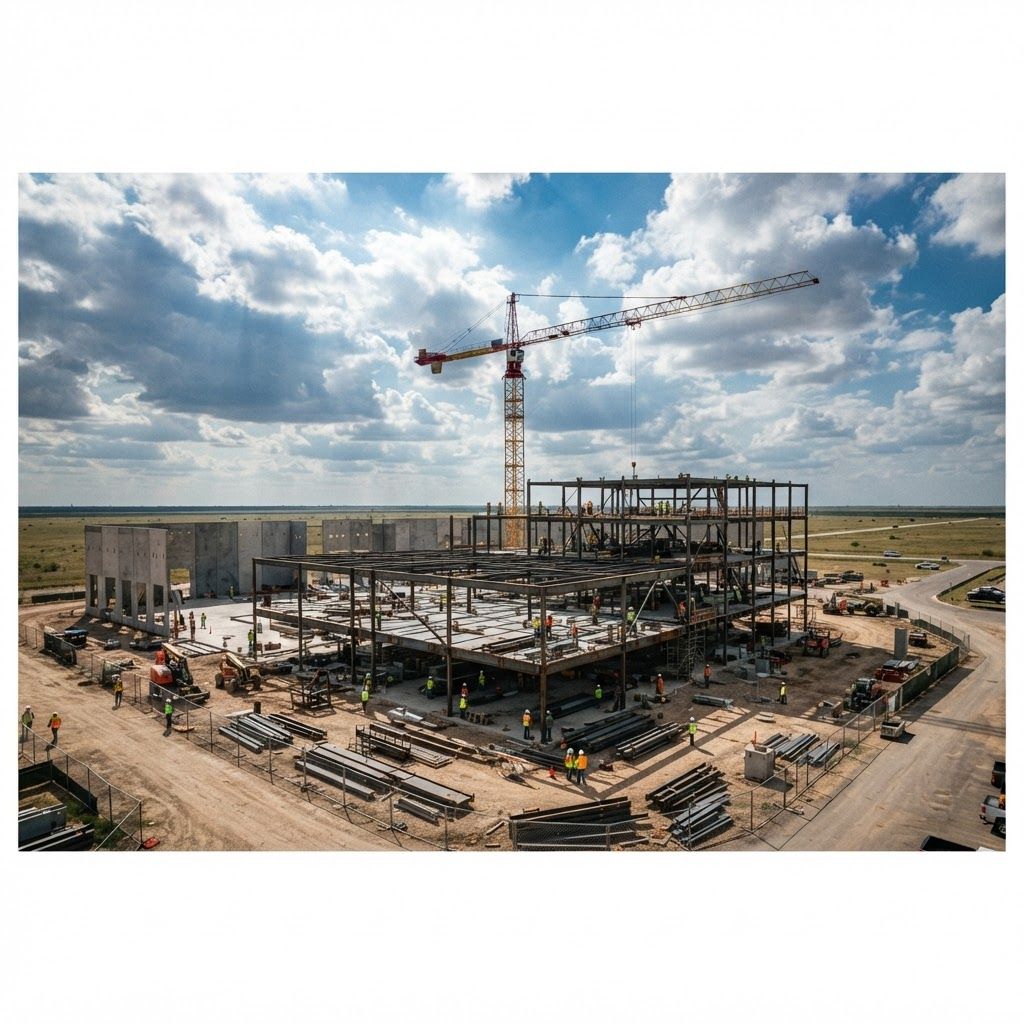
The Commercial Construction Market in Lubbock
Lubbock functions as the economic centre of a very large region, and its commercial construction market reflects that role. Healthcare facilities serve patients from across the South Plains and eastern New Mexico. Texas Tech University and the health sciences centre generate consistent institutional work. Retail, restaurant and hospitality development follows population growth on the city's south and west edges. Distribution and light industrial buildings support regional logistics, and agricultural processing facilities remain a significant sector given the surrounding cotton and grain economy.
Each of these building types demands different expertise. A medical facility involves infection control, medical gas systems, specialised electrical redundancy and stringent inspection regimes. A cold storage or food processing plant involves insulated envelopes, refrigeration and sanitary finishes. A distribution warehouse revolves around slab flatness tolerances, dock equipment and fire protection design. Owners who select a contractor on price alone, without regard to sector experience, frequently pay the difference later.
How Commercial Contractors Are Organised
General contractors hold the prime contract and coordinate all trades. On commercial work they typically self-perform some scope, often concrete or carpentry, and subcontract the remainder.
Construction managers may act as an owner's agent, providing preconstruction advice, bidding oversight and administration without carrying trade risk, or as construction manager at risk, converting to a guaranteed maximum price once design advances.
Design-build firms hold both design and construction responsibility, which suits owners who value a single point of accountability and a compressed schedule, particularly for warehouses, offices and standardised retail formats.
Specialty and industrial contractors concentrate on particular scopes such as metal building systems, pre-engineered structures, tilt-up concrete, mechanical and electrical work, or process piping for agricultural and energy facilities.
The Value of Preconstruction
Preconstruction is the phase where a commercial contractor most influences project outcome, and it is frequently undervalued. A capable team performs constructability review, identifying conflicts between architectural, structural and mechanical drawings before they become field problems. They provide cost modelling at multiple design stages so the owner knows whether the design remains within budget. They deliver value engineering that reduces cost without eroding function, distinguishing genuine savings from short-sighted substitutions.
Preconstruction also covers permitting strategy with local authorities, utility coordination, phasing plans for occupied sites, and critically, procurement planning for long-lead equipment. Electrical switchgear, rooftop mechanical units, elevators, generators and specialised glazing carry lead times that can dictate the entire schedule, and identifying them early is often the single most valuable thing a contractor does.
Evaluating a Commercial Contractor
Bonding capacity is the most objective indicator available. A surety company examines a contractor's financial statements, work in progress, management depth and history before extending bonding capacity, so a contractor bondable for your project size has effectively passed an independent financial review.
Safety performance is both an ethical and practical measure. Ask for the experience modification rate and recordable incident rates, and ask how safety is managed on site: whether there is a dedicated safety professional, how orientations and toolbox talks are handled, and how subcontractor compliance is enforced. Safe projects are also better organised projects, and the correlation with schedule and quality performance is strong.
Sector-specific experience should be verified with comparable projects, not general claims. Request three similar facilities completed recently, and speak with those owners and their architects. Architects are particularly candid about a contractor's submittal quality, coordination discipline and willingness to solve problems.
Project team quality determines daily outcomes. Identify the proposed project manager and superintendent, review their individual project histories, and ask what else they will be running concurrently. A superintendent split across three jobs cannot supervise yours properly.
Project controls capability separates professional firms from opportunistic ones. Ask to see a sample schedule with a critical path, a sample monthly report, a sample change order and a sample submittal log. The quality of these documents predicts how the project will be administered.
Subcontractor prequalification and payment practices matter enormously. Contractors known for prompt payment attract better trades and receive priority when labour is tight, which is a decisive advantage in the current market.
Trends Shaping Commercial Work
Skilled labour scarcity is the defining constraint. Contractors are responding with prefabrication of mechanical racks, bathroom pods, exterior panels and electrical assemblies in controlled shop environments, reducing on-site labour hours and weather exposure.
Material lead times and price escalation remain elevated compared with historic norms, making early procurement, escalation provisions and alternate specification pathways standard components of commercial contracts.
Building information modelling has become routine on complex projects. Three-dimensional coordination of structure, ductwork, piping, conduit and equipment access eliminates the field conflicts that once consumed weeks of rework.
Energy and commissioning requirements continue to tighten. Envelope air leakage testing, mechanical commissioning, lighting controls verification and measurement of system performance are increasingly contractual obligations rather than optional quality steps.
Renovation and adaptive reuse have grown as a share of the market. Converting retail space to medical or office use, upgrading ageing institutional buildings and repurposing industrial structures all require contractors comfortable with unknown existing conditions and phased work around occupants.
Practical Guidance for Owners
Choose the delivery method deliberately. Competitive lump sum bidding suits well-defined, conventional projects. Construction manager at risk suits complex or fast-tracked work where early contractor input matters. Design-build suits standardised building types where speed and single-source responsibility are priorities.
Do not bid incomplete documents. Bidding a design that is only partially resolved guarantees assumption-based pricing and a steady stream of change orders. Either complete the design or use a delivery method built to accommodate development.
Carry an appropriate contingency, and keep it under the owner's control with a clear process for release. Renovation projects warrant substantially more contingency than new construction.
Establish reporting expectations in the contract: monthly schedule updates with critical path analysis, cost reports reconciling budget to committed and forecast costs, photographic documentation and a formal request for information and submittal process with defined response times.
Plan closeout from the beginning. Commissioning scope, training requirements, spare parts, warranty documentation and as-built deliverables should be specified up front, because negotiating them at the end rarely goes well.
Final Thoughts
Lubbock's commercial construction sector includes firms with genuine depth in healthcare, education, industrial, agricultural and retail work, alongside capable specialty contractors. The owners who consistently get good results are those who select for relevant experience and financial strength, invest properly in preconstruction, define scope thoroughly and then administer the contract with discipline. Construction rewards preparation more than almost any other business activity.