
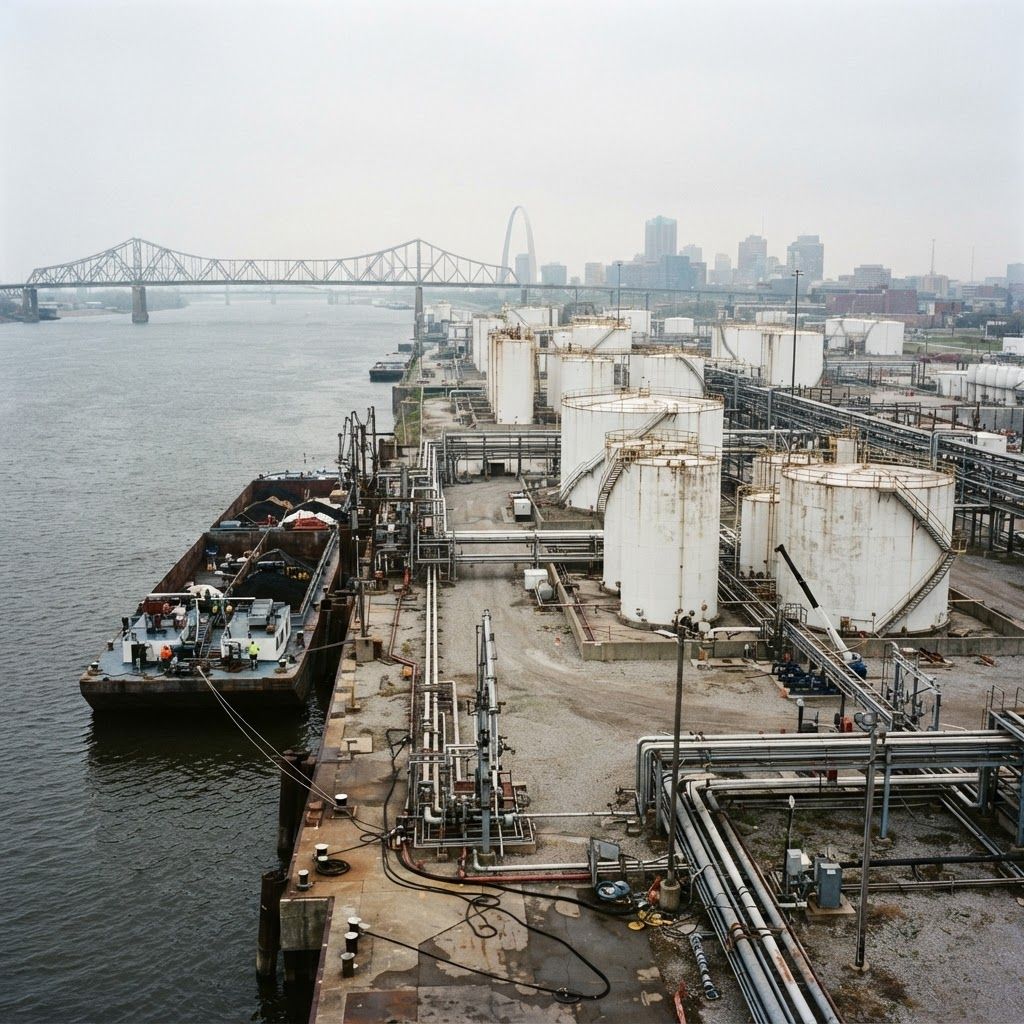
A River City Built on Energy Logistics
St. Louis has never been an oil production center, and that is precisely what makes its energy sector interesting. The region's strength lies in movement, processing, and distribution. Positioned at the confluence of the Mississippi and Missouri rivers, served by six Class I railroads, and crossed by major interstate corridors and pipeline systems, the metro is one of the most efficient places in the country to move liquid fuels and natural gas.
The nearby Wood River refinery complex in Roxana, Illinois, operated as a joint venture between Phillips 66 and Cenovus Energy, ranks among the largest refineries in the Midwest and processes both conventional and heavy Canadian crude. Its presence supports an extensive network of terminals, tank farms, barge operators, trucking fleets, contractors, and specialty service firms throughout the bi-state area. Spire, the natural gas utility headquartered in St. Louis, serves well over a million customers across Missouri and Alabama and anchors the downstream gas side of the market.
The Segments of the Regional Industry
Understanding the local sector requires separating its layers. Refining and processing converts crude into gasoline, diesel, jet fuel, asphalt, and petrochemical feedstocks. Midstream logistics moves those products through pipelines, terminals, barges, rail, and tanker trucks. Terminal and storage operators manage tank farms, blending, additive injection, and load rack operations under strict measurement and environmental controls.
Wholesale fuel distribution supplies retail stations, commercial fleets, agricultural customers, marine operators, and industrial users, often bundling in lubricants, DEF, propane, and fuel management technology. Natural gas distribution delivers to homes, commercial buildings, and industrial plants through an extensive local network, with associated construction, leak survey, and pipeline integrity work. Retail fueling operates convenience stores and truck stops, a segment where several regional chains have built strong brands.
Finally, the services layer is substantial: environmental and remediation consultants, tank inspection and cathodic protection specialists, industrial contractors performing turnaround work, measurement and metering firms, safety training providers, and engineering companies designing terminal and pipeline modifications.
What Marks a Strong Operator
In this industry, excellence is measured first in safety and integrity management. Leading operators maintain process safety management systems that genuinely function, conduct rigorous mechanical integrity inspections, run robust management of change procedures, and treat near-miss reporting as valuable rather than embarrassing. Their incident rates reflect that discipline, and so do their insurance terms.
Environmental performance is the second marker. That means vapor recovery compliance, spill prevention control and countermeasure planning, stormwater management, methane leak detection and repair, and honest reporting. Companies operating near the rivers and in densely populated corridors face particular scrutiny, and the best ones invest ahead of requirements rather than reacting to enforcement.
Operational reliability comes third. Terminal uptime, accurate custody transfer measurement, on-time delivery performance, and disciplined inventory management determine whether customers stay. For distributors, supply reliability during weather events and price volatility separates the dependable from the opportunistic. Finally, financial and contractual transparency matters: clear pricing mechanics, index references, and pass-through terms build durable commercial relationships.
Trends Defining the Next Decade
The sector is adapting rather than disappearing. Renewable fuels have become a major growth area, with renewable diesel, biodiesel blending, ethanol logistics, and renewable natural gas from landfills and agricultural digesters all expanding across the Midwest. Terminal operators are investing in blending infrastructure and tankage to handle these products, and the region's agricultural base gives it a structural feedstock advantage.
Carbon management has entered the planning horizon, with interest in capture at industrial and ethanol facilities and considerable public debate over sequestration pipelines. Regulatory attention to methane emissions has pushed gas utilities toward accelerated main replacement, advanced leak detection, and aerial survey technology. Digitalization has spread through the industry via remote terminal automation, predictive maintenance on rotating equipment, drone and robotic tank inspection, and analytics-driven route optimization for delivery fleets.
Workforce transition is a quiet but critical theme. A significant share of experienced operators, pipefitters, welders, instrumentation technicians, and control room personnel are approaching retirement, and companies that built apprenticeship pipelines with local trade unions and community colleges are far better positioned than those that did not.
How Commercial Customers Should Evaluate Suppliers
Fleet managers, manufacturers, and institutional buyers should look beyond posted price. Ask about supply diversity and what happens during regional allocation events. Examine delivery reliability data, tank monitoring and automatic replenishment capability, and the quality of reporting for fuel tax and sustainability accounting.
Review contract mechanics closely: index basis, differential, freight, and fees should each be visible rather than bundled into an opaque number. Confirm insurance, environmental compliance history, and driver safety programs. For natural gas procurement, understand the difference between utility supply, marketer contracts, and transportation arrangements, and model the impact of basis and capacity costs rather than focusing only on the commodity strip.
The Regional Outlook
St. Louis will remain a critical energy logistics hub because geography does not change. Rivers, rail, pipelines, and highways converge here, and the fuels moving through that infrastructure will evolve toward lower-carbon blends without eliminating the need for the infrastructure itself. The companies that thrive will be those that run safely, invest in integrity and emissions performance, adapt tankage and blending for new products, and build the skilled workforce required to operate increasingly instrumented facilities.