
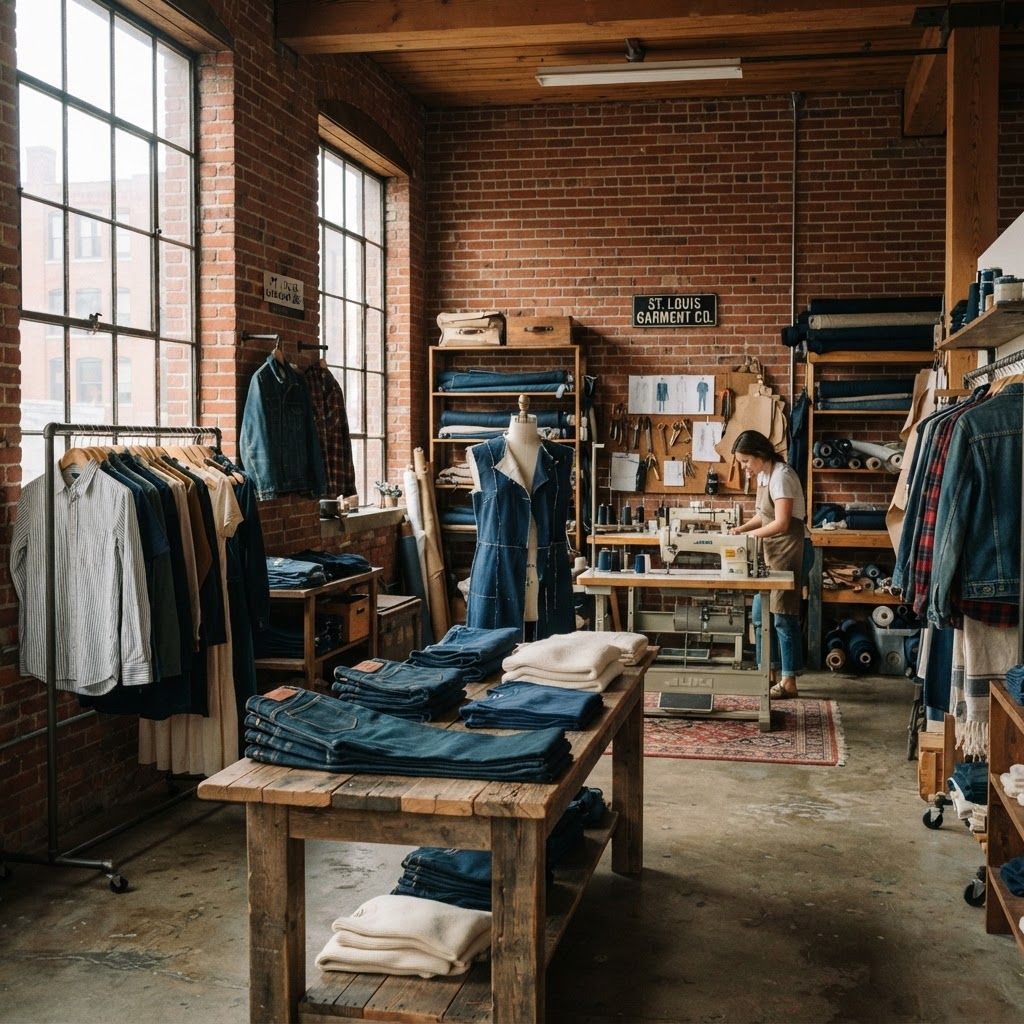
St. Louis is not usually named alongside the recognized American fashion cities, which has turned out to be an advantage. Lower overhead, available industrial space and a genuine manufacturing history have allowed independent apparel brands to grow here on real economics rather than venture funding, producing labels that make durable clothing and actually turn a profit doing it.
The St. Louis Apparel Story
The city's garment history runs deeper than most people realize. St. Louis was once a significant center for shoe and apparel manufacturing, with a downtown garment district that employed thousands. That industry largely departed, but the buildings, some equipment knowledge and a cultural memory of making things locally remained.
What has emerged in recent decades is different in scale but connected in spirit. Small-batch producers, screen printers, cut-and-sew operations and designer labels now cluster in neighborhoods like Cherokee Street, the Grove and parts of downtown. The aesthetic tends toward durability and understatement rather than trend chasing, which suits both the local climate and the local temperament.
The Top 10 Clothing Brands in St. Louis
1. Gateway Workwear Company
Produces heavy-duty canvas and duck cotton workwear including chore coats, painter pants and utility shirts. Reinforced construction and honest material sourcing have earned a following well beyond people who actually work in trades.
2. Cherokee Street Denim Works
Focuses on selvedge and raw denim cut and sewn locally, with repair services for garments they produce. Emphasis on fit range and long-term wearability positions denim as an investment rather than a seasonal purchase.
3. Mound City Knitwear
Specializes in knit basics — tees, sweatshirts, thermals — made from mid and heavyweight cottons that hold shape through repeated washing. Fabric weight and shoulder construction are noticeably better than mass market equivalents.
4. Delmar Loop Streetwear Collective
A collaborative label producing graphic apparel drawing on St. Louis music, sports and neighborhood culture. Limited drops and genuine local reference points have built a committed community rather than a passive customer base.
5. Forest Park Outerwear
Designs jackets and coats engineered for Missouri's wide temperature range, including waxed cotton, insulated parkas and transitional shells. Practical layering design suited to a climate that swings dramatically within a single week.
6. Soulard Tailored Goods
Produces made-to-measure and small-run tailored clothing including suits, sport coats and trousers. In-house fitting and alteration capability makes proper tailoring accessible at a price point below traditional bespoke.
7. Grand Center Studio Apparel
A designer-led label producing small collections with an emphasis on unusual silhouettes and natural fibers. Sold primarily through local boutiques and direct channels, with production runs deliberately kept small.
8. Riverfront Athletic Wear
Focuses on performance apparel for running, cycling and training, developed with input from local athletic communities. Technical fabric selection and reflective detailing designed around actual regional training conditions.
9. Tower Grove Sustainable Clothing
Built around organic and recycled fibers, low-impact dyeing and transparent supply chain documentation. Publishes material sourcing and production detail rather than making vague environmental claims.
10. Lafayette Square Children's Apparel
Produces durable children's clothing designed for growth and hard wear, with adjustable features and reinforced knees and elbows. Hand-me-down durability is treated as a design requirement rather than an accident.
How to Buy Clothing Well
Learn to read fabric. Fiber content, weight and weave determine how a garment wears far more than brand reputation. Heavier cotton knits resist stretching and pilling, tightly woven wovens hold structure, and blended synthetics behave very differently depending on proportion. Check the label and handle the fabric before buying.
Prioritize fit over size labels. Sizing is inconsistent across brands to the point of being nearly meaningless, and shoulder fit on a jacket or rise on trousers matters more than the number on the tag. Small local brands frequently offer more consistent sizing because they use a single fit block, and many will alter garments they sell.
Calculate cost per wear. A well-constructed jacket at three hundred dollars worn two hundred times costs less per wear than a poorly made one at eighty worn fifteen times before it fails. Examine seam allowances, stitch density, button attachment and lining quality, since these predict longevity better than price does.
Support local brands practically. Buying direct improves their margins, providing honest fit feedback improves their product, and using repair services they offer extends garment life and deepens the relationship.
Trends in Independent Apparel
Domestic small-batch manufacturing has become economically viable again as consumers accept higher prices for durability and transparency. Repair and resale programs are increasingly offered directly by brands, extending product lifecycles. Size inclusivity has expanded meaningfully among independent makers who can adjust patterns without massive production commitments. Natural and lower-impact fibers continue gaining share, and direct-to-consumer models allow small labels to reach national customers while remaining rooted locally.
Final Thoughts
St. Louis clothing brands reflect the city itself — practical, well made and largely uninterested in performance for its own sake. Buy fewer garments, examine construction closely, prioritize fit over labels, and use the repair and alteration services local makers offer. That approach builds a wardrobe that lasts while supporting the small manufacturing base that makes the local scene possible.