
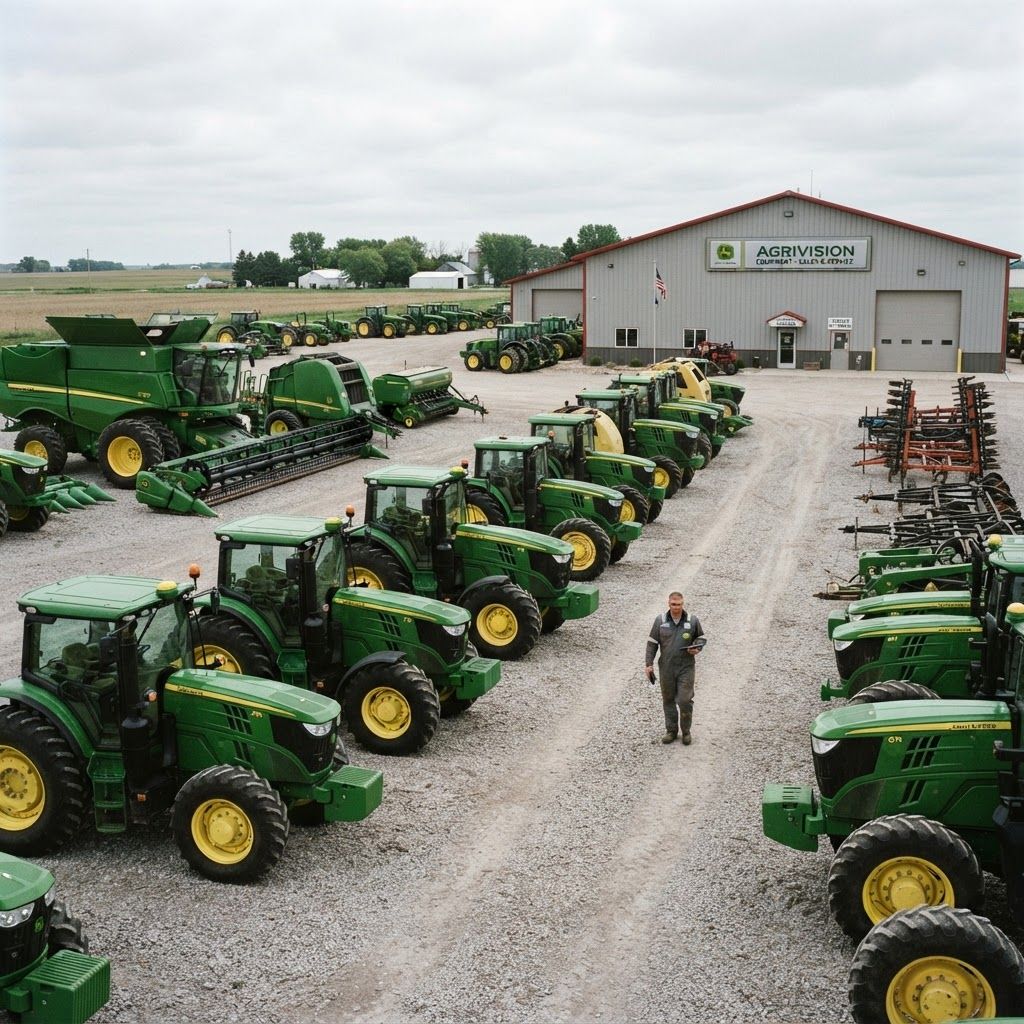
Farm equipment decisions have unusually long consequences. A tractor purchased today may still be working in twenty years, and the choice of brand determines not only capability but the parts network, service relationship and resale value you live with for that entire period. In the Buffalo region, where the field window is compressed and weather can force an entire operation to complete planting or harvest in a handful of workable days, machinery reliability is not a preference but a financial necessity.
What Buffalo-Area Conditions Demand
Local agriculture places specific stresses on equipment. Heavy clay-loam soils in parts of the region require adequate horsepower and traction. Wet spring conditions demand flotation and careful weight management to avoid compaction. Short harvest windows reward capacity and uptime. And the same machines that work fields in summer are frequently repurposed for snow handling in winter, meaning hydraulic capability and cab comfort matter well outside the growing season.
Dealer density is also a genuine factor. Western New York is well served, but coverage varies by brand, and a machine supported by a dealer forty minutes away with parts in stock will outperform a technically superior machine supported from three hours out.
The Top 10 Agricultural Equipment Brands in the Buffalo Region
1. John Deere
The most widely supported brand in the region, with strong dealer coverage, deep parts availability and mature precision agriculture integration. Guidance, telematics and data platforms are well developed, and resale values remain among the strongest in the industry.
2. Case IH
Highly regarded for row crop tractors and combines, with a loyal following among grain producers. Known for strong drivetrains, effective harvesting capacity and precision systems that integrate well with third-party agronomic software.
3. New Holland
Popular across dairy operations for hay and forage equipment, including balers, mowers and forage harvesters. Practical cab ergonomics and competitive pricing make it a common choice for mixed livestock and crop farms.
4. Kubota
Dominant in the compact and utility tractor segment, which suits smaller farms, vegetable growers, orchards and municipal use. Reliable diesel engines, tight turning radius and broad implement compatibility explain its wide regional presence.
5. Massey Ferguson
Offers strong value across utility and mid-range tractors with straightforward serviceability. Appeals to operations that prioritize mechanical simplicity and lower acquisition cost over the most advanced electronics packages.
6. Kuhn
A specialist in implements rather than tractors, particularly hay tools, mixers, spreaders and tillage. Build quality on forage equipment is widely respected among dairy producers where feed consistency directly affects milk production.
7. Claas
Known for forage harvesters and high-capacity balers used by larger dairy and custom harvesting operations. Engineering focused on throughput and chop quality makes it a strong fit where feed volume is the constraint.
8. Great Plains
Focused on seeding and tillage equipment, including no-till drills and vertical tillage tools. Growing adoption of conservation practices in the region has increased demand for their precision seeding capability.
9. Bobcat
Widely used for compact loaders, telehandlers and utility vehicles that handle everything from barn cleaning to snow removal. Attachment versatility makes a single machine useful across many farm tasks year round.
10. Gehl
Offers skid loaders, telescopic handlers and agricultural attachments with a reputation for durability in confined livestock facilities. Practical serviceability and competitive parts pricing appeal to operations doing their own maintenance.
How to Choose Agricultural Equipment
Start with dealer support rather than specification sheets. Ask about typical service response time during peak season, whether the dealer stocks common wear parts locally, how many trained technicians they employ, and whether they offer loaner equipment during major repairs. In a compressed season, a two-day wait for a part can cost more than the price difference between brands.
Calculate cost per acre or per hour rather than purchase price. Fuel consumption, maintenance intervals, expected component life and residual value all feed into the real figure. Well-supported brands often carry higher purchase prices and lower lifetime costs.
Consider technology honestly. Guidance, section control, yield mapping and telematics deliver measurable input savings on larger acreages, but a small diversified vegetable operation may gain far more from mechanical simplicity and easy repair. Match the technology level to your actual management capacity. Finally, evaluate used and refurbished options seriously — a well-maintained previous-generation machine from a strong dealer network frequently outperforms a new machine from a thin one.
Trends in Farm Machinery
Autonomy is advancing steadily, with automated steering already standard and driverless field operations moving from demonstration toward practical deployment. Electrification is entering compact and utility categories first, where duty cycles suit battery capability. Right-to-repair pressure has produced meaningful movement toward greater owner access to diagnostics and repair documentation. Data interoperability is improving as growers refuse to be locked into single-vendor ecosystems, and equipment-sharing or custom-hire arrangements are expanding as a way to access high-capacity machinery without owning it.
Final Thoughts
The best agricultural equipment brand for a Buffalo-area farm is the one whose dealer will answer the phone at seven in the morning during harvest and have the part on the shelf. Specification comparisons matter, but support determines outcomes. Talk to neighboring operations about their actual service experience, demand written response commitments on critical machines, and build your fleet around brands your local network can genuinely sustain. That approach protects both your season and your capital.