
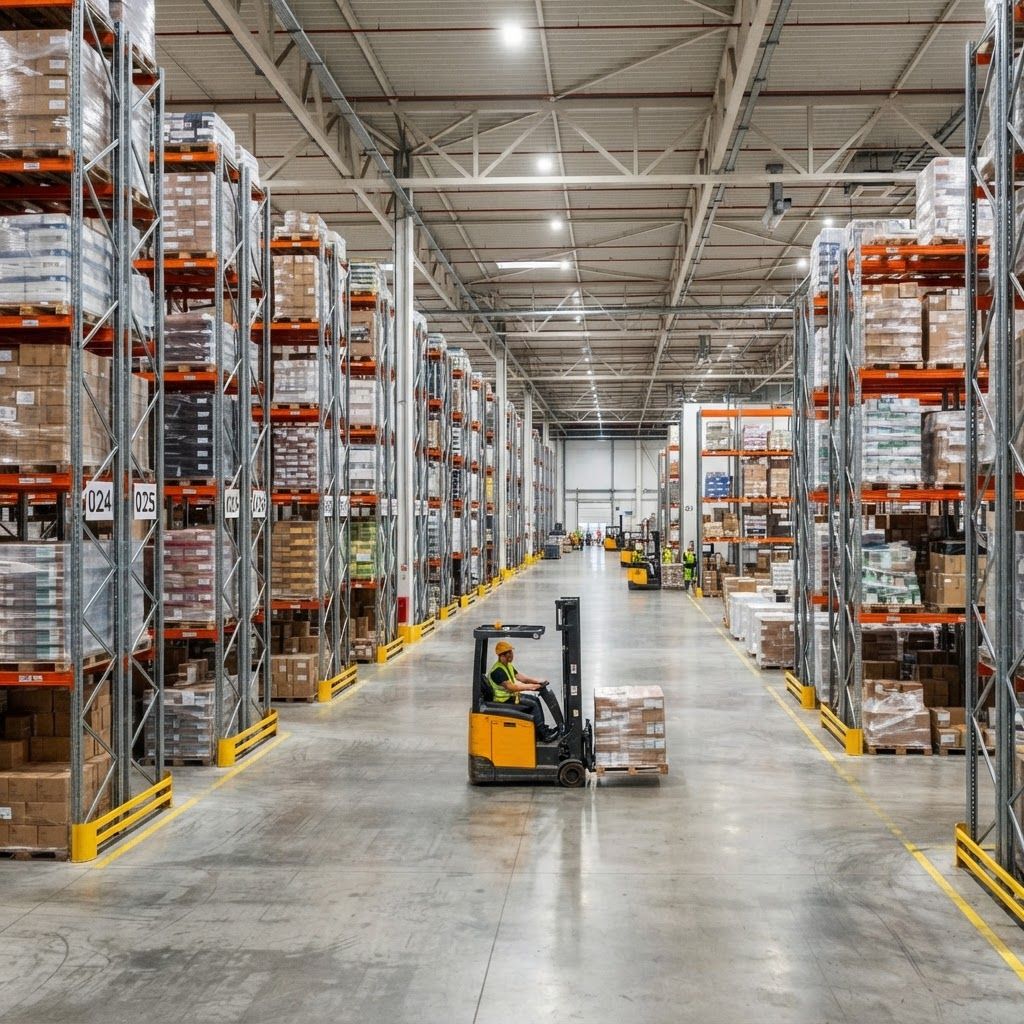
Why St. Louis Is a Warehousing Market
Geography made this decision a long time ago. St. Louis sits near the population centroid of the United States, at the convergence of six interstate highways, six Class I railroads, the northernmost ice-free port on the Mississippi River, and two significant cargo airports. From a distribution center here, a single-day truck move reaches a large fraction of the country's population, and a two-day move reaches most of it.
The practical result is a deep, competitive warehousing market with meaningful specialization. The Earth City, Hazelwood and Riverport industrial areas concentrate distribution space near the airport and I-70. Corridors in St. Charles County and along I-55 south serve manufacturing. Across the river, Illinois industrial parks around Edwardsville and Granite City combine rail access with lower land cost. Choosing among them is a real decision with real cost consequences.
Understanding What You Are Actually Buying
Warehousing terminology obscures important differences. Public warehousing is shared space billed per pallet or per square foot with handling charges, appropriate for variable volume and short commitments. Contract warehousing is dedicated space and labor under a multi-year agreement, which lowers unit cost and transfers volume risk to you. Third-party logistics adds order fulfillment, pick and pack, kitting, returns processing and transportation management on top of storage.
Then there are specialized categories. Temperature-controlled and cold storage for food, pharmaceutical and chemical goods. Foreign trade zone and bonded warehousing, which defers or eliminates duty on imported goods until they enter domestic commerce, a genuine cash flow advantage for importers. Hazardous materials storage with the requisite permitting and containment. Rail-served facilities for bulk and heavy freight.
Match the category before comparing prices, because a cold storage rate and a dry public warehousing rate are not comparable numbers.
The Ten Best Warehousing Companies in St. Louis
1. Hub Group Logistics
Operating substantial warehousing and distribution capacity in the region, Hub Group combines storage with intermodal transportation, which is the natural pairing in a market with this much rail. For shippers moving container volume, having warehousing and drayage under one provider removes a great deal of coordination overhead and typically improves dwell time.
2. Wagner Logistics
A Midwest contract logistics provider with strong St. Louis operations, Wagner handles dedicated warehousing, value-added services like kitting and packaging, and integrated transportation. Their strength is manufacturing support: sequencing parts to production schedules and running supplier consolidation programs that reduce inbound freight cost.
3. Cass Information Systems and Regional Partners
Cass is a St. Louis institution in freight audit and payment rather than a warehouse operator, but for anyone building a regional distribution network it belongs in the conversation. Their spend visibility routinely identifies warehousing and freight cost that companies did not know they had. Pair them with a physical provider rather than choosing between them.
4. Americold Logistics
Temperature-controlled warehousing with regional capacity serving the food and beverage sector. Cold chain is a specialized discipline involving validated temperature monitoring, food safety compliance, blast freezing and audit-ready documentation. Attempting it with a general warehouse provider is a false economy, and Americold is the category benchmark.
5. Bommarito Logistics Services
A locally rooted provider handling public and contract warehousing across the metro with flexible space commitments. Their advantage is responsiveness at mid-market scale: they will take a fifteen-thousand square foot requirement seriously, where national providers optimized for hundred-thousand-foot deals often will not.
6. St. Louis Regional Freightway Partner Facilities
The Freightway is an economic development enterprise rather than an operator, but its facility and site inventory is the single most useful research tool for anyone evaluating industrial space in the bi-state region. They maintain data on available buildings, rail service, utility capacity and incentive programs across both states, which shortens a site selection process considerably.
7. Gateway Industrial Warehousing
Focused on rail-served bulk and heavy freight storage in the Illinois industrial corridor, with transload capability between rail, truck and barge. For commodity, metals and building products shippers, multimodal transload access at a single facility is exactly the capability that makes the St. Louis geography pay off.
8. Ozburn-Hessey and Successor Operations
Contract logistics operations in the region serve retail and consumer goods distribution with omnichannel fulfillment, handling both bulk retail replenishment and direct-to-consumer picking from the same inventory pool. That dual capability has become essential rather than optional for consumer brands.
9. Midwest Fulfillment Solutions
Serving small and mid-sized e-commerce brands with pick-and-pack fulfillment, integrated shipping and returns handling, plus platform integrations to the major online marketplaces and storefront systems. Appropriate for brands shipping a few hundred to a few thousand orders monthly, a volume band where enterprise providers are uninterested and self-fulfillment has become unsustainable.
10. Foreign Trade Zone 102 Operators
The St. Louis foreign trade zone covers designated sites across the region, and operators within it provide bonded warehousing where duty is deferred until goods enter domestic commerce, avoided entirely on re-exports, and sometimes reduced through inverted tariff treatment on manufacturing. For importers of meaningful volume the working capital effect is substantial and frequently overlooked.
How to Evaluate a Warehousing Provider
Tour the facility. A site visit reveals more in twenty minutes than a proposal does in twenty pages: dock condition, racking quality, housekeeping, whether inventory is where the system says it is. Ask about warehouse management system capability and whether they can integrate with your systems by electronic data interchange or API, because manual data exchange becomes a permanent tax.
Request real performance metrics: inventory accuracy, on-time shipping, order accuracy, dock-to-stock time. Providers who measure these will share them, and providers who do not measure them are telling you something. Understand the full rate structure including storage, inbound and outbound handling, accessorials, and minimums, since the headline storage rate is frequently a minority of the actual invoice.
Closing Thought
The region's warehousing advantage is real, but it only materializes if you pick the right category and the right location within the metro. Define whether you need public, contract, cold, bonded or fulfillment space first. Then negotiate on the total landed cost of storage, handling and outbound freight together, because optimizing any one of those alone reliably makes the other two worse.