
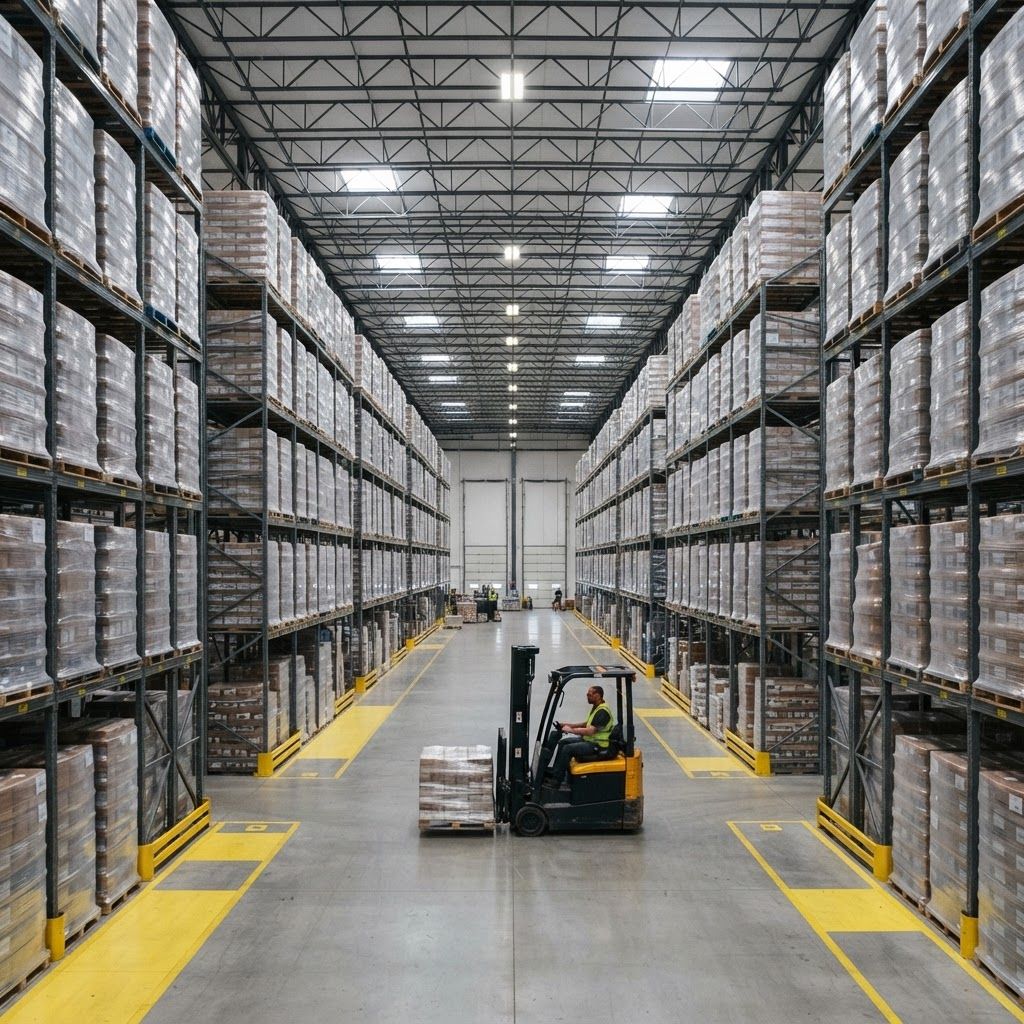
Why Buffalo Became a Warehousing Hub
Buffalo's warehousing sector is a direct inheritance of its industrial past. The city was built as a transfer point, where grain from the Great Lakes met the Erie Canal and, later, where steel and manufactured goods met a dense rail network. Those bones are still in place: large-span industrial buildings, active rail spurs, deep-water access, and highway corridors connecting to Interstates 90 and 190. What has changed is the cargo. Instead of grain and ore, today's Buffalo warehouses hold consumer electronics, food and beverage inventory, automotive components, medical supplies, and pallets of ecommerce goods waiting to be picked and packed.
The other driver is geography. Buffalo sits directly across the border from the Greater Toronto Area, one of North America's largest consumer markets. That makes local warehouse space unusually valuable for companies moving goods in either direction. A Canadian brand selling into the United States can hold inventory in Buffalo and ship domestically without repeated customs entries. An American company serving Ontario can stage freight locally and cross the Peace Bridge in a single truckload. Warehousing in Buffalo is therefore rarely just storage. It is a cross-border strategy.
The Main Categories of Provider
Public warehousing is the most familiar model. The operator owns or leases the building, and customers pay for the pallet positions and handling they actually use. This suits seasonal businesses, companies testing a new region, and anyone who wants to avoid a long-term lease. Rates are typically quoted per pallet per month plus in-and-out handling charges.
Contract warehousing dedicates defined space, labor, and equipment to a single client under a multi-year agreement. The customer gets predictable capacity, a team trained on their specific product, and often a customized layout. In exchange, they commit to volume. Manufacturers with steady production runs and distributors with stable order patterns tend to prefer this structure.
Third-party logistics providers, commonly called 3PLs, bundle warehousing with transportation, order fulfillment, returns processing, and reporting. For an online retailer, a 3PL may receive containers, store inventory, pick individual orders, print labels, and hand parcels to carriers, all under one invoice. Buffalo's 3PL community has grown quickly alongside ecommerce.
Bonded and foreign trade zone facilities occupy a specialized niche. Goods stored in a bonded warehouse have not formally entered United States commerce, so duty payment is deferred until the product is withdrawn. For importers with slow-moving or re-export inventory, that deferral is a real cash flow advantage, and it is one reason border cities like Buffalo attract international shippers.
Names Active in the Buffalo Market
The market includes national operators and long-established local firms. On the national and regional side, Americold, NFI Industries, Ryder Supply Chain Solutions, Penske Logistics, and DHL Supply Chain maintain distribution and warehousing capability serving Western New York. Regional and locally rooted operators including Sonwil Distribution Center, Ridge Logistics, Buffalo Warehousing and Distribution, and Niagara Frontier Warehousing are known for cross-border expertise and flexible handling of mixed freight. Cold storage specialists serve the region's substantial food processing base, while several bonded operators near the border focus specifically on customs-deferred inventory.
Reputation in this industry is built quietly. The operators customers stay with for a decade are the ones whose inventory counts reconcile, whose dock appointments run on time, and whose staff catch a damaged pallet before it ships rather than after.
Services That Distinguish Strong Operators
Beyond racking and forklifts, the differentiators are usually informational and value-added. A modern warehouse management system that gives customers real-time visibility into inventory levels, receipts, and shipments is now table stakes rather than a premium feature. Electronic data interchange and application programming interface connections that push order status directly into a client's own system reduce manual work on both sides.
Value-added services matter just as much. Kitting and assembly, display building for retail programs, labeling and relabeling for different markets, repackaging, quality inspection, and returns grading all keep work inside the warehouse that would otherwise require a separate vendor. Temperature control, food-grade certification, hazardous materials authorization, and pharmaceutical handling standards open doors to regulated industries.
Trends Shaping Local Warehousing
Automation is arriving incrementally rather than all at once. Barcode and radio frequency scanning are universal, and larger Buffalo facilities have added conveyor sortation, automated print-and-apply labeling, and in some cases mobile robots that bring shelving to pickers. Full lights-out automation remains rare at this market's scale, but data-driven slotting, where fast-moving items are placed nearest the pack stations, delivers meaningful productivity gains without heavy capital expense.
Sustainability has also moved from marketing into operations. LED retrofits, rooftop solar, electric forklifts, and pallet and corrugate recycling programs reduce both emissions and cost. Some operators now report carbon data to customers who need it for their own disclosures.
How to Choose the Right Partner
Start with a clear picture of your own profile: how many pallets, how fast they turn, how orders are structured, and what certifications your product requires. Then tour the facility in person. Look at aisle housekeeping, dock congestion, racking condition, and whether staff seem trained or improvised. Ask for inventory accuracy and on-time shipping metrics, and ask how they are measured.
Read the rate structure carefully. Storage looks cheap until handling, accessorial, and minimum charges are added. Understand liability limits and insurance requirements, since standard warehouse liability is often far lower than the value of the goods. Finally, evaluate the relationship itself. Warehousing is an operational partnership measured in years, and responsiveness during a problem tells you more than any proposal document.
Final Thoughts
Buffalo offers something increasingly scarce in North American logistics: substantial industrial capacity, multimodal connections, an experienced labor pool, and immediate border access, all at costs well below coastal markets. Whether you need a hundred pallet positions or a dedicated cross-border distribution center, the depth of the local market means the right operator almost certainly exists. The work is in matching your specific inventory profile to a partner whose systems, certifications, and culture genuinely fit it.