
Why Towing Demand Is High in Chattanooga
Chattanooga sits at the convergence of major interstate corridors carrying enormous freight and passenger volume. Add steep mountain grades, tunnel approaches, frequent summer heat, and occasional winter ice on elevated roadways, and the result is a metropolitan area with consistently high demand for towing and recovery services.
That demand supports a wide range of providers, from large operations with heavy recovery equipment to small local operators. Quality and pricing vary considerably, and the moment of breakdown is the worst possible time to evaluate options. Knowing the landscape in advance is genuinely valuable.
1. Motor Club and Roadside Assistance Programs
National motor club memberships dispatch contracted local providers and cover a set number of tows annually within defined mileage limits. The pricing is predictable, the dispatch process is standardized, and disputes have a clear escalation path. For most drivers, membership is the most cost-effective baseline protection available.
2. Insurance Provided Roadside Coverage
Many auto insurance policies include roadside assistance for a small premium addition. Coverage is typically comparable to a motor club, and claims are handled through the insurer's app or hotline. Drivers frequently pay for both an insurance rider and a separate club membership without realizing it, so reviewing existing coverage before buying more is worthwhile.
3. Manufacturer Roadside Assistance
New vehicles usually include manufacturer roadside assistance during the warranty period, often with towing directed to a franchised dealer. This is the preferred option for warranty-related breakdowns, since it keeps the repair within the manufacturer's network and avoids disputes about diagnosis.
4. Independent Local Towing Operators
Independent towing companies throughout Hamilton County provide direct service without membership requirements. Response times from local operators familiar with the area's roads are often faster than nationally dispatched providers. Rates should be confirmed by phone before dispatch, including hook fee, per-mile charge, and any after-hours premium.
5. Flatbed Towing Specialists
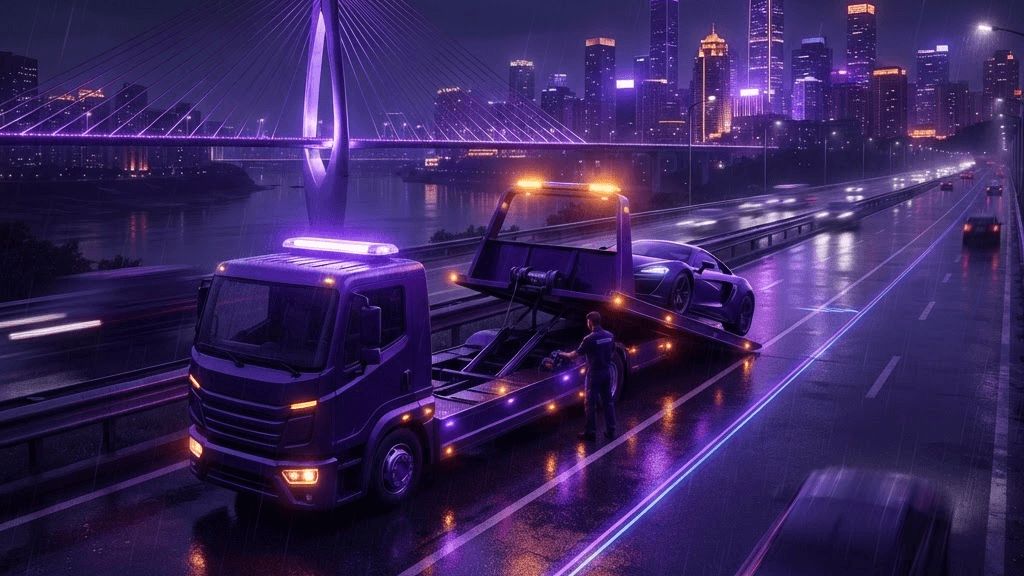
Flatbed transport lifts the entire vehicle onto the truck bed, eliminating drivetrain stress and ground clearance problems. It is required for all-wheel drive vehicles, lowered vehicles, exotic and classic cars, and most electric vehicles. When arranging a tow, specify flatbed if any of these apply, since the wrong equipment can cause expensive damage.
6. Heavy Duty and Commercial Recovery
Given regional freight volume, several operators maintain heavy wreckers capable of recovering commercial trucks, buses, and equipment. Heavy recovery is a specialized discipline involving rigging, load stabilization, and coordination with law enforcement. Commercial fleet operators should establish a relationship with a heavy recovery provider before they need one.
7. Motorcycle Transport Services
Motorcycles require specific equipment including wheel chocks and soft straps to avoid damage to forks and bodywork. Providers experienced with motorcycle transport are worth identifying in advance, particularly for riders who regularly ride mountain routes far from the city.
8. Accident Recovery and Law Enforcement Rotation
Following a collision, towing is often dispatched through a law enforcement rotation list. Vehicle owners generally retain the right to request a specific provider and to direct where the vehicle is taken, subject to investigation requirements. Storage fees accumulate daily, so arranging prompt release to a chosen repair facility limits cost.
9. Lockout, Jump Start, and Fuel Delivery
Many calls do not require towing at all. Roadside providers handle lockouts, battery jump starts, tire changes, and fuel delivery at substantially lower cost than a tow. Describing the problem accurately to dispatch ensures the correct service and equipment arrive.
10. Long Distance Vehicle Transport
For relocations, vehicle purchases from distant sellers, or non-running project vehicles, transport brokers and carriers move vehicles regionally and nationally. This is a scheduled service rather than emergency response, and booking in advance produces significantly better pricing.
What to Verify Before the Hook Up
Confirm the company name, provide precise location including direction of travel and nearest exit or mile marker, and ask for an estimated arrival window. Request the total cost including hook fee, mileage rate, and any additional charges. Confirm the destination and that the operator will not divert to a storage lot you did not authorize. Ask whether the company is licensed and insured, and note the truck number on arrival.
Staying Safe While Waiting
On interstate shoulders, safety matters more than the vehicle. Move as far right as possible, activate hazard lights, and if traffic is heavy, exit through the passenger side and wait behind the guardrail rather than inside the vehicle. On mountain grades with limited sight lines, this is especially important. Tennessee's move over requirements protect roadside workers, but distance from traffic is the only reliable protection.
Controlling Costs
Towing charges typically combine a base hook fee with a per-mile rate, and after-hours or holiday calls carry premiums. Storage fees begin accumulating immediately if a vehicle is taken to a lot, which is why directing the tow straight to your chosen repair shop is usually cheaper. If a motor club or insurance rider covers the tow, calling them first rather than a direct provider avoids paying out of pocket and seeking reimbursement later.
Preventing the Call
A substantial share of local tows result from battery failure, overheating, and tire issues. Summer heat in Chattanooga is hard on batteries, which often fail with little warning after three to four years. Cooling system maintenance prevents overheating on sustained grades, and tire condition checks prevent blowouts on hot pavement. Routine attention to these three areas eliminates most breakdown risk.
Final Thoughts
Reliable towing is infrastructure most drivers ignore until they need it urgently. Review your existing coverage, save a trusted local provider's number before a breakdown, specify the correct equipment for your vehicle, and prioritize personal safety over vehicle concerns on the roadside. Preparation turns a serious disruption into a manageable inconvenience.