
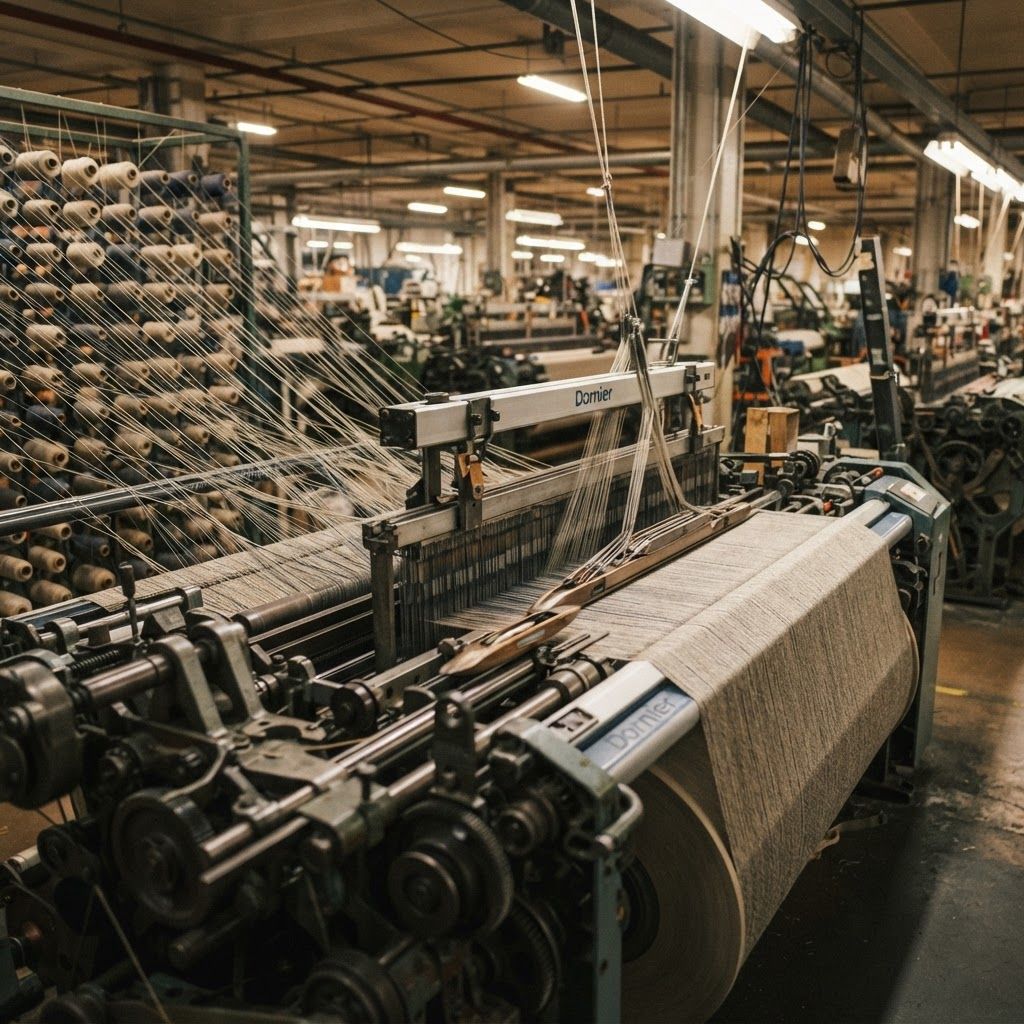
The Evolution of Textiles in Western New York
Buffalo was never a textile capital in the way New England or the Carolinas were, but the city developed a substantial garment and industrial fabric sector during the twentieth century, supported by rail access, immigrant labor and proximity to Canadian markets. Most commodity apparel production left North America decades ago. What remains in Western New York is more interesting: technical textiles, industrial fabrics, protective apparel, upholstery, filtration media, medical textiles and short-run custom manufacturing.
This shift reflects a broader economic logic. Domestic textile survival depends on characteristics offshore production cannot easily match, including short lead times, small minimum order quantities, engineering collaboration, regulatory compliance documentation and intellectual property protection. Buffalo manufacturers competing on those dimensions have generally done well.
Why Domestic Sourcing Is Growing Again
Several forces have improved the case for buying textiles domestically. Supply chain disruptions demonstrated the real cost of long, fragile logistics chains, and companies that lost entire seasons to shipping delays recalculated their risk assumptions. Rising labor costs in traditional low-cost countries have narrowed the price gap. Tariffs and trade policy volatility added uncertainty to landed cost planning.
Equally important, buyers now face genuine scrutiny on labor practices and environmental impact throughout their supply chains. Domestic production offers auditability that is difficult to achieve through multiple tiers of overseas subcontracting. For companies selling to government agencies, domestic content requirements make American production a contractual necessity rather than a preference.
Ten Textile Manufacturers and Producers
1. Niagara Lubricant and industrial textile suppliers illustrate the region's industrial fabric segment, supplying wiping cloths, filtration media, and specialty materials to manufacturers across Western New York. Industrial textiles are unglamorous but represent steady, technically demanding business.
2. Buffalo Batt and Felt has a long history in the region producing fiber batting, felt and cushioning materials used in furniture, bedding, automotive and industrial applications. Nonwoven materials manufacturing has proven more durable in North America than woven apparel production.
3. Sunbrella and marine fabric fabricators in the Buffalo area convert performance textiles into boat covers, awnings, patio furniture cushions and architectural shade structures. The Great Lakes boating market and Western New York's demanding weather sustain a real cut-and-sew fabrication trade.
4. Custom uniform and workwear manufacturers serving Erie County produce garments for healthcare systems, hospitality, municipal departments and industrial employers, often with embroidery, screen printing and inventory management services bundled in. Uniform programs favor domestic producers because reorder speed and consistency matter more than unit cost.
5. Confer Plastics adjacent fabric and composite operations reflect the increasingly blurred boundary between textiles and polymer composites in Western New York manufacturing. Coated fabrics, geotextiles and reinforced membranes sit at that intersection.
6. Upholstery textile suppliers serving regional furniture makers provide woven and coated fabrics for residential and contract furniture production. Contract furniture, meaning hospitality, healthcare and office seating, requires fabrics meeting demanding abrasion, flammability and cleanability standards.
7. Medical and protective textile converters in the region produce surgical drapes, barrier fabrics, wound care substrates and protective apparel components. This segment expanded substantially in recent years and involves rigorous quality systems and regulatory documentation.
8. Screen printing and apparel decoration companies across Buffalo operate as the finishing layer of the local apparel economy, serving sports teams, breweries, colleges and the region's substantial merchandise market. Many have added direct-to-garment and embroidery capability to serve very small orders profitably.
9. Independent cut-and-sew shops in Western New York handle prototype development and small production runs for designers and product companies. These shops are essential infrastructure for anyone bringing a soft-goods product to market, and they are increasingly scarce nationally.
10. Recycled textile processors and reclamation operations collect, sort and process post-consumer and post-industrial textiles into wiping cloths, insulation and fiber feedstock. Circular textile processing is a growth area driven by both regulation and genuine material economics.
Technical Capabilities Worth Understanding
Modern textile manufacturing involves far more than weaving and sewing. Coating and laminating add water resistance, breathability or barrier properties. Digital printing enables short runs and complex patterns without screen setup. Ultrasonic welding and heat sealing join synthetic materials without stitching, which matters for waterproof and medical applications. Automated cutting improves yield on expensive material.
Testing and certification are increasingly central. Flammability standards for furniture and children's products, abrasion resistance ratings for contract textiles, colorfastness testing, and chemical restriction compliance all require documentation. A manufacturer that can produce test reports and maintain traceability is worth more than one competing purely on price.
How to Source Textiles Locally
Begin with a clear specification. Fiber content, weight, construction, finish, performance requirements, colorway, and applicable standards should all be defined before requesting quotes. Vague specifications produce quotes that cannot be compared and samples that disappoint.
Ask about minimum order quantities, lead times for both first production and reorders, and tolerance for design changes mid-program. Request references from customers with similar volume, and if quality is critical, visit the facility. Walking a plant floor reveals organization, maintenance and quality culture in ways that a call cannot.
Discuss capacity honestly. Small manufacturers can be excellent partners but may struggle with sudden volume increases. Establishing expectations about growth, forecasting and inventory responsibility prevents the most common failure in domestic sourcing relationships.
Outlook for Buffalo Textiles
The sector will not return to its historical employment levels, and it does not need to in order to matter. The current trajectory favors technically specialized, compliance-heavy, quick-turn production, all of which suits Buffalo's cost structure, workforce and industrial infrastructure. Companies with genuine engineering capability and documented quality systems have real pricing power. For buyers in Western New York, the practical takeaway is that credible domestic textile partners exist locally, and the reasons to use them extend well beyond patriotism to speed, control and risk management.