
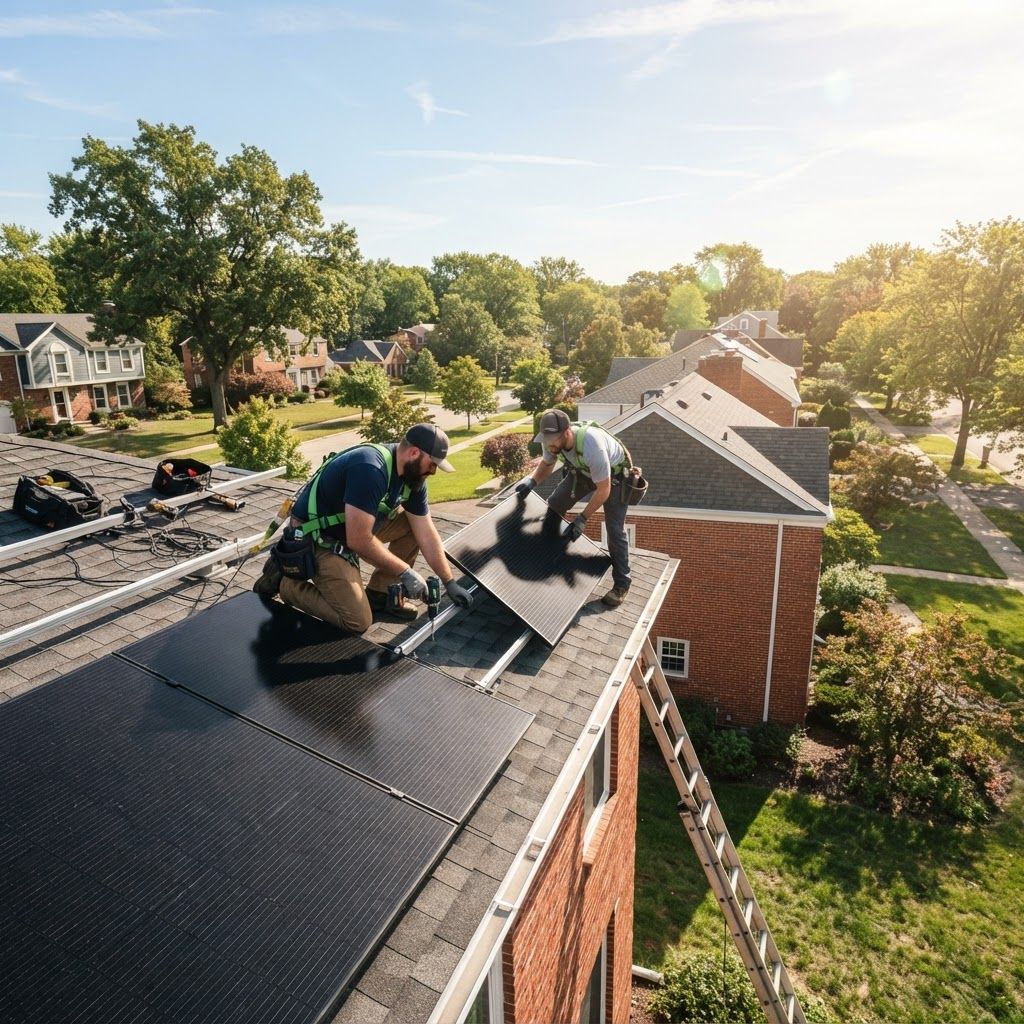
Solar Makes More Sense in St. Louis Than People Expect
A common misconception holds that solar only works in the desert Southwest. In practice, the St. Louis region receives solar resource comparable to much of Germany and Japan, two of the most successful solar markets in the world, and considerably better than most of the northern United States. Panels also operate more efficiently in cool temperatures, so crisp Midwestern spring and autumn days often produce excellent output.
What really determines project economics is the combination of solar resource, installed cost, electricity rates, rate structure, and incentives. In the St. Louis area, commercial customers with significant daytime load and demand charges frequently see the strongest returns, while residential returns depend heavily on roof orientation, shading, system cost, and financing terms. The market has matured to the point where these variables can be modeled with real confidence.
Understanding the Local Solar Landscape
The regional solar industry breaks into several distinct types of companies. Full-service residential installers handle sales, design, permitting, installation, interconnection, and service for homeowners. Commercial and industrial specialists design larger rooftop, carport, and ground-mount systems for warehouses, manufacturers, schools, faith communities, and municipal buildings, and they typically bring in-house engineering and structural analysis.
Utility-scale developers assemble land, secure interconnection, and build multi-megawatt arrays that sell power under long-term agreements. Electrical contractors with solar divisions serve as installation partners for developers and often perform the most technically demanding work. Finally, distributors, racking fabricators, and operations and maintenance providers support the entire chain.
Two additional participants shape the market. Community solar and subscription programs allow customers who cannot host panels to access solar output, and nonprofit and cooperative purchasing initiatives have periodically organized group buys that lower costs through aggregated volume. Both have expanded access considerably.
What Separates a Quality Installer
Design rigor comes first. A capable installer produces a shading analysis based on site measurement, models production with recognized software, verifies roof structure and remaining service life, evaluates the electrical service and panel capacity, and sizes the system to actual consumption rather than to available roof area. Oversizing to inflate a contract is a persistent problem in the industry and a reliable warning sign.
Installation quality shows in details that are easy to skip: proper flashing and penetration sealing, correct conductor sizing and conduit routing, neat and labeled equipment, appropriate grounding, and rapid shutdown compliance. Certification through the North American Board of Certified Energy Practitioners, licensed electricians on site, and manufacturer certifications for the specific equipment installed all signal seriousness.
Documentation and follow-through matter equally. The best companies handle permitting and utility interconnection paperwork completely, provide as-built drawings, register warranties, commission the system with documented testing, and set up monitoring before they leave. They also answer the phone two years later, which is when workmanship warranties actually get tested.
Financing and Incentives
Ownership structures drive economics as much as hardware. Cash purchase yields the highest lifetime return. Secured or unsecured loans preserve ownership of tax benefits while spreading cost. Leases and power purchase agreements shift ownership to a third party, which can suit organizations that cannot use tax credits, including nonprofits and public entities, though the long-term value captured is lower.
Federal investment tax credits, accelerated depreciation for business owners, utility rebates where available, and renewable energy certificate revenue all influence the model. Because incentive programs change, a trustworthy proposal separates guaranteed savings from incentive-dependent savings and states clearly which assumptions carry risk. Net metering rules and rate schedules deserve particular attention, since a change in how exported energy is credited can meaningfully alter payback.
How to Compare Proposals
Normalize every quote before comparing. Convert pricing to cost per watt, confirm module and inverter model numbers, compare production estimates in kilowatt-hours per year per kilowatt installed, and check whether degradation and inverter replacement are included in long-term projections. A proposal that promises higher output with the same equipment on the same roof is using optimistic assumptions, not better technology.
Read the warranty stack carefully. Modules typically carry separate product and performance warranties, inverters carry their own term, and workmanship warranties come from the installer. A long workmanship warranty from a company with a short operating history is worth less than a moderate one from an established firm. Ask about roof penetration warranties specifically, since leaks are the most common post-installation complaint.
Operations, Maintenance, and Long-Term Value
Solar systems are low maintenance but not no maintenance. Monitoring should be checked monthly, at least briefly, so that a failed optimizer or offline inverter does not go unnoticed for a season. Panels in the region generally clean adequately with rainfall, though sites near industrial dust or heavy tree cover benefit from periodic washing and trimming. Inverters remain the most likely component to require replacement within the system's life, and budgeting for that is a mark of realistic planning.
For commercial owners, integrating solar data with building management and utility billing analysis turns the array from a static asset into an operational tool, revealing load anomalies and demand spikes that create additional savings opportunities.
Choosing Confidently
The best solar energy companies in St. Louis are engineering-led, transparent about assumptions, meticulous in installation, and present long after commissioning. Get multiple quotes, insist on site visits rather than satellite-only designs for anything complex, verify licensing and insurance, and choose the company that explains the tradeoffs instead of only the upside. Solar is a twenty-five year decision, and the quality of the installer determines most of what happens in years three through twenty-five.