
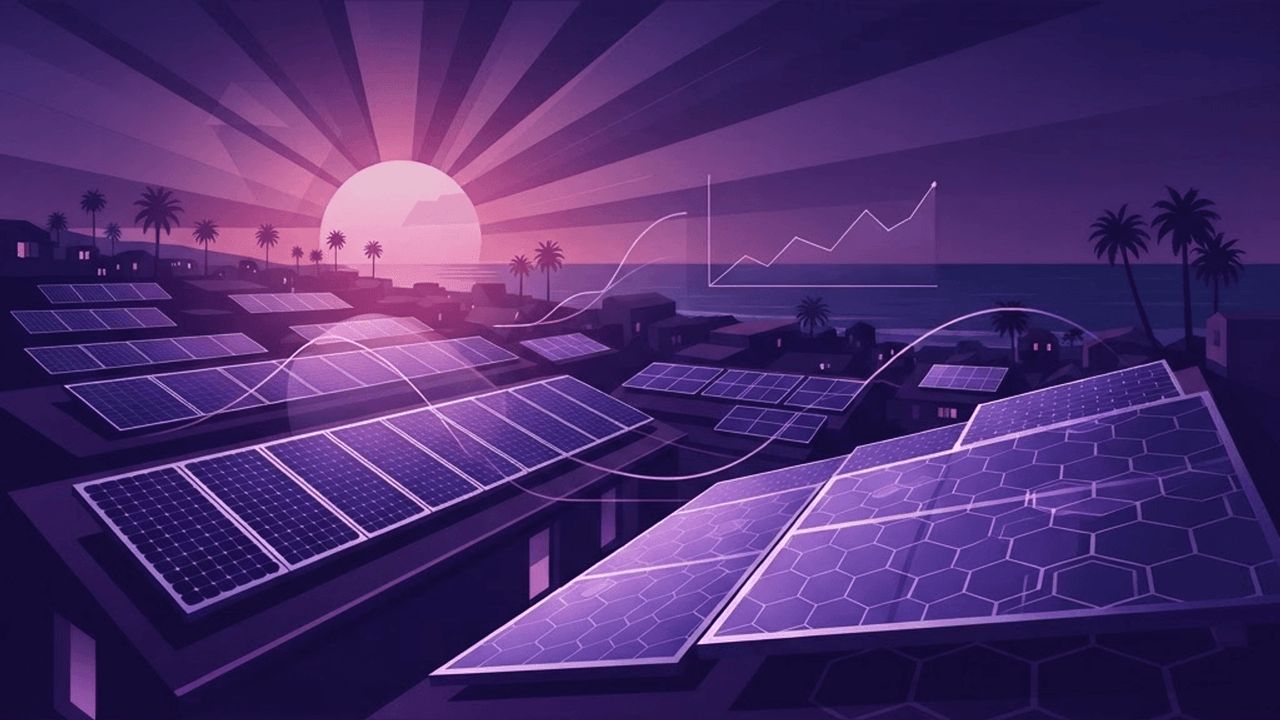
Why Solar Works Well in Oceanside
Oceanside receives strong, consistent sunlight across most of the year, and its moderate coastal temperatures actually help panel performance, since photovoltaic efficiency declines as cell temperature rises. The combination of high irradiance and mild ambient conditions produces output profiles that compare favorably with hotter inland locations.
Roof characteristics in the area vary considerably, from newer tract housing with large uninterrupted south-facing planes to older homes with complex rooflines, dormers, and mature tree shading. That variability makes site-specific assessment essential. Two neighboring properties can have materially different production potential.
Understanding What You Are Actually Buying
A solar installation consists of panels, inverters, mounting hardware, wiring, monitoring equipment, and increasingly a battery. Panels convert sunlight to direct current. Inverters convert that to usable alternating current, either as a single central unit or as microinverters and optimizers attached to each panel. Panel-level electronics cost more but perform better on complex or partially shaded roofs and simplify fault diagnosis.
Mounting and flashing quality determines whether the roof stays watertight for decades. This is the least glamorous part of the system and the most common source of long-term complaints. Workmanship warranty terms matter here far more than panel brand.
Ten Solar Companies Serving Oceanside
Sunline Coastal Solar handles residential installations end to end with in-house crews, and is known for detailed shading analysis and conservative production estimates that customers report meeting or exceeding.
Pacific Ray Energy focuses on premium residential systems using panel-level electronics, targeting complex rooflines where string inverter designs underperform.
Harborlight Solar Works serves small commercial properties, including retail buildings and light industrial facilities, with emphasis on demand charge reduction modeling.
Blue Horizon Photovoltaics specializes in solar plus storage packages, designing systems around self-consumption rather than grid export.
Seacliff Solar Contractors combines roofing and solar capability, which suits owners whose roof needs replacement before or during installation.
Mission Sun Systems works with multifamily and HOA-governed properties, navigating architectural review requirements and shared metering arrangements.
Tidewave Solar Installations offers ground-mount and carport structures for properties with unsuitable roofs or available open land.
Northgate Renewable Roofing integrates solar into new construction projects, coordinating with builders so conduit and structural provisions are handled before finish work.
Anchor Solar Service Group concentrates on maintenance, repair, and system takeover for customers whose original installer is no longer operating.
Coastline Energy Consultants provides independent system design review and proposal comparison for owners who want analysis separate from a sales relationship.
Trends Changing Solar Economics
Export compensation reform has been the single largest shift. Under earlier net metering rules, excess production was credited at or near retail rates, which meant system sizing simply tracked annual consumption. Current structures value exported energy considerably lower, so the economics now favor consuming your own production, ideally shifting it through storage into evening peak hours.
Battery costs have declined enough that pairing storage with new solar has become common rather than exceptional. Systems designed without considering storage readiness can be expensive to retrofit later, so even owners deferring batteries should ensure inverter compatibility.
Panel efficiency has continued improving, meaning a given roof area now supports meaningfully more capacity than it did several years ago. For space-constrained roofs, this has real consequences for whether a project pencils out.
How to Compare Proposals Intelligently
Normalize the comparison. Ask every bidder for annual production estimates in kilowatt-hours, system size in kilowatts, total installed cost before any incentives, equipment make and model for panels and inverters, and warranty durations for equipment, production, and workmanship separately.
Scrutinize production estimates that diverge significantly between bidders for the same roof. Optimistic modeling is the easiest way to make a proposal look better without changing anything physical. Ask what shading data and degradation rate each estimate assumes.
Understand the financing structure completely. Cash purchase, secured loan, unsecured loan, lease, and power purchase agreements produce very different long-term outcomes and different implications when selling the property. Dealer fees embedded in financed deals are often invisible in the quoted price.
Verify contractor licensing, confirm that the company performing installation is the company signing the contract, and check how service requests are handled after commissioning.
Maintenance and Long-Term Performance
Solar systems are low maintenance but not maintenance free. Coastal environments deposit salt and dust on panel surfaces, and periodic cleaning restores output that gradually declines between rainfalls. Inverters have shorter service lives than panels and should be treated as a mid-life replacement item in financial planning.
Monitoring is the practical safeguard. Systems fail quietly, and without production alerts an owner can lose months of output before noticing it on a utility bill. Confirm that monitoring is included, accessible to you directly, and configured to alert on underperformance.
Final Thoughts
Solar remains a strong investment for many Oceanside properties, but the quality gap between installers is wide and the cost of a poor installation compounds over decades. The companies described above span residential, commercial, storage-focused, roofing-integrated, and service specialties. Prioritize honest production modeling, solid workmanship warranties, and a company likely to be available when service is needed years from now.