
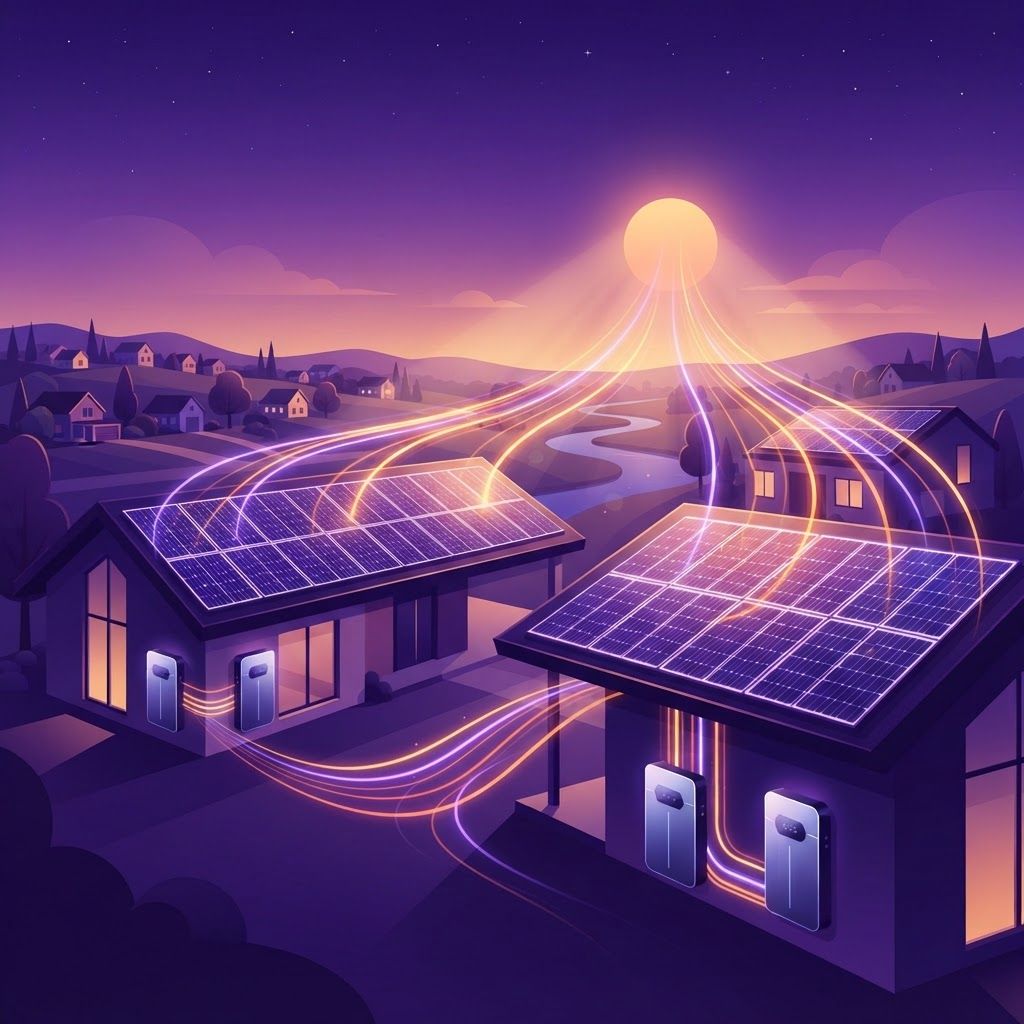
Solar Power as a Mainstream Choice
Solar energy has moved decisively from early-adopter technology to conventional home and business improvement. Equipment costs have declined dramatically over the past decade, panel efficiency has improved, installation practices have standardized, and financing options have multiplied. For many Clarksville property owners, the question is no longer whether solar works but whether their specific property and consumption profile make it worthwhile.
Middle Tennessee receives solar resource well within the range where photovoltaic systems perform economically. The region sees strong production through spring, summer and early autumn, with reduced but meaningful winter output. Systems are sized against annual consumption rather than any single month, and well-designed installations account for seasonal variation from the outset.
How Residential Solar Systems Work
A photovoltaic system converts sunlight into direct current electricity through semiconductor panels. An inverter converts that into alternating current usable by the property. Systems connect to the electrical panel and, in grid-tied configurations, to the utility connection.
Three main architectures exist. String inverter systems route multiple panels into a single central inverter, offering lower cost but reduced performance when any panel is shaded. Microinverter systems place a small inverter at each panel, maximizing output under partial shading and enabling panel-level monitoring. Power optimizer systems combine panel-level electronics with a central inverter as a middle option.
Mounting varies by installation. Roof-mounted arrays are most common and require assessment of roof age, material, structural capacity and orientation. South-facing surfaces produce most, with east and west orientations producing somewhat less but still often viable. Ground-mounted arrays suit properties with suitable land and allow optimal tilt and orientation independent of building geometry.
Battery storage can be added at installation or later. Storage enables backup power during outages, allows stored generation to be used in the evening, and provides protection against changing utility rate structures. It is worth noting that standard grid-tied systems without storage shut down during outages for safety reasons, which surprises many owners who assume solar automatically means backup power.
What Determines Project Economics
Consumption profile is the starting point. Reviewing twelve months of utility bills establishes annual usage and seasonal pattern. Systems are typically sized to offset a target percentage of that consumption rather than to fill available roof space.
Roof characteristics substantially affect output and cost. Orientation, pitch, available unshaded area, obstructions such as vents and chimneys, and remaining roof life all matter. Installing solar on a roof nearing replacement is a costly sequencing error, since panels must be removed and reinstalled.
Shading analysis is critical. Mature trees, neighboring structures and even a single chimney can reduce production meaningfully. Professional assessment measures shading across the full year rather than at a single moment.
Incentives and financing shape the net cost considerably. Federal tax credits have historically covered a significant portion of qualifying system cost, subject to eligibility and having sufficient tax liability to use them. Any utility programs, interconnection terms and available financing all require current verification, since these provisions change over time.
Equipment selection affects both cost and long-term value. Higher-efficiency panels produce more from limited roof area. Inverter quality and warranty length matter because inverters are typically the first component to require replacement. Mounting and flashing quality determines whether roof penetrations remain watertight for decades.
Evaluating Solar Installers
Verify licensing, insurance and certification. Confirm electrical contractor licensing, general liability and workers compensation coverage, and recognized installer certification. Ask whether installation is performed by employees or subcontracted crews, and who holds responsibility for workmanship issues.
Assess local track record. A company with years of completed installations in the Clarksville area, verifiable references and a physical local presence is far more likely to honor a workmanship warranty than an out-of-area operation that arrived recently.
Require a detailed written proposal covering system size, specific panel and inverter models, mounting method, estimated annual production with stated assumptions, total cost, incentive treatment, financing terms if applicable, warranty details, timeline and scope of permitting and interconnection work.
Compare quotes properly. Price per watt installed provides a useful normalization, but only when equipment quality and scope are comparable. A meaningfully cheaper quote usually reflects lower-tier components, subcontracted labor, or excluded items such as electrical panel upgrades.
Be alert to warning signs: pressure to sign immediately, production estimates far above competitors, claims about incentives expiring within days, vague warranty language, large upfront deposits, or reluctance to provide local references.
The Installation Process
A typical project follows a predictable sequence. After the initial consultation and bill analysis, the installer conducts a site assessment covering roof, electrical and shading conditions. A final design and proposal follows, then contract signing and financing arrangement.
Permitting and utility interconnection application come next and often account for much of the overall timeline. Structural and electrical permits are reviewed by local authorities, and the utility must approve the interconnection.
Physical installation is usually the shortest phase, frequently completed within one to three days for a residential system. Inspection by the local authority follows, then utility approval to operate, after which the system is commissioned and begins producing.
Owners should expect monitoring access showing production data, and should understand the maintenance requirement, which is minimal but not zero. Periodic visual inspection, occasional cleaning in dusty conditions, and keeping vegetation trimmed maintain output. Production monitoring is the best early warning of any component problem.
Commercial Solar Considerations
Businesses in Clarksville often achieve strong returns from solar because of large roof areas, daytime consumption aligning well with production, demand charge management opportunities and depreciation benefits. Warehouses, manufacturing plants, retail properties, churches and agricultural buildings are particularly well suited.
Commercial projects warrant a preliminary energy audit, careful attention to utility rate structure, and consideration of whether storage would reduce demand charges enough to justify inclusion.
Making a Confident Decision
Solar is a long-term infrastructure investment with a service life measured in decades, so the priority should be quality and durability rather than lowest initial price. Analyze your actual consumption, address roof condition first, obtain several detailed proposals, verify credentials and references independently, confirm incentive eligibility with a tax professional, and read warranty terms closely.
Clarksville property owners who approach solar methodically typically find a well-designed system delivers predictable savings, meaningful protection against rising electricity costs, and added property value, while requiring remarkably little attention once operating.