
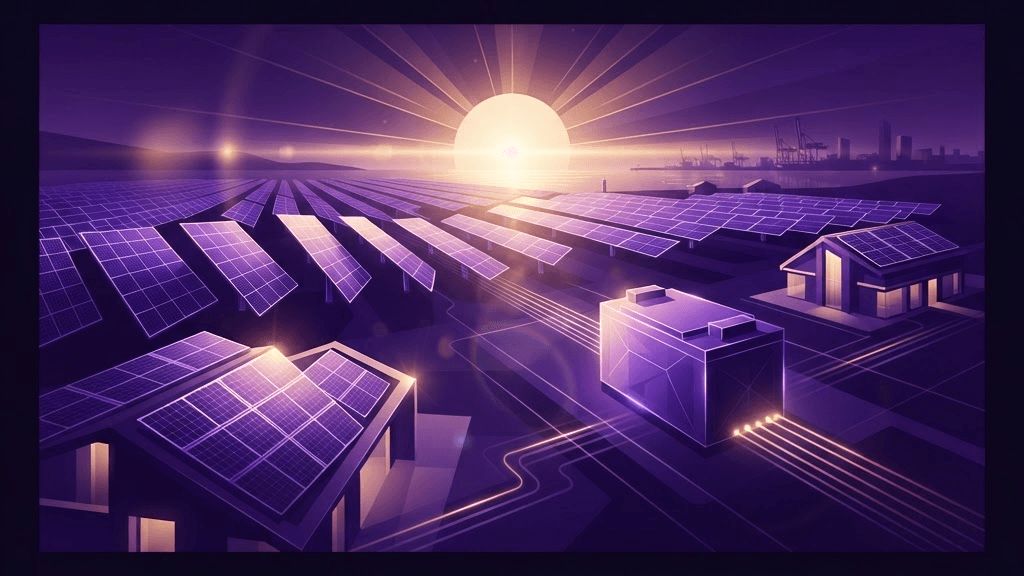
Why Solar Works in Charleston
South Carolina receives strong solar irradiance, and the Charleston region sees enough annual sunshine to support productive systems on well-oriented roofs. Electricity demand here is also cooling-driven, meaning consumption peaks during hot, sunny afternoons when solar production is highest. That alignment between production and demand improves the economics considerably compared with heating-dominated northern markets.
Beyond economics, resilience matters. Hurricane season brings outage risk every year, and a solar system paired with battery storage can maintain critical loads when the grid is down. Homeowners increasingly cite backup capability as a primary motivation rather than a secondary benefit.
The Top 10 Solar Energy Companies in Charleston
1. Alder Energy Systems
A South Carolina-based developer and installer with a strong commercial and utility-scale portfolio alongside residential work. Its engineering depth benefits complex installations and larger arrays.
2. Sunstore Solar
A Lowcountry installer known for custom system design, battery integration, and off-grid capability. It suits customers who want a technically tailored solution rather than a standard package.
3. Palmetto Solar
Operating across multiple states with South Carolina roots, this company combines residential installation with ongoing monitoring and service offerings, appealing to homeowners who value long-term support infrastructure.
4. Charleston Rooftop Solar Company
A local residential specialist focused on peninsula and suburban homes, with experience navigating historic district approvals and older roof structures that require additional engineering attention.
5. Coastal Commercial Solar Partners
Designs commercial rooftop and carport systems for warehouses, hotels, and manufacturing facilities, structuring projects around demand charge reduction and available tax treatment.
6. Lowcountry Solar and Storage
Emphasizes solar-plus-battery installations for resilience, including whole-home backup configurations and critical load panel design for hurricane preparedness.
7. Harbor Solar Engineering Services
Provides independent design, production modeling, and owner's representation for customers who want technical review separate from the selling installer. This service is particularly valuable on larger projects.
8. Tidewater Solar Maintenance and Repair
Services existing systems regardless of original installer, handling inverter replacement, panel cleaning, monitoring restoration, and repairs after storm damage. As the installed base ages, this segment is growing quickly.
9. Palmetto Ground Mount Solar
Specializes in ground-mounted arrays for rural and large-lot properties where roof constraints or shading make rooftop installation impractical.
10. Charleston Solar Finance Advisors
Focuses on financing structure, incentive qualification, and comparing purchase, loan, and third-party ownership options. Financing terms often affect lifetime value more than modest equipment differences.
How System Sizing Should Work
A credible proposal begins with twelve months of actual utility usage data, not an estimate. The installer should analyze consumption patterns, assess roof orientation and pitch, model shading throughout the year, and account for planned changes such as an electric vehicle or heat pump. Oversizing wastes capital because excess production is usually compensated at less favorable rates. Undersizing leaves savings on the table.
Ask what production modeling software was used and request the underlying assumptions about degradation, soiling, and system losses. Compare proposals on estimated annual production per installed kilowatt rather than on headline system size, which reveals meaningful differences in equipment and design quality.
Understanding Your Financing Options
Cash purchase delivers the best lifetime return and full ownership of incentives, but requires capital. Solar loans preserve ownership and incentive eligibility while spreading cost, though dealer fees are often embedded in low advertised rates; always compare the cash price against the financed price to identify the true cost of borrowing. Leases and power purchase agreements involve third-party ownership, requiring no upfront cost but transferring incentive benefits to the owner and introducing escalator clauses that should be examined carefully. Any third-party arrangement also creates considerations at the time of home sale.
Warranties and What They Actually Cover
Three separate warranties matter. The panel manufacturer warranty typically covers product defects and guarantees a production level over decades. The inverter warranty is shorter and is the component most likely to require replacement during system life. The installer workmanship warranty covers roof penetrations, wiring, and mounting, and is only as reliable as the installer's longevity. Ask specifically who pays labor costs for a warranty replacement, since a free part with expensive labor is a partial warranty at best.
Coastal Installation Factors
Salt air corrosion requires appropriate mounting hardware and component ratings. Wind load requirements in coastal South Carolina are stringent, and permitting will require structural documentation. Roof condition matters enormously: installing on a roof with fewer than ten years of remaining life means paying to remove and reinstall the array later, so replacing the roof first is usually the correct sequence. Flood-prone properties should locate inverters and batteries above expected water levels.
Red Flags When Evaluating Proposals
Be cautious of high-pressure sales tactics, particularly claims that an incentive expires imminently. Be skeptical of production estimates materially higher than competing bids for the same roof, since inflated modeling is a common sales tactic. Avoid companies unwilling to provide local references or proof of licensing and insurance. Read any document before signing, especially those presented on a tablet during a home visit, and never sign a contract that permits the price to change after a site survey without your approval.
Maintenance Expectations
Solar systems require little routine maintenance, but they are not maintenance free. Monitor production monthly and investigate unexplained declines. Expect pollen and salt film to reduce output modestly, with occasional cleaning worthwhile. Plan for inverter replacement at some point during system life. After any major storm, have the array inspected even if it appears undamaged.
Final Thoughts
Solar in Charleston is a sound investment when the system is properly sized, competently installed, and honestly financed. The difference between a good outcome and a disappointing one usually comes down to installer quality and realistic modeling rather than panel brand. Obtain at least three detailed proposals, compare them on production and total cost, and prioritize companies likely to still be operating when a warranty claim arises.