
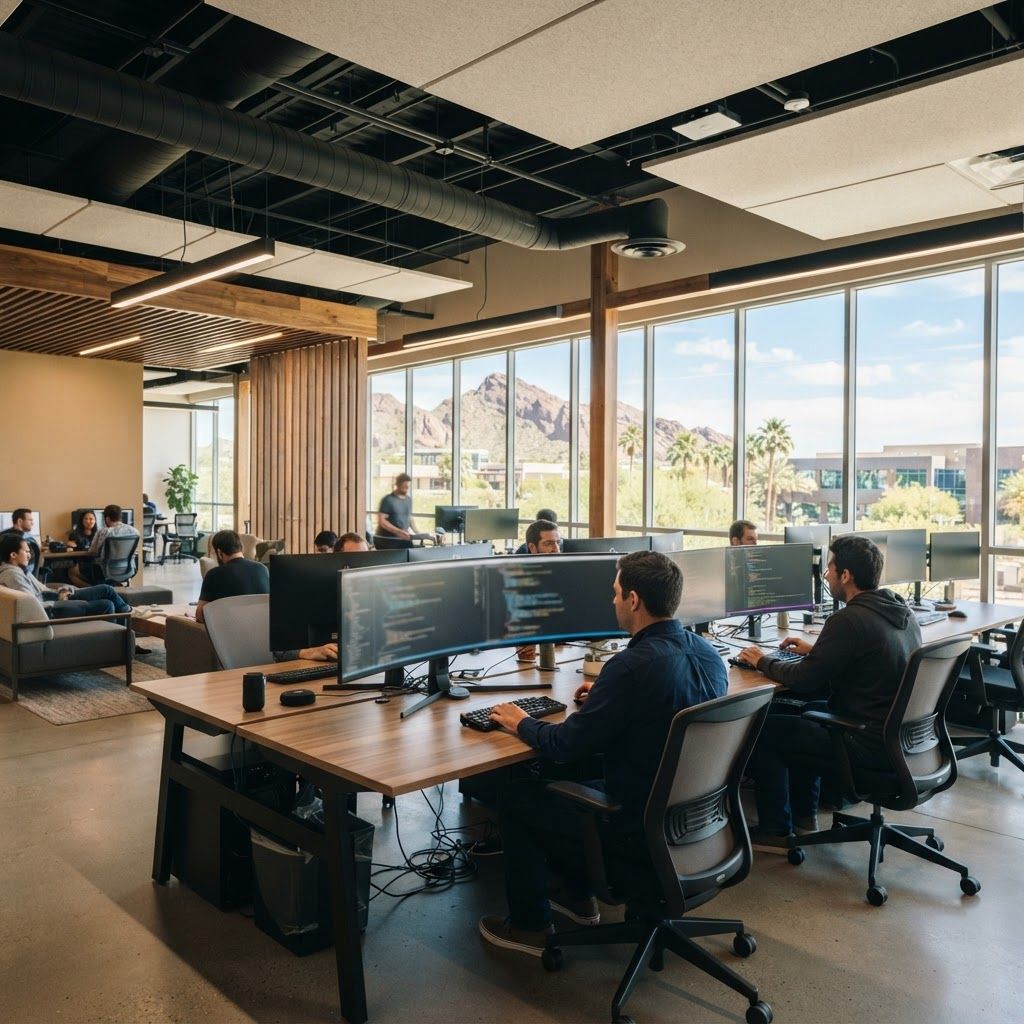
How Scottsdale Became a Technology Center
Scottsdale's emergence as a software hub was gradual and driven by fundamentals rather than incentives alone. Three factors did most of the work. Cost structure allowed companies to operate at materially lower expense than California or Seattle while paying competitive salaries, and no state-level barriers complicated relocation. Talent supply arrived through Arizona State University, which produces one of the largest engineering graduating classes in the country, supplemented by steady in-migration of experienced technologists. And quality-of-life factors, including climate, housing availability relative to coastal markets, and proximity to outdoor recreation, made recruiting from expensive metros unusually effective.
The Scottsdale Airpark district became the physical center of this growth, offering a dense concentration of office space, proximity to executive housing, and its own airport. North Scottsdale and the Scottsdale Quarter area followed, and the corridor now hosts everything from venture-backed startups to established enterprise operations.
The Sectors Driving Local Software Employment
Local technology activity concentrates in identifiable clusters. Financial technology is the largest, built on the Phoenix metro's substantial banking, lending, and payments operations, and it covers payment processing, lending platforms, insurance technology, and wealth management software. Healthcare technology follows, driven by regional hospital systems and a growing digital health sector working on care coordination, revenue cycle management, and patient engagement. Enterprise software and services covers customer relationship management implementations, enterprise resource planning integration, and vertical software for construction, hospitality, and automotive sectors. Real estate technology has grown alongside the region's development activity. And custom development and consulting firms serve businesses that need software built rather than bought.
Ten Software Companies in the Scottsdale Market
Axon, headquartered in Scottsdale, is the most globally recognized technology company in the city. Originally known for conducted energy devices, it has become substantially a software company, with its evidence management, digital records, and real-time operations platforms serving public safety agencies worldwide. Its engineering organization handles large-scale video infrastructure, machine learning, and cloud systems, and it functions as the anchor employer that legitimized Scottsdale as a serious technology location.
JDA Software, now operating as Blue Yonder, built a major supply chain software business from the Scottsdale area. Its planning, forecasting, and fulfillment platforms serve global retailers and manufacturers, and generations of local supply chain and enterprise software talent were trained in its organization.
Nextiva, based in Scottsdale, provides cloud communications and customer experience software serving small and mid-sized businesses. Its growth demonstrated that a Scottsdale company could build significant recurring revenue in a competitive software-as-a-service category.
Clearwater Analytics operations and comparable investment technology firms in the metro serve institutional investment accounting and reporting. Financial technology of this kind demands unusual precision and auditability, and the engineering culture reflects that.
Trainual, a Scottsdale company, builds documentation and onboarding software for small businesses. It represents the newer generation of Valley software startups: product-led, subscription-based, and focused on underserved small business needs.
Zenefits and comparable human resources technology operations maintaining Valley engineering presence handle payroll, benefits administration, and compliance, a category with high regulatory complexity that rewards deep domain knowledge.
Healthcare technology firms serving Valley hospital systems work on interoperability, clinical documentation, and revenue cycle platforms. These companies must handle protected health information under strict regulatory frameworks, which shapes both architecture and hiring.
Custom software development and consulting firms in the Airpark corridor build bespoke applications, integrations, and data platforms for regional businesses. The stronger ones specialize by vertical rather than positioning as generalists, which produces better outcomes for clients.
Real estate and construction technology companies serve the region's development sector with project management, bidding, field operations, and property management platforms. Proximity to actual construction activity gives these firms unusually good product feedback loops.
Venture-stage startups across the Airpark and North Scottsdale corridors round out the ecosystem, working across artificial intelligence applications, marketplaces, developer tooling, and vertical software. Local venture and angel capital has grown considerably, though most larger rounds still involve outside investors.
What the Market Means for Engineers
Compensation in Scottsdale generally sits below top-tier coastal markets while remaining well above national medians, and the cost-of-living differential typically favors Scottsdale on disposable income, though housing costs have risen substantially. The absence of state-level income tax advantages relative to California is a genuine factor in total compensation comparisons.
The technical environment skews toward cloud infrastructure, enterprise integration, data engineering, and increasingly machine learning applications. Fully remote and hybrid arrangements are common, which has both expanded local opportunity and increased competition from candidates elsewhere.
Choosing a Development Partner
Businesses hiring a Scottsdale software firm should evaluate on a few specific dimensions. Ask for architecture documentation from a past project, not just screenshots, because the quality of technical thinking is visible there. Confirm who owns the code and the repository, and insist on ownership transfer terms in writing. Establish how testing, deployment, and monitoring are handled, since firms that treat these as optional generate expensive maintenance burdens later.
Probe domain experience honestly. A firm that has built three systems in your industry will anticipate requirements that a generalist will discover expensively during development. Finally, discuss what happens after launch. Software requires ongoing maintenance, dependency updates, and security patching, and engagements that end at delivery leave clients with depreciating assets.
Scottsdale's software sector offers genuine depth for both employers and buyers. The talent is real, the cost structure remains favorable, and the presence of anchor companies has created an ecosystem that continues to compound.