
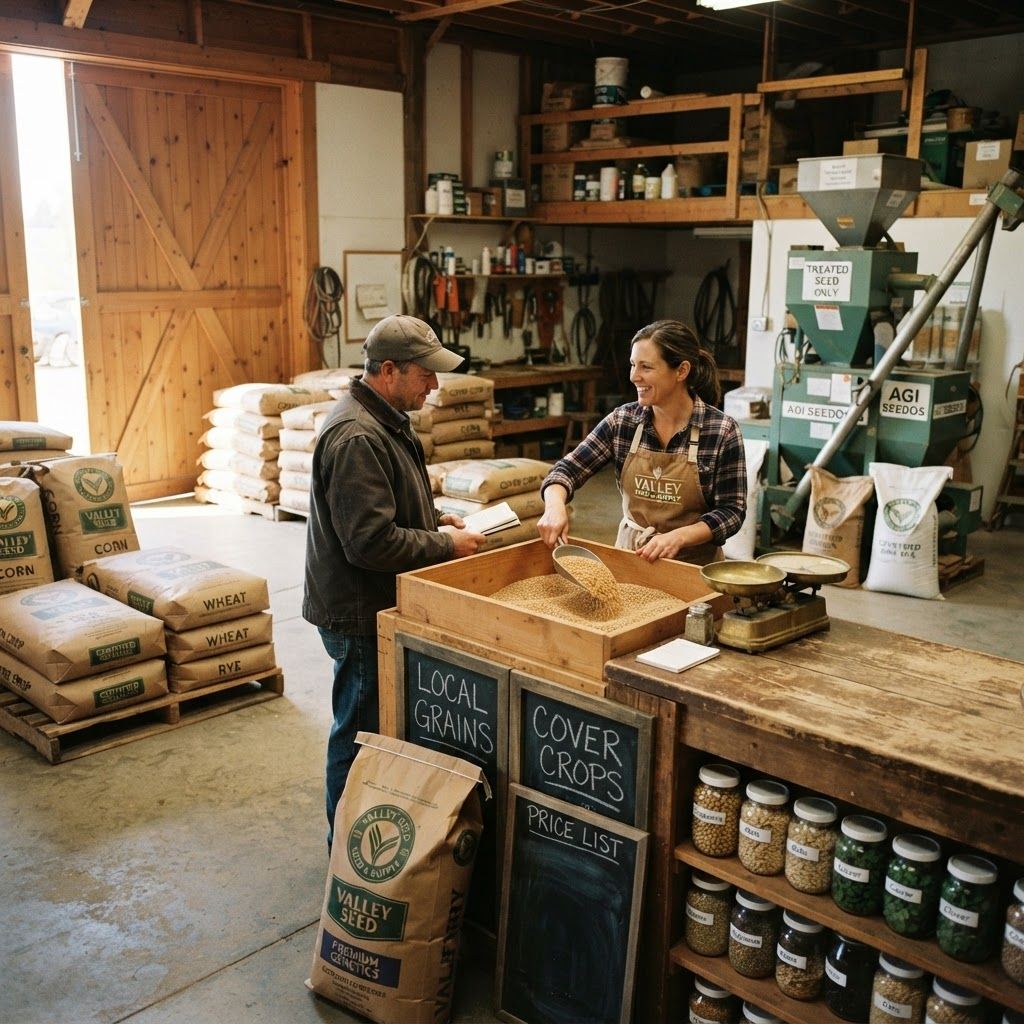
Every decision a grower makes downstream — fertility, spacing, pest management, harvest timing — is constrained by the seed chosen months earlier. In the Buffalo region, that decision is unusually consequential because the growing season is short, spring soils are cold and wet, and the lake moderates temperature in ways that vary substantially over just a few miles. A variety that thrives near the lakeshore may struggle twenty minutes inland.
Regional Growing Conditions and Seed Selection
Western New York growers work with roughly 150 to 170 frost-free days depending on proximity to Lake Erie and elevation. That range dictates maturity selection: corn hybrids must reach physiological maturity before killing frost, and vegetable varieties need to fit within a window that often opens late due to saturated spring fields.
Disease pressure is the other regional constraint. Humidity from the lakes favors foliar disease, so resistance packages matter more here than in drier climates. Late blight in potatoes and tomatoes, white mold in beans, and various leaf diseases in cucurbits all argue for genetics selected specifically for humid Northeast conditions rather than generic national varieties.
The Top 10 Seed Companies Serving Buffalo
1. Queen City Agricultural Seed Company
A regional commercial seed dealer offering corn, soybean and small grain genetics selected for Northeast maturity zones. Local plot trials give growers actual performance data from comparable soils rather than relying on national averages.
2. Niagara Vegetable Seed Supply
Focuses on commercial vegetable growers with varieties chosen for regional disease resistance, storage quality and market appearance. Sizeable range across brassicas, cucurbits, alliums and root crops with practical agronomic guidance.
3. Lakeshore Heirloom and Open-Pollinated Seeds
Specializes in heirloom and open-pollinated varieties, many regionally adapted through years of local seed saving. Popular with market gardeners and restaurant-focused growers seeking flavor and distinctiveness over shipping durability.
4. Erie Basin Cover Crop and Forage Seed
Provides cover crop mixes, forage grasses, alfalfa and pasture blends. As conservation tillage and soil health practices expand across the region, their custom mix formulation for specific goals has become increasingly valuable.
5. Buffalo Organic Seed Collective
Supplies certified organic seed for growers who require it, along with untreated conventional options. Certification documentation and clear treatment disclosure simplify compliance for certified organic operations.
6. Great Lakes Turf and Lawn Seed
Concentrates on turfgrass for lawns, athletic fields, golf courses and municipal spaces. Cool-season blends adapted to the region's freeze-thaw cycles, shade patterns and salt exposure along roadways.
7. Southtowns Native Plant and Wildflower Seed
Focuses on native prairie, meadow and pollinator seed mixes for restoration and landscaping projects. Locally sourced ecotypes establish more reliably than generic mixes and support regional pollinator populations.
8. Allentown Urban Garden Seed Exchange
Serves community gardens, school programs and city growers with small-packet seed, compact varieties and container-suitable selections. Educational support and seed library programs extend its impact well beyond sales.
9. Cheektowaga Greenhouse Plug and Transplant Seed
Supplies seed and started plugs to greenhouse growers producing bedding plants and vegetable transplants. Precision-graded and pelleted seed for automated seeding equipment improves plug uniformity noticeably.
10. Chautauqua Grape and Fruit Rootstock Nursery
Rather than annual seed, this operation supplies grape vines, fruit tree rootstock and berry plants suited to the lake belt. Certified virus-tested material protects the long-term productivity of perennial plantings.
How to Evaluate Seed Quality
Read the seed tag carefully. Germination percentage, purity, inert matter, weed seed content and test date are all disclosed there, and a test date more than a year old warrants questions about storage conditions. High germination on a recent test is the baseline for everything else.
Understand treatments. Fungicide and insecticide seed treatments protect against early-season pathogens and pests common in cold wet Buffalo springs, but they are incompatible with organic certification and may be unnecessary in warmer plantings. Pelleted seed improves precision seeding accuracy but shortens storage life. Ask specifically what a lot has been treated with.
Prioritize regional trial data. National yield claims are far less useful than performance from plots in similar soils and maturity zones. Any seed company genuinely committed to this market should be able to show local trial results and explain the maturity rating in the context of your specific field. Finally, diversify varieties rather than committing an entire operation to one genetic package, which spreads disease and weather risk meaningfully.
Trends in Seed and Genetics
Disease resistance breeding continues to accelerate, reducing reliance on fungicide programs. Interest in regionally adapted and locally bred varieties is growing among both commercial and market growers who find nationally distributed genetics poorly matched to Northeast conditions. Cover crop seed demand has expanded sharply alongside soil health adoption. Native and pollinator seed has moved from niche restoration work into mainstream landscaping specification. Seed saving and community seed libraries have also revived, preserving genetic diversity that commercial catalogs have gradually narrowed.
Final Thoughts
Seed is the cheapest input with the largest influence on outcome, which makes it the wrong place to economize. For Buffalo-area growers, prioritize maturity ratings that comfortably fit the local season, resistance packages matched to humid conditions, and suppliers who can produce regional trial data. Order early, since the best varieties sell out, and keep records of what performed well on each field. Over a few seasons that accumulated knowledge becomes more valuable than any catalog.