
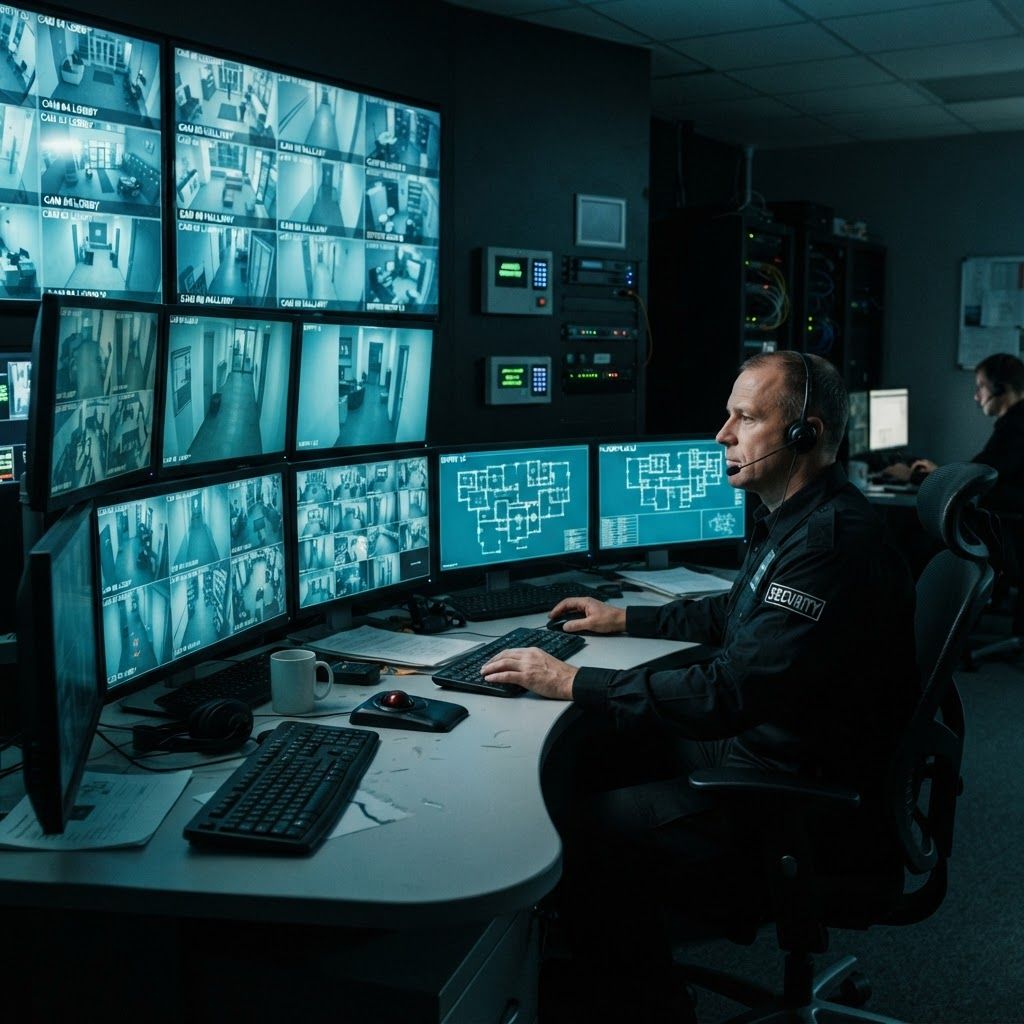
Security is a category where buyers are poorly positioned to evaluate quality. The service works invisibly when it works, failures are rare but consequential, and vendors compete partly on fear. That combination rewards providers who invest in marketing over capability. Buffalo's market includes genuinely strong operators alongside weaker ones, and telling them apart requires asking specific questions rather than comparing monthly rates.
The Buffalo Security Market
Local demand comes from several distinct directions. The region's healthcare systems and universities operate large campuses requiring layered physical security and regulated data protection. Manufacturing and logistics facilities need perimeter control and asset protection across large footprints. Retail and hospitality prioritize loss prevention and guest safety. Residential demand centers on monitored alarms and increasingly on camera systems. And cross-border commerce with Canada adds a compliance dimension around cargo and facility security that inland markets do not face.
New York State also licenses security guards and private investigators, meaning legitimate providers operate under a regulatory framework worth verifying rather than assuming.
The Top 10 Security Companies in Buffalo
1. Queen City Protective Services
Provides licensed uniformed and plainclothes guarding for commercial, industrial and event settings. Emphasis on documented training, supervision structure and incident reporting quality distinguishes them from providers competing purely on hourly rate.
2. Niagara Electronic Security Systems
Designs and installs access control, intrusion detection and video surveillance systems. Strong integration capability across platforms means facilities can consolidate multiple legacy systems rather than operating them separately.
3. Lakeshore Central Monitoring
Operates a monitoring center handling alarm, fire and video verification signals with redundant communication paths. Video verification significantly reduces false dispatches, which matters both for cost and for maintaining law enforcement responsiveness.
4. Erie County Cybersecurity Partners
Focuses on information security: network assessment, endpoint protection, incident response and compliance support for healthcare and financial clients. Physical and digital security have converged sufficiently that most organizations now need both.
5. Buffalo Event and Crowd Safety
Specializes in event security including access screening, crowd management, credentialing and emergency evacuation planning. Experience with the region's stadium, arena and festival events translates into realistic staffing plans.
6. Great Lakes Fire and Life Safety
Handles fire alarm systems, sprinkler monitoring, extinguisher service and code compliance inspection. Regulatory documentation and inspection recordkeeping are as central to the service as the equipment itself.
7. Southtowns Residential Alarm Services
Serves homeowners with monitored alarm systems, smart home integration, cameras and environmental sensors. Local installation and service technicians, rather than a national call center, is the practical differentiator.
8. Allentown Loss Prevention Consulting
Works with retail and hospitality operators on shrink reduction, internal theft investigation, procedure design and staff training. Addressing process weaknesses often reduces losses more than adding surveillance hardware.
9. Cheektowaga Facility Security Integration
Focuses on large industrial and warehouse sites with perimeter detection, gate control, license plate recognition and remote guarding via monitored cameras. Remote monitoring extends coverage across large sites more economically than additional patrols.
10. Buffalo Investigative and Risk Consulting
Provides licensed private investigation, background screening, workplace investigations and threat assessment. Valuable for employers handling sensitive personnel matters requiring documented, legally defensible process.
How to Evaluate a Security Provider
Verify licensing first. In New York, security guard companies and individual guards must be licensed and registered, and private investigators separately so. Ask for license numbers and confirm they are current. Also confirm insurance, specifically general liability and, where guards are involved, coverage for errors and assault or battery claims.
Ask about staffing reality rather than promises. Guard services live or die on turnover, supervision and training. Ask what the annual turnover rate is, how many supervisory visits occur per shift, what training hours are provided beyond the statutory minimum, and how post orders are documented. High turnover with minimal supervision produces a presence rather than protection.
Scrutinize technology contracts carefully. Alarm and monitoring agreements frequently include multi-year terms, automatic renewal, equipment ownership clauses and substantial early termination fees. Establish whether you own the equipment, whether the system can be monitored by another provider if you switch, and what happens at renewal. Proprietary equipment locked to one monitoring company reduces your leverage permanently.
Trends in Security Services
Remote guarding using monitored cameras with live intervention is displacing some physical patrol work, offering broader coverage at lower cost. Video analytics have improved substantially, reducing false alarms and enabling proactive rather than forensic use of footage. Cloud-based access control has simplified credential management across multiple sites. The convergence of physical and cyber security continues, since a networked camera system is also an attack surface. Privacy regulation is also tightening around biometric and video data, making compliance guidance part of the service rather than an afterthought.
Final Thoughts
Choosing a security provider in Buffalo should begin with license verification, insurance confirmation and honest questions about turnover and supervision. Read monitoring contracts closely for term length, equipment ownership and termination costs before signing. And recognize that most losses stem from process weaknesses rather than insufficient hardware, so a provider willing to examine your procedures is usually worth more than one selling additional cameras.