
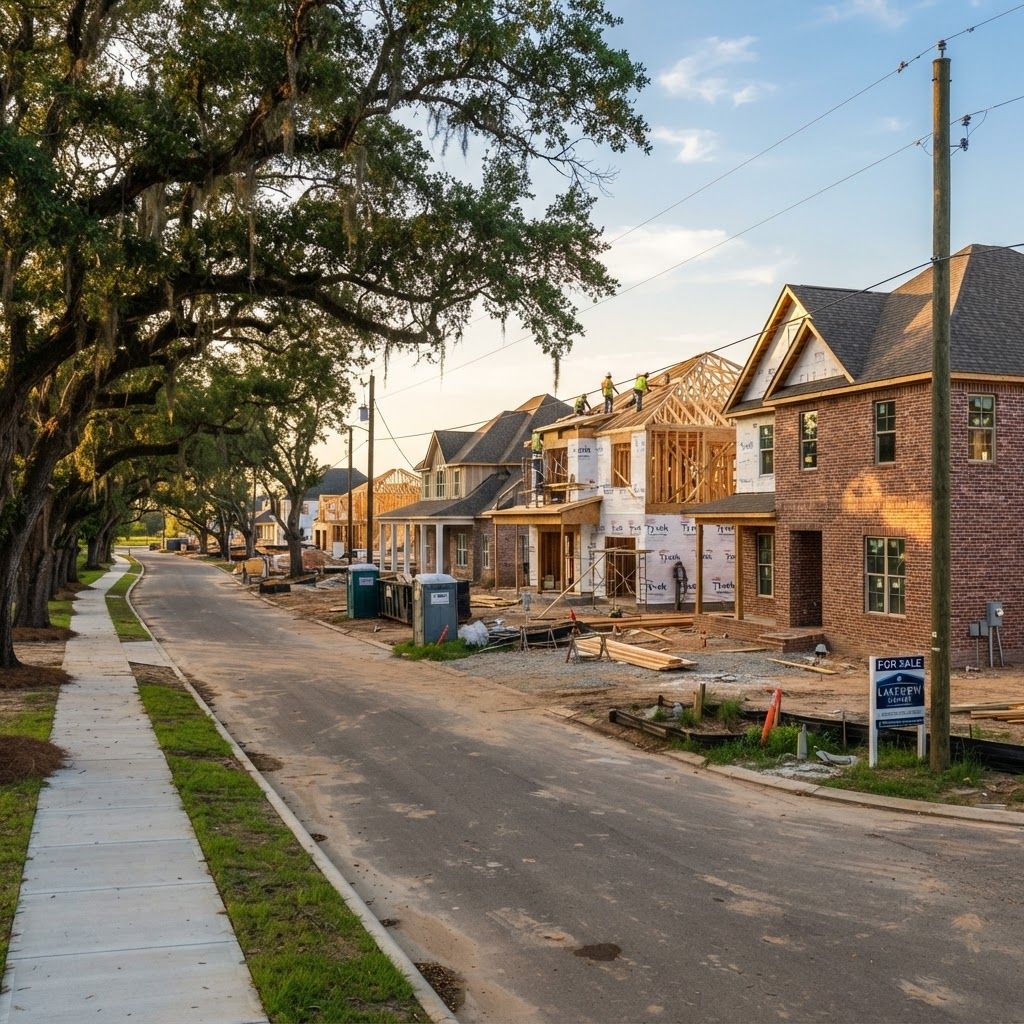
The Shape of Residential Development in Baton Rouge
Residential development in the Baton Rouge metro has been defined for two decades by outward pressure. Growth pushed southeast toward Ascension Parish, east along the Interstate 12 corridor, and north into Zachary and Central, chasing school district boundaries and available land. More recently, a countervailing trend has emerged: infill and redevelopment inside the city, particularly around Mid City, the Perkins corridor, and the downtown periphery, where buyers want shorter commutes and walkable amenities.
Two constraints now shape nearly every project. The first is drainage. After the 2016 flood, both parish regulators and buyers began scrutinizing elevation, detention capacity, and floodplain maps with a rigor that simply did not exist before. Developers who can document engineered drainage and elevated slabs command a real premium. The second is insurance. Rising property insurance costs in south Louisiana have squeezed affordability, pushing developers toward fortified roof standards and tighter building envelopes that qualify for premium discounts.
1. Level Homes
Level Homes is among the most recognizable residential builders operating across the Baton Rouge metro, known for design-forward floor plans and a strong emphasis on energy performance. The company has built extensively in master-planned communities and has leaned into third-party energy certification as a selling point — a meaningful differentiator in a market where summer cooling costs are a household line item.
2. Alvarez Construction Company
A long-established local builder, Alvarez Construction has developed a reputation for delivering solid value in the entry-level and move-up segments. The company operates across multiple subdivisions in East Baton Rouge and Ascension parishes, offering standardized plan libraries that keep costs predictable. For first-time buyers navigating financing, that predictability is often more valuable than customization.
3. DSLD Homes
DSLD Homes has become one of the highest-volume builders in the region, with an operating model built on rapid delivery and consistent specifications. Its subdivisions are visible throughout Ascension, Livingston, and East Baton Rouge parishes. The company's scale gives it purchasing leverage on materials, which has helped it hold price points during periods of volatile construction costs.
4. Manning Family Companies
Known for developing distinctive residential communities in the greater Baton Rouge area, this developer emphasizes neighborhood character over sheer unit count. Projects typically feature curated streetscapes, green space, and architectural guidelines that protect long-term resale values. Buyers seeking a community with enforceable design standards often look here first.
5. Rouzan Development
Rouzan represents Baton Rouge's most visible experiment in traditional neighborhood development — a walkable, mixed-use community inside the city on Perkins Road. Narrow lots, front porches, alley-loaded garages, and a village center reflect New Urbanist planning principles rarely executed at this scale in Louisiana. The project has become a reference point for infill development debates across the parish.
6. Long Farm Village
Long Farm Village is a master-planned community that blends single-family homes, townhomes, and shared amenities on a large tract in southeast Baton Rouge. Its appeal lies in variety: buyers at several price points can stay within the same community as their needs change, and the amenity package — trails, pools, gathering spaces — is shared across product types.
7. Conrad Development
Conrad Development focuses on residential subdivisions with an emphasis on lot engineering and infrastructure quality. In a market increasingly sensitive to drainage, developers who invest early in detention ponds, elevated pads, and properly sized stormwater systems earn credibility with both regulators and buyers. This developer's projects are frequently cited in that context.
8. Sunrise Homes and Custom Builders
Operating in the semi-custom space, this builder serves buyers who want meaningful input on layout and finishes without commissioning a fully custom architect-led home. The model works well for growing families with specific needs — multi-generational suites, home offices, or accessibility features — that stock plans do not accommodate.
9. Cottages at Nicholson
Student and workforce housing is an underappreciated pillar of Baton Rouge residential development, driven by LSU's enrollment. Developments along the Nicholson Drive corridor have transformed a formerly industrial stretch into dense residential product, and the model has since influenced how developers think about rental-oriented residential projects near campus.
10. Highland Custom Homes
At the top of the market, custom builders serve clients developing individual lots in established neighborhoods like Bocage, Country Club of Louisiana, and Southdowns. Work here is architecture-led, with attention to elevation, hurricane resilience, generator integration, and high-performance mechanical systems. These builders often set the technical standards that production builders adopt years later.
Trends Driving New Residential Construction
Lot supply is the binding constraint. Developable land inside East Baton Rouge Parish with adequate drainage and sewer capacity has grown scarce, which explains both the migration to surrounding parishes and the renewed interest in infill. Expect continued growth in townhomes and small-lot detached housing as developers seek density that appraises well.
Resilience has moved from marketing language to engineering requirement. Fortified roof designations, elevated finished floors, impact-rated glazing, and whole-home generator prewiring now appear in mid-market specifications, not just luxury builds, largely because insurers reward them. Meanwhile, build-to-rent has entered the Baton Rouge market, with developers constructing entire subdivisions as rental communities — a response to affordability pressure and buyers priced out of ownership.
How to Evaluate a Residential Developer
Visit a community the developer completed five or more years ago, not just the model home. Drainage performance, streetscape maintenance, landscaping maturity, and resale activity tell you more than any brochure. Ask specifically about finished floor elevation relative to the surrounding grade and the flood map, and request documentation rather than reassurance.
Review the homeowners association structure, reserve funding, and design covenants before signing. Ask about warranty terms, who services them, and how long the developer has operated under its current ownership. Finally, talk to residents. In a market as relationship-driven as Baton Rouge, word of mouth from people who have lived through a warranty claim is the most reliable data available.
Final Thoughts
Baton Rouge's residential development market rewards developers who take water seriously, build for insurability, and offer product diversity as household needs shift. Whether the goal is a first home in Ascension Parish, a walkable infill townhome, or a custom build on an established lot, the region's developers offer genuine range — provided buyers do the diligence that south Louisiana demands.