
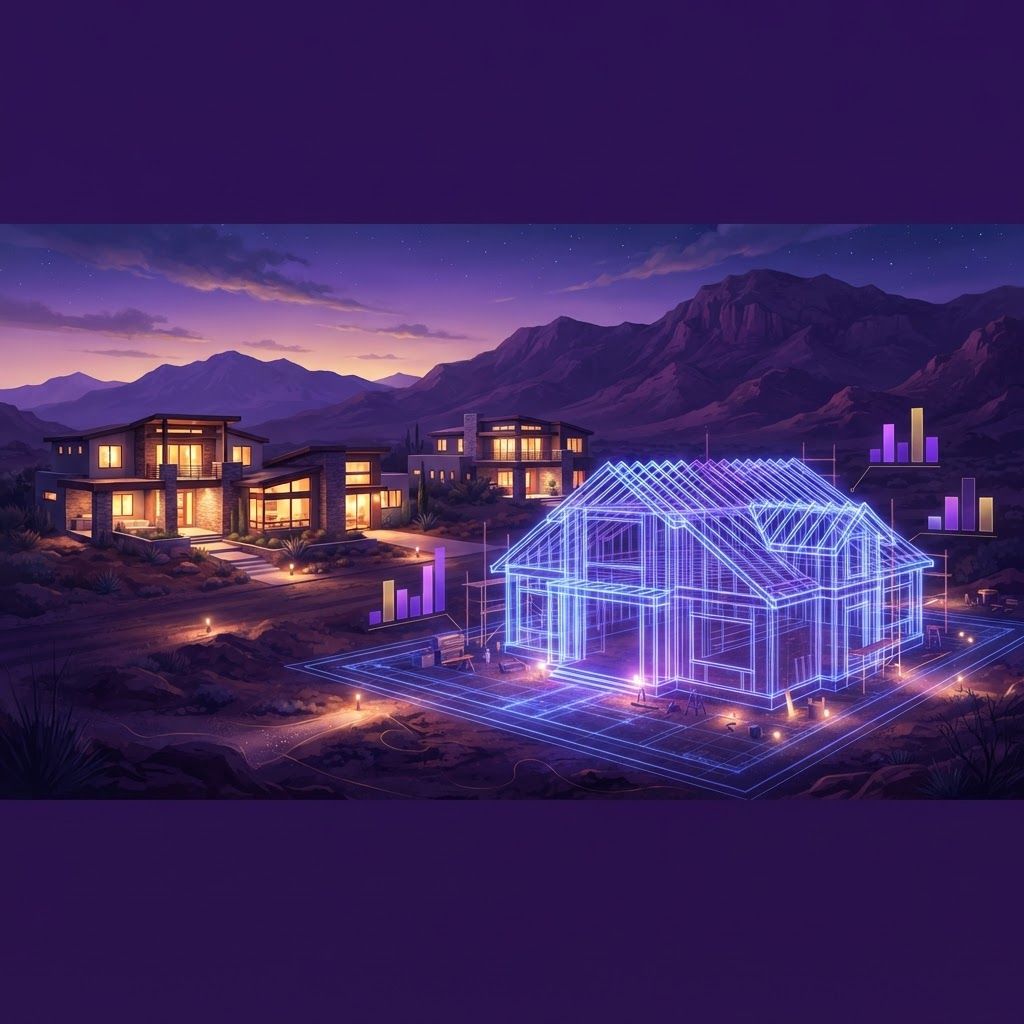
Residential Building in a Desert Valley
Home construction in Sunrise Manor is governed by conditions that differ meaningfully from most of the country. Expansive and collapsible soils are common across the valley, making geotechnical investigation and engineered foundation design a genuine necessity rather than an optional expense. Cooling loads rather than heating loads drive energy design, which shifts emphasis toward roof assembly performance, glazing orientation, shading, duct sealing, and high-efficiency mechanical equipment.
Water conservation requirements shape landscaping and plumbing fixture choices. Flash flood risk influences site grading and drainage design even though annual rainfall is minimal. And the summer construction calendar imposes real scheduling limits, since concrete placement, roofing, and exterior finishing all become difficult or unsafe during peak afternoon heat.
Builders who have absorbed these realities produce homes that stay comfortable and structurally sound. Those applying generic national practices produce homes that struggle within a few years.
What Distinguishes a Quality Residential Builder
Start with proper state licensing in the correct classification with an adequate monetary limit, plus current liability and workers compensation coverage. Then look at engineering discipline. A builder who commissions a soils report and follows the resulting foundation recommendations is protecting you from the most expensive category of future failure.
Specification clarity is the next marker. Strong builders provide detailed specifications naming actual products for windows, insulation, roofing, mechanical equipment, and finishes, with allowances stated in dollar amounts. Vague specifications are where budgets quietly expand.
Finally, examine warranty structure and service responsiveness. A written warranty covering workmanship for at least one year, mechanical systems for two, and structural elements for ten is a reasonable expectation, and the builder's willingness to return for warranty items says a great deal about how they operate.
Leading Residential Construction Companies
Manor Custom Homes builds fully custom residences with in-house design coordination, engineered foundations, and a specification process that documents every product selection before construction begins.
Desert Ridge Residential Builders focuses on semi-custom homes on infill lots, an increasingly important niche as available land tightens. Their expertise in navigating irregular parcels and existing utility constraints is notable.
Eastside Home Construction handles large-scale additions, second-story expansions, and whole-home reconstruction, work that demands careful structural evaluation of existing framing and foundations.
Valley Energy Efficient Homes specializes in high-performance building envelopes, advanced framing, spray foam and radiant barrier systems, and mechanical designs that substantially reduce summer cooling costs.
Nellis Family Builders serves buyers seeking predictable pricing on well-specified plans, with a fixed-price contract model and transparent change order pricing.
Sahara Accessory Dwelling Construction concentrates on guest houses, casitas, and accessory units, a growing segment driven by multigenerational households and rental demand.
Charleston Modular and Panelized Homes uses factory-built components to compress on-site schedules and reduce weather exposure, an approach that works particularly well during summer months.
Sunrise Barrier Free Builders focuses on accessible design, including single-level layouts, roll-in showers, wider doorways, and aging-in-place modifications planned from the outset rather than retrofitted.
Boulder Highway Rebuild Specialists handles reconstruction after fire or water loss, coordinating with insurers while bringing older homes up to current code.
Lamb Boulevard Residential Group completes the list with a focus on investor and rental property construction, emphasizing durable finishes and low maintenance requirements.
Current Trends in Residential Construction
Energy performance has moved from marketing claim to measured requirement, with blower door testing and duct leakage verification now routine. Homeowners increasingly request solar readiness, including conduit pathways and electrical panel capacity, even when deferring panel installation.
Multigenerational design is reshaping floor plans, with demand for secondary suites, separate entrances, and flexible spaces that can serve as offices or bedrooms. Water-wise landscaping is now standard rather than optional, driven by both regulation and cost.
Material and labor cost volatility has pushed builders toward earlier procurement and longer lead time planning, which is why realistic builders quote longer schedules than they did several years ago.
Managing Your Build
Invest in thorough planning before breaking ground. Changes made on paper cost a fraction of changes made in the field, and the most expensive projects are almost always the ones that started before decisions were finalized.
Obtain a geotechnical report and ensure the foundation design responds to it. Confirm that permits are pulled in the contractor's name, which keeps code responsibility with the professional rather than with you.
Structure payments against verified milestones and hold meaningful retention until final inspection and punch list completion. Require lien waivers with every disbursement. Consider hiring an independent inspector at key stages, particularly foundation, framing, and pre-drywall, since a few hundred dollars spent on verification can prevent very costly concealed defects.
Walk the site frequently and keep a written log of questions and answers. In Sunrise Manor, the homeowners who end up satisfied are consistently those who treated construction as an active partnership rather than a delegated task.