
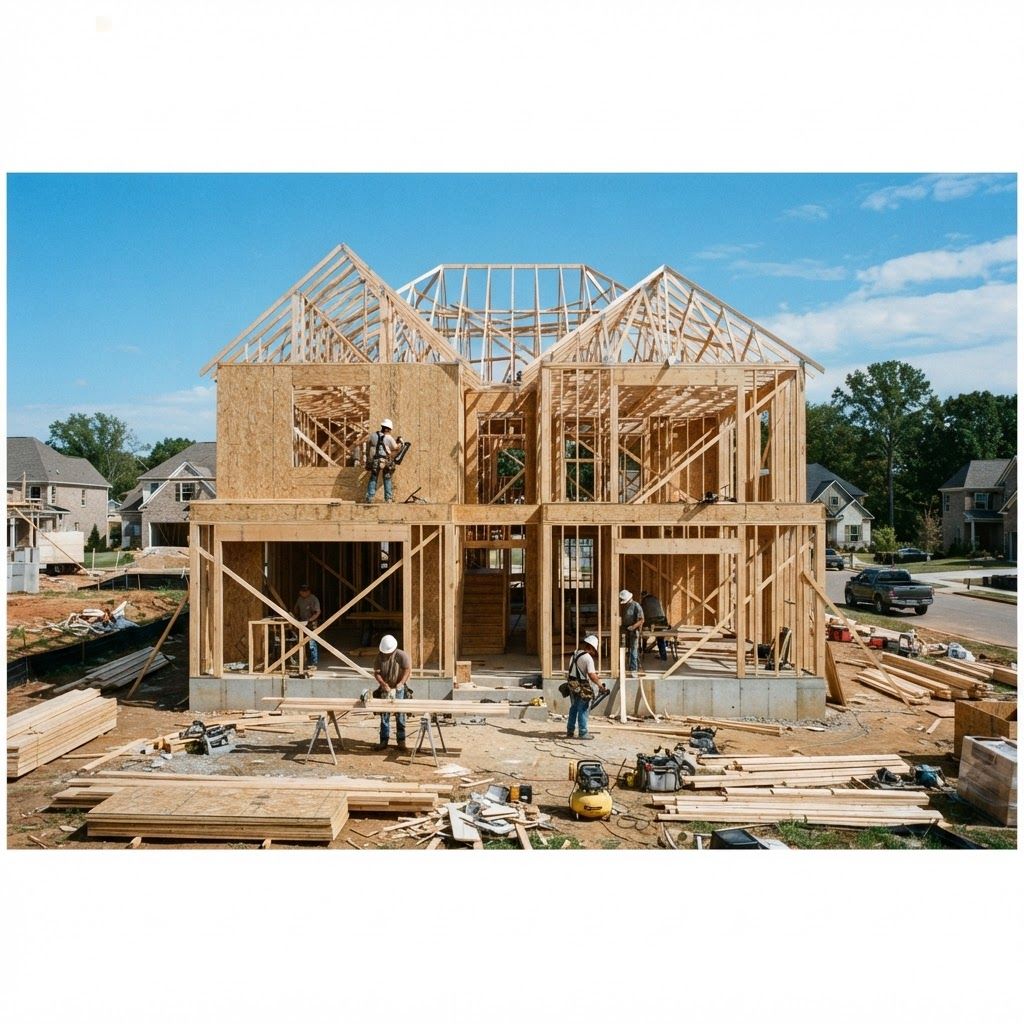
The St. Louis Residential Building Market
Residential construction in the St. Louis metro area covers an unusually wide range of work. In St. Charles County and Wentzville, production builders deliver large volumes of semi-custom homes on subdivision lots. In Ladue, Clayton, Frontenac and Kirkwood, custom builders execute one-off architectural homes on infill or teardown sites. In the city itself, builders work within historic districts where facade requirements, party walls and century-old foundations govern what is possible. A company that excels in one of these environments does not automatically excel in another.
Local conditions shape the work. Much of the region sits on expansive clay soils that swell and shrink with moisture, which makes foundation design, drainage and grading disproportionately important. Freeze-thaw cycling stresses masonry and flatwork. Summer humidity makes envelope detailing and mechanical sizing consequential. Experienced St. Louis builders account for all of this as a matter of routine; newcomers frequently do not.
Understanding the Three Builder Models
Production builders work from a defined library of plans with structured option packages. The advantage is predictable pricing and schedule; the tradeoff is limited flexibility. Semi-custom builders start from a base plan and allow meaningful structural modification, which suits families who want individuality without a full design process. True custom builders begin with a blank site and an architect, offering complete control at higher cost and longer timelines.
A fourth model deserves mention: design-build. Here a single company carries both design and construction responsibility, which eliminates the finger-pointing that occurs when drawings and field conditions conflict. For complex sites or additions, design-build often produces the smoothest process.
Ten Leading Residential Construction Companies
1. Fischer & Frichtel has built across the St. Louis region for generations and remains one of the most recognizable local homebuilders. Its strength is semi-custom work at scale, with established communities in St. Charles and West County and an option process that gives buyers real structural choices while keeping pricing legible.
2. McBride Homes is among the highest-volume builders in the metro area, with a business model built on standardized plans, controlled costs and included features rather than long option lists. For first-time buyers and families prioritizing value and delivery certainty, it is a natural starting point.
3. Payne Family Homes occupies a middle position, offering personalization beyond typical production builders while maintaining disciplined scheduling. The company has developed a reputation for responsive selections guidance, which matters more than buyers expect once finish decisions begin.
4. Hibbs Homes focuses on custom and high-performance residential construction, including energy-efficient and healthy-home building practices. The company is a reasonable first call for owners who care about envelope performance, indoor air quality and long-term operating costs rather than square footage alone.
5. Simon Homes builds custom residences in West County and surrounding communities with an emphasis on architectural detail and craftsmanship. Its work tends to appeal to owners who arrive with an architect and a clear design intent.
6. Mosby Building Arts is best known for renovation and addition work but functions as a full residential construction resource with in-house design and a diagnostic approach to existing structures. For homeowners in established St. Louis neighborhoods, that combination is genuinely valuable.
7. Consort Homes serves St. Charles County and surrounding growth corridors with semi-custom homes and a structured build process. The company has invested in customer communication systems, which reduces the information gaps that frustrate buyers during construction.
8. Rolwes Company has a long track record in the region's suburban markets, delivering single-family homes and villa communities. Its villa and low-maintenance products suit downsizing buyers, a growing segment across the metro area.
9. Bridgewater Communities builds custom and luxury homes with attention to site planning and neighborhood character. The company works comfortably on individual lots as well as within its own developments.
10. Kingsbridge Homes handles custom residential construction and substantial whole-house projects, with a smaller portfolio that allows closer principal involvement. Owners who want direct access to decision makers throughout the build often prefer this scale of firm.
How to Evaluate a Residential Builder
Start with completed homes rather than model homes. Model homes are built to sell; a home finished two years ago and lived in tells you how the builder's details hold up. Ask to see a project currently under construction as well, since site organization, framing quality and moisture protection during the build are visible only mid-process.
Scrutinize the contract's allowance structure. Low allowances for flooring, cabinetry, lighting and plumbing fixtures create the appearance of a competitive base price and then generate change orders. A builder who sets realistic allowances is quoting the house you will actually receive.
Confirm licensing and insurance appropriate to the municipality, since requirements vary across St. Louis City, St. Louis County and the individual municipalities within it. Verify general liability limits and workers compensation coverage for the builder and major subcontractors.
Site and Soil Considerations
Because of the region's clay soils, ask specifically how the builder handles foundation drainage, backfill, final grading and downspout discharge. Proper perimeter drainage, adequate positive slope away from the foundation and extended downspout runs prevent the majority of basement moisture complaints in this market. Builders who treat grading as an afterthought produce homes that generate service calls for years.
Radon is common in eastern Missouri geology, and passive radon-resistant construction is inexpensive at the build stage and costly to retrofit. A builder who proposes it without being asked is demonstrating regional competence.
Budgeting and Timeline Realities
Material and labor pricing has stabilized relative to peak volatility but remains higher than pre-2020 baselines. Sensible practice is to hold a contingency of roughly five to ten percent of contract value for custom work, less for production builds where scope is fixed. Timelines for semi-custom homes commonly run six to nine months from permit; custom homes on complex sites frequently exceed a year once design time is included.
Financing structure matters. Construction-to-permanent loans require draw schedules aligned with the builder's billing, and inspection requirements can affect cash flow. Builders experienced with local lenders manage this coordination smoothly.
Final Perspective
The best residential construction company in St. Louis is the one whose model matches your project. A family seeking predictable value in St. Charles County is served well by a high-volume builder with strong included features. An owner building an architect-designed home on a difficult West County lot needs a custom builder with real problem-solving depth. Interview at least three companies in the same category, compare contracts line by line rather than by bottom-line price, and weight communication quality heavily. Construction is a months-long relationship, and how a builder answers questions during the estimate is a reliable preview of how they will answer them during framing.