
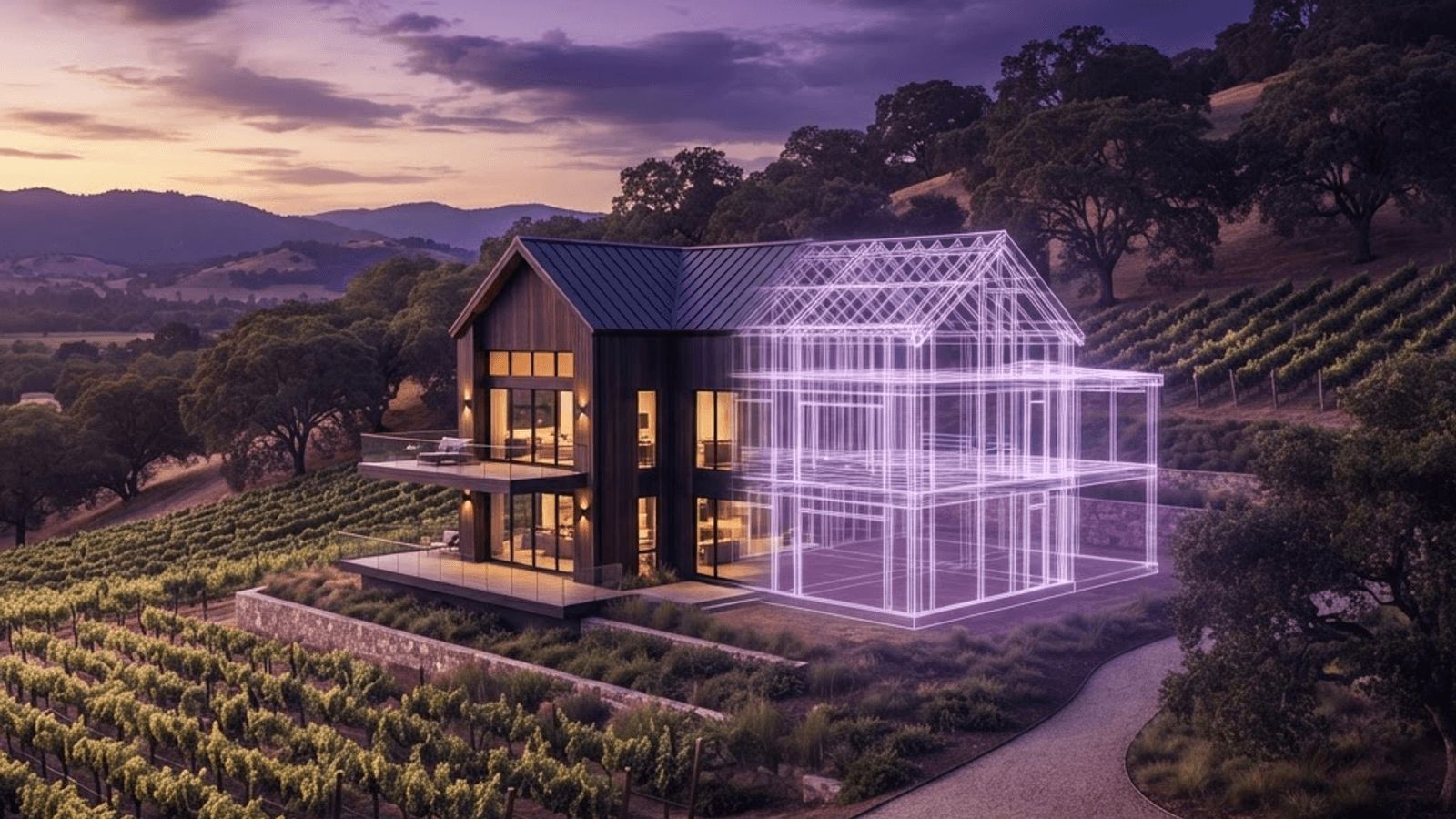
Residential Construction in Sonoma County Today
Home building in Santa Rosa operates under conditions that distinguish it from most American markets. California's energy standards require high-performance envelopes, efficient mechanical systems, and solar generation on most new residential construction. Wildland-urban interface requirements govern exterior materials, roofing assemblies, vent design, and defensible space across large portions of the county. Seismic design standards shape foundations and lateral bracing. And land costs mean that construction quality directly determines whether a project makes financial sense.
These conditions reward experienced builders and punish inexperienced ones. Understanding the segments within residential construction helps homeowners match a builder to their specific project.
1. Custom Home Builders
Custom builders construct one-of-a-kind homes designed for a specific client and site. They coordinate with architects and engineers from the earliest stages, manage extended permitting processes, and handle the site-specific challenges common on Sonoma County parcels: slope, drainage, access, well and septic systems, and utility extension. Custom work carries the longest timelines and highest per-square-foot costs, but produces exactly what the owner specified.
2. Semi-Custom and Production Builders
Semi-custom builders work from proven plan sets with selectable finishes and modest layout modifications. The model reduces design cost and construction risk because the builder has constructed the plan before and knows its real cost. For buyers who want a new home without a multi-year design process, this approach delivers strong value.
3. Whole-House Remodel Contractors
Sonoma County's existing housing stock includes substantial mid-century inventory with dated layouts, inadequate insulation, and original mechanical systems. Whole-house remodelers reconfigure floor plans, upgrade building envelopes, replace systems, and modernize finishes. Done well, comprehensive remodeling delivers new-home performance at a lower total cost than demolition and rebuilding, while preserving established neighborhood character and mature landscaping.
4. Home Addition Specialists
Additions require careful structural integration with existing construction, foundation matching, roof tie-ins that shed water correctly, and exterior finish blending. Specialists in this work also manage the code upgrade triggers that additions often activate, since expanding a home can require bringing existing systems up to current standards.
5. Accessory Dwelling Unit Builders
Accessory dwelling units have become one of the most active residential segments in California. Builders specializing in these projects handle detached cottages, garage conversions, and attached units, navigating streamlined state permitting rules and local utility connection requirements. Property owners pursue them for rental income, multigenerational housing, and long-term property value, and the compact scope makes timelines far shorter than full home construction.
6. Fire Rebuild Contractors
Builders who worked through Sonoma County's rebuild efforts developed specialized capability: insurance scope negotiation, documentation for claims, expedited permit pathways, and deep familiarity with ignition-resistant assemblies. Even outside insurance rebuilds, this expertise applies to any new construction in high fire hazard severity zones, where material selection and detailing directly affect both survivability and insurability.
7. Green and High-Performance Builders
Some Santa Rosa builders specialize in performance well beyond code minimums: advanced framing, continuous exterior insulation, controlled mechanical ventilation, heat pump systems, and near-zero-energy designs. The additional upfront cost is offset by dramatically lower operating expense, better comfort, and improved indoor air quality, which matters considerably during wildfire smoke events.
8. Modular and Prefabricated Home Providers
Factory-built housing has shed its earlier reputation. Modern modular construction happens in controlled environments with consistent quality control, then assembles on site in days rather than months. The approach suits rural Sonoma County parcels where weather delays and labor availability complicate conventional site building, and shortens overall timelines significantly.
9. Multifamily Residential Builders
California's housing shortage has pushed policy strongly toward higher-density residential development. Builders in this segment construct duplexes, townhomes, and apartment buildings, working within the density bonus provisions and streamlined approval processes state legislation created. The construction discipline differs from single-family work in fire separation, sound attenuation, and accessibility requirements.
10. Foundation and Structural Specialists
Some residential projects are fundamentally structural: foundation replacement, house lifting, seismic retrofitting, and slope stabilization. These specialists work with geotechnical and structural engineers on projects that most general builders decline. Hillside Sonoma County properties frequently require this expertise, particularly older homes on original post-and-pier foundations.
Realistic Timelines and Budgets
Homeowners consistently underestimate schedule. A custom home in Sonoma County typically requires four to eight months for design and engineering, three to nine months for permitting depending on jurisdiction and site complexity, and ten to sixteen months for construction. Rural parcels requiring well drilling, septic design, and utility extension extend the front end considerably.
On budget, establish a total project figure that includes design fees, engineering, permits and impact fees, site work, construction, landscaping, and a contingency of at least fifteen percent. Contingency is not optional. Every project encounters conditions that drawings did not anticipate, and a project without reserves stops when that happens.
Questions Every Homeowner Should Ask
Ask how many projects the builder currently has under construction and how many superintendents manage them. A builder running eight simultaneous projects with one superintendent cannot supervise any of them adequately. Ask to visit an active job site, because site organization and cleanliness predict finished quality reliably.
Request references from clients whose projects completed two or more years ago rather than recent ones, since warranty responsiveness reveals more about a builder than fresh enthusiasm. Confirm the builder's license classification, insurance coverage, and warranty terms in writing. Finally, verify that the payment schedule ties to completed milestones and that you never pay substantially ahead of work performed.