
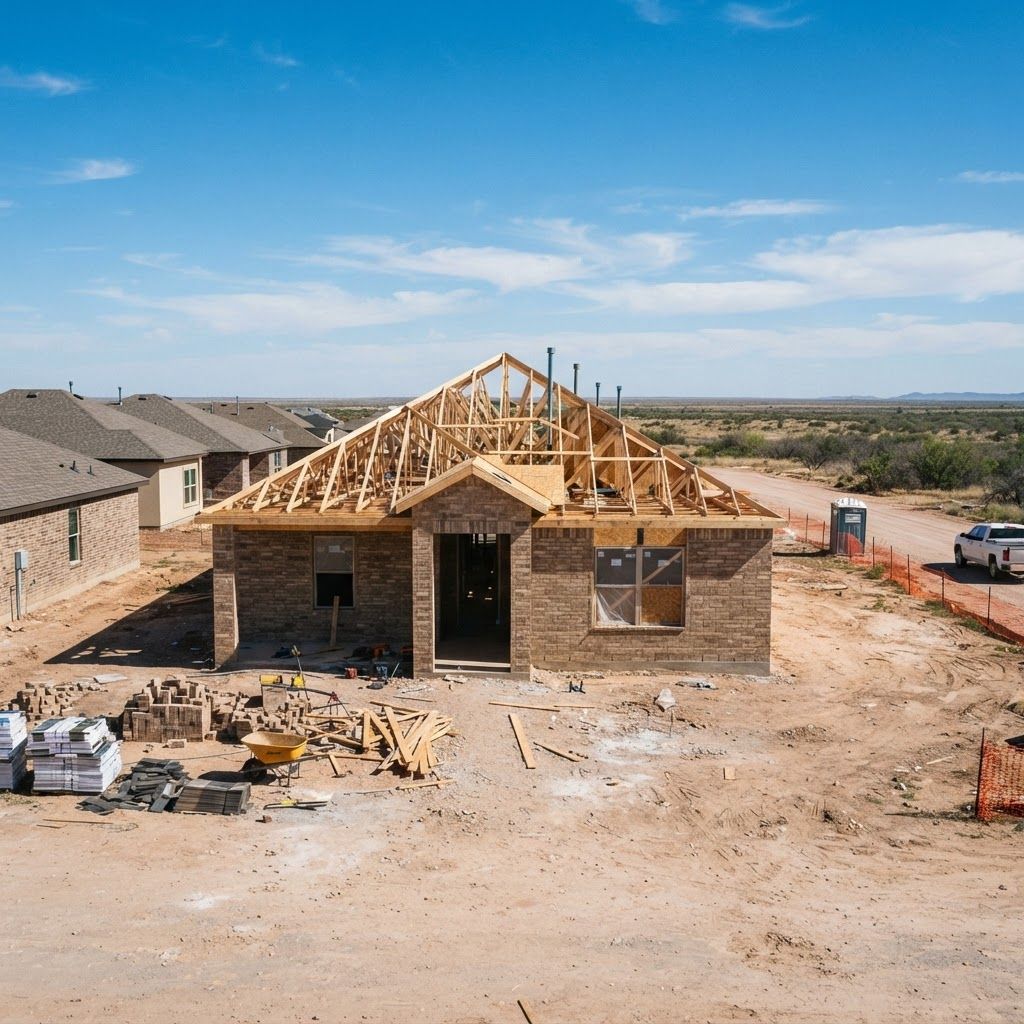
Residential Construction on the Llano Estacado
Lubbock's housing market has expanded steadily as the city has grown outward, particularly to the south and west, and residential construction is one of the most visible industries in the region. New subdivisions, custom homes on acreage, infill builds in established neighbourhoods and rental housing serving the university all contribute to a busy and competitive builder market.
Building well here requires respect for local conditions. Portions of the South Plains have expansive clay soils that swell and shrink with moisture change, which makes geotechnical investigation and appropriate foundation design far more than a formality. Sustained winds and severe thunderstorm activity demand proper structural connections and careful roof edge detailing. Hail is a recurring reality that influences roofing, siding and window selection. And a climate with hot summers and genuine winter freezes rewards serious attention to insulation, air sealing and duct design.
Types of Residential Builders
Production builders construct homes from a defined set of plans within developed subdivisions. Their strength is efficiency: standardised details, established subcontractor crews, predictable pricing and relatively short build cycles. Buyers choose from curated finish packages rather than designing from scratch. For many families this is the best value route to a new home.
Semi-custom builders occupy the middle ground, offering base plans that can be meaningfully modified. Room configurations, ceiling treatments, kitchen layouts and finish levels can be adjusted, giving individuality without the cost and timeline of full custom design.
Custom builders work from architect-designed plans on a client's own lot, managing a bespoke project from geotechnical study through final landscaping. This route offers complete control over layout, materials and systems, and is the appropriate choice for unusual sites, distinctive architecture or high specification requirements.
Remodel and addition specialists focus on existing homes, adding square footage, reconfiguring interiors, finishing basements where they exist, or modernising older properties in Lubbock's established neighbourhoods. Working in an occupied home is a distinct skill involving dust control, phased construction and daily coordination with a family's routine.
Investment and rental builders construct duplexes, small multifamily buildings and student-oriented housing, where durability of finishes and cost per unit drive most decisions.
What Quality Residential Construction Looks Like
Foundation work is where quality is either established or permanently compromised. A responsible builder commissions a soils report, designs the slab or pier system to suit the findings, controls moisture during curing, and provides positive drainage away from the structure with correctly graded soil and functional gutters and downspouts. Poor drainage is the leading cause of foundation movement in expansive soil regions, and it is entirely preventable.
Framing quality shows in straight walls, properly sized headers, correct nailing patterns, adequate blocking and the shear and uplift connections that resist wind loads. Straightness matters visually as well as structurally, because drywall and cabinetry cannot conceal a poorly framed wall.
The building envelope determines long-term comfort and utility cost. Continuous air sealing at top plates, penetrations and rim joists, correctly installed insulation without compression or gaps, properly integrated weather-resistant barriers and flashing at windows, doors and roof intersections, and adequate attic ventilation all contribute. A blower door test at completion is the honest way to verify that air sealing was actually achieved rather than merely specified.
Mechanical design deserves far more scrutiny than it usually receives. Right-sized heating and cooling equipment based on a proper load calculation, ducts sized and sealed correctly and located inside conditioned space where possible, balanced airflow to every room and controlled ventilation produce a home that is comfortable in both August and January. Oversized equipment short cycles, dehumidifies poorly and wears out early.
Roofing and exterior selections should reflect hail exposure. Impact-resistant shingles or metal roofing, quality underlayment, correct valley and penetration flashing, and durable siding materials pay for themselves over the life of a home in this region, and often reduce insurance premiums.
Finish quality is what buyers notice: consistent drywall texture, tight trim joints, level cabinetry, properly sloped tile in wet areas, correctly sealed grout and doors that latch without adjustment. These details reflect supervision more than material cost.
Trends in Lubbock Home Building
Energy performance has moved from marketing feature to buyer expectation. High-efficiency heat pumps, improved window packages, radiant barrier sheathing, spray foam or dense-packed insulation and LED lighting throughout are increasingly standard rather than upgrades.
Flexible floor plans reflect changed living patterns. Dedicated home offices, multi-generational suites with private entrances, larger utility and pantry spaces and covered outdoor living areas that make sense in a dry climate all appear regularly in current designs.
Water-conscious landscaping has gained ground for practical reasons. Drought-tolerant planting, efficient irrigation with smart controllers and reduced turf areas suit both the climate and long-term water availability on the South Plains.
Construction technology has also improved transparency. Cloud-based selection portals, digital schedules, photo documentation and electronic change orders give homeowners visibility that simply did not exist a decade ago.
How to Choose a Residential Builder
Tour completed homes, ideally ones built three to five years ago rather than only new models. Older homes reveal how a builder's work holds up: whether doors still align, whether cracks have appeared, whether drainage has performed.
Talk to past clients about the process, not just the product. Ask how selections were handled, whether the schedule held, how change orders were priced and how warranty requests were answered after closing.
Read the contract carefully. Look for the allowance amounts and whether they are realistic, the specification list and its level of detail, the change order procedure, the payment schedule tied to verifiable milestones, the completion date and any delay provisions, and the warranty terms including what is excluded.
Verify insurance and licensing for the builder and confirm that subcontractors carry their own coverage. Ask how lien waivers are collected, since unpaid subcontractors can place liens on a completed home.
Consider commissioning an independent third-party inspection at foundation, pre-drywall and final stages. It is a modest cost relative to a home's price and it catches issues while they are still easy to correct.
Final Thoughts
Lubbock offers a genuinely broad range of residential builders, from efficient production companies delivering excellent value in new subdivisions to custom firms capable of highly individual architecture. The best outcome comes from matching builder type to your priorities, understanding the specification rather than only the price per square foot, and paying particular attention to foundation, envelope and mechanical decisions that are difficult and expensive to change once a home is finished.