
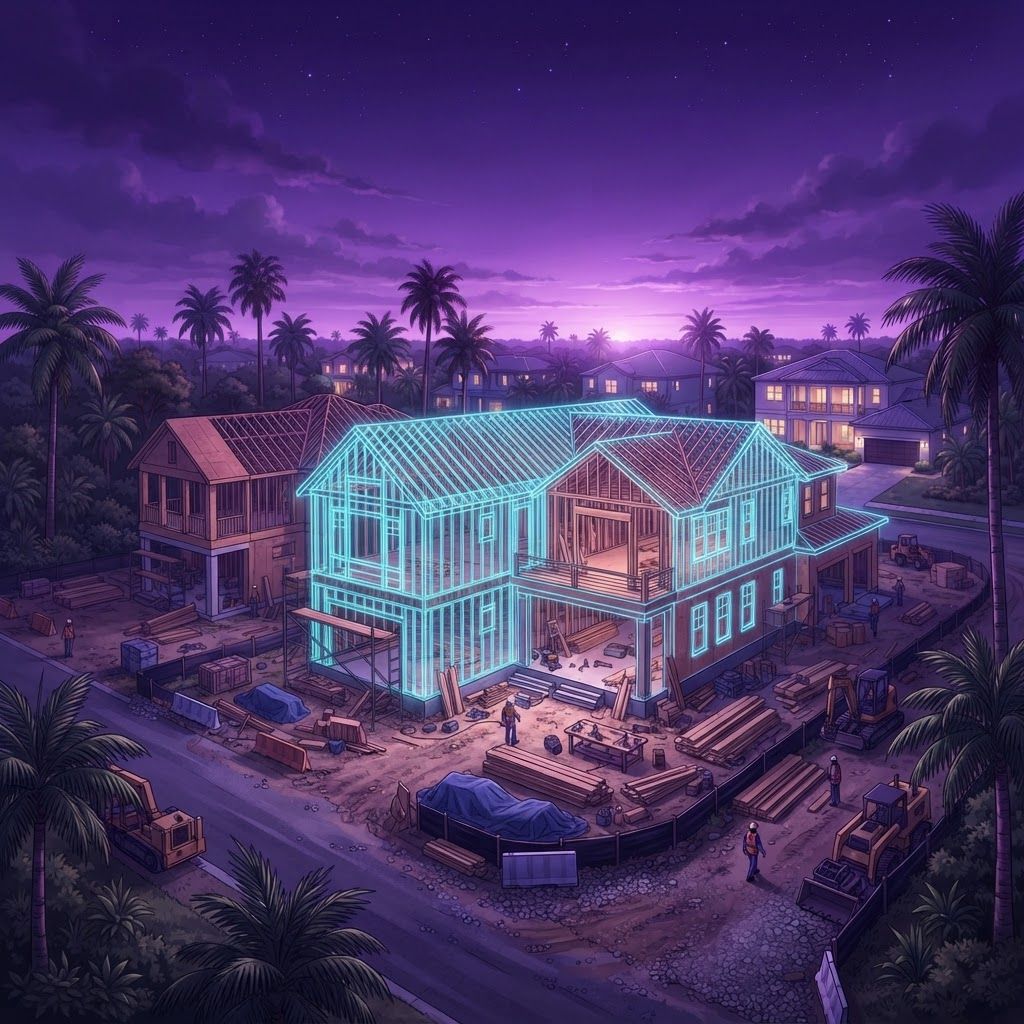
Residential Building in South Florida
Home construction in Hialeah follows a distinct regional pattern. Reinforced concrete masonry walls, tie beams, and either concrete tile or metal roofing dominate because these assemblies withstand hurricane wind loads and resist the termite and moisture pressures that damage wood-framed structures in a subtropical climate. The result is housing stock that is heavier, more durable, and more expensive per square foot than comparable homes in most of the country.
Land availability shapes the market as much as code does. Hialeah is largely built out, so new residential work concentrates on infill lots, teardown and rebuild projects, and substantial additions to existing homes. This urban context introduces constraints that builders must manage skillfully, including limited staging space, neighbor proximity, restricted access for equipment, and zoning limits on setbacks, height, and lot coverage.
1. Custom Home Builders
Custom builders construct one-off homes designed specifically for a client and a particular lot. They coordinate architects, structural and civil engineers, surveyors, and specialty trades, and they manage the extended permitting process that custom designs require. The best custom builders in Hialeah bring value during design by identifying expensive details early, suggesting alternatives that preserve the design intent at lower cost, and confirming that the design satisfies High Velocity Hurricane Zone requirements before drawings are finalized.
2. Production and Semi-Custom Home Builders
Production builders work from a library of proven plans with defined option packages. This model reduces cost and shortens schedules because designs are already engineered, approved products are already specified, and trades repeat familiar work. For buyers who value predictable pricing and faster delivery over complete design freedom, semi-custom construction is often the more rational choice. The trade-off is limited flexibility on layout changes once construction begins.
3. Infill and Small-Lot Specialists
Building on a narrow urban lot surrounded by existing homes requires particular expertise. Specialists in this segment manage access logistics, protect neighboring structures, sequence deliveries to avoid street blockage, and design within tight setback envelopes. They also handle the drainage and grading analysis needed to ensure that a new structure does not redirect stormwater onto adjacent properties, which is a common source of neighbor disputes and permit objections.
4. Teardown and Rebuild Contractors
Replacing an aging home with new construction on the same lot has become increasingly common as land values rise. These contractors manage demolition permitting, utility disconnection and reconnection, asbestos and lead assessment on older structures, debris hauling, and then full new construction. Careful evaluation of the existing foundation and site conditions early in the process prevents costly surprises after demolition exposes the ground.
5. Addition and Second-Story Contractors
Expanding upward or outward preserves an established neighborhood location while adding needed space. Second-story additions are structurally demanding because the existing walls and foundation must be verified to carry the new load, often requiring reinforcement. Ground-level additions involve foundation work, roof integration, and matching existing finishes convincingly. Both require electrical service capacity review and often air conditioning system upsizing.
6. Townhouse and Small Multi-Family Developers
Given land scarcity, attached housing and small multi-family buildings are an efficient use of available parcels. Builders in this category handle party wall fire separation requirements, individual utility metering, shared drainage and parking design, and the additional code provisions that apply once a structure contains multiple dwelling units. They also navigate the more complex zoning approvals that density increases typically trigger.
7. Concrete Shell and Structural Contractors
Some firms specialize exclusively in the structural shell, pouring foundations, laying reinforced block, forming tie beams and columns, and setting elevated slabs. General contractors frequently subcontract this scope because it demands specific crews and equipment. Quality here determines everything that follows, since walls that are out of plumb or openings that are dimensionally wrong create problems for every subsequent trade.
8. Roofing and Envelope Specialists for New Homes
Roofing on a new South Florida home is a heavily engineered assembly involving specific underlayment layers, fastening patterns, and secondary water barriers, all using county-approved products. Envelope specialists also install impact-rated windows and doors, apply stucco systems, and detail flashing at every penetration. Because water intrusion is the leading long-term failure mode in the local climate, envelope execution matters as much as structural work.
9. Interior Finish and Trim Contractors
Finish contractors deliver the elements owners actually see and touch daily: tile and flooring, cabinetry, countertops, interior doors, baseboard and casing, and paint. Coordination discipline is essential because finish trades work in sequence in the same spaces, and a delay in one cascades through the rest. Skilled finish contractors also handle the moisture-related details that matter locally, including proper shower waterproofing and adequate bathroom ventilation.
10. Green Building and Energy Efficiency Builders
A growing segment focuses on reducing operating costs in a climate where cooling dominates energy use. Strategies include continuous insulation, reflective roofing, high-performance impact glazing with low solar heat gain, right-sized and properly commissioned air conditioning, sealed duct systems within conditioned space, and solar photovoltaic installation. These measures raise initial cost modestly but reduce monthly bills substantially and improve comfort and humidity control noticeably.
What Drives Cost and Schedule
Several factors dominate residential construction budgets locally. Structural concrete and masonry work is labor-intensive and represents a large share of shell cost. Impact-rated windows and doors are significantly more expensive than standard units and often carry long lead times, so ordering early is critical. Site conditions matter greatly, since poor soil, high water table, or the need for fill and compaction can add substantial expense before anything visible is built. Permitting and inspection sequencing adds calendar time that cannot be compressed by adding labor.
Realistic scheduling assumes weather interruptions during the summer rainy season, when afternoon storms limit concrete pours and roofing work. Builders who plan around this rather than promising unrealistic completion dates are demonstrating competence, not pessimism.
How to Evaluate a Builder
Verify state licensing and confirm the classification covers residential construction of the type and scale you need. Request current general liability and workers compensation certificates and verify them with the carriers directly. Ask for a list of homes completed in the last three years, then visit one and speak with the owner about communication quality, change order handling, and warranty responsiveness after move-in.
Review the proposed contract carefully. It should include a complete scope, specific material allowances rather than vague placeholders, a milestone-based payment schedule, a written change order process, a defined warranty period, and clear provisions for handling unforeseen site conditions. Confirm how lien releases will be collected from subcontractors and suppliers, since Florida lien law allows claims against the property even after the owner has paid the general contractor.
Final Thoughts
Residential construction in Hialeah rewards builders who understand concrete construction, hurricane code, water management, and urban lot logistics. Choose the category that matches your project, whether custom, production, infill, teardown, or addition, and evaluate candidates on documented licensing, verified insurance, recent comparable work, and contract quality rather than the lowest number on a bid. Build the envelope and structure correctly and the home will serve reliably for generations in one of the most demanding climates in the country.