
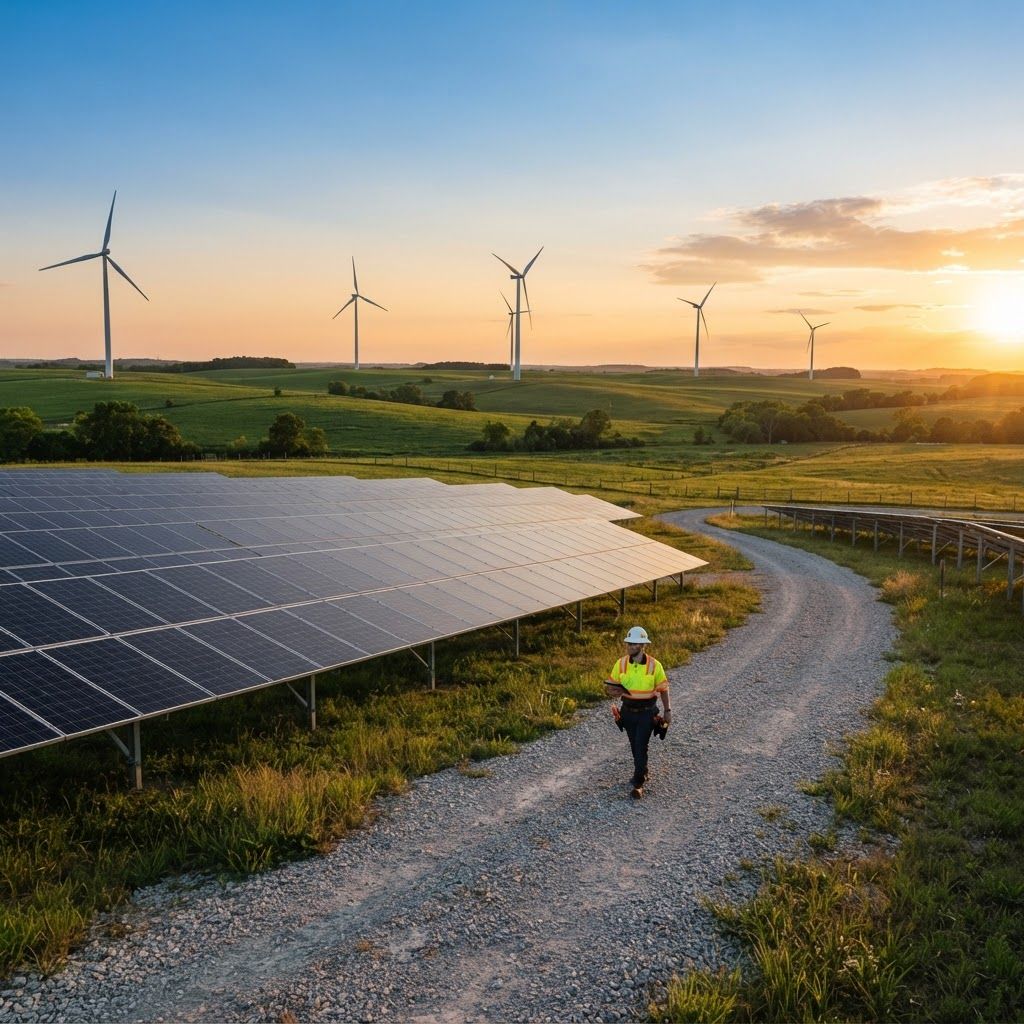
The Midwest Clean Energy Shift Runs Through St. Louis
For much of the twentieth century, the St. Louis region powered itself with coal from nearby Illinois and Missouri basins. That equation has changed. Utility resource plans across the state now call for large additions of solar, wind, and battery storage alongside retirement of aging thermal plants. The region's location at the junction of two major transmission footprints, its industrial load base, and its concentration of engineering and construction talent have made it a natural staging ground for clean energy work across a multi-state territory.
Ameren Missouri, headquartered in St. Louis, anchors the market. Its integrated resource planning has committed to substantial renewable capacity additions and storage deployment over the coming decades, and its procurement activity shapes the pipeline for developers, engineering firms, and contractors throughout the region. Around that anchor sits a dense ecosystem of independent developers, EPC contractors, component distributors, financing specialists, and efficiency consultants.
The Segments That Make Up the Market
Renewable energy is not a single industry. Utility-scale development involves land acquisition, interconnection queue management, permitting, power purchase agreement negotiation, and large-scale construction. Commercial and industrial solar focuses on rooftop and ground-mount systems for warehouses, manufacturing plants, universities, hospitals, and municipal facilities, typically financed through direct ownership, leases, or power purchase agreements.
Residential solar and storage serves homeowners, with a business model that depends heavily on financing options, roof condition assessment, and interconnection processing. Energy storage has grown into its own discipline, encompassing utility-scale batteries for capacity and frequency response as well as behind-the-meter systems for demand charge management and backup power. Efficiency and building performance work, including lighting retrofits, controls, HVAC optimization, and building envelope improvements, often delivers the fastest payback of any category and remains a major source of regional employment.
Supporting these segments are geothermal heat pump installers, biogas and landfill gas operators, renewable natural gas developers, hydroelectric operators on the region's rivers, and a growing set of firms working on electric vehicle charging infrastructure and fleet electrification.
What the Strongest Companies Have in Common
The best renewable energy companies in the region share a recognizable operating profile. They perform rigorous engineering before quoting, using actual utility bill analysis, load profiles, shading studies, and structural assessment rather than rule-of-thumb sizing. They hold appropriate licensing and safety certifications, carry meaningful insurance, and use trained in-house crews for critical work rather than routing everything to subcontractors.
They also present economics honestly. That means modeling production with defensible assumptions, disclosing degradation rates, explaining how net metering and rate structures affect savings, and separating incentive-dependent returns from baseline returns. Firms that lead with an aggressive savings figure and bury the assumptions tend to disappoint. Finally, the strongest firms treat operations and maintenance as a real service line, with monitoring, response commitments, and warranty administration rather than a handshake after commissioning.
Trends Shaping the Regional Market
Several forces are accelerating activity. Corporate procurement is now a primary driver, with major headquarters companies in the region signing renewable supply agreements to meet emissions targets. Data center growth across the Midwest has sharply increased load forecasts, which in turn increases demand for new generation and storage. Manufacturing reshoring has brought energy-intensive facilities that need reliable, price-stable supply.
On the technical side, module efficiency continues to improve while costs have broadly declined over the long term, and storage duration is increasing. Interconnection queue congestion has become the dominant constraint on utility-scale projects, elevating the value of developers with strong queue positions and grid expertise. Workforce development has emerged as a strategic issue, with union training programs, community colleges, and apprenticeships expanding to supply electricians and technicians.
How to Choose a Renewable Energy Partner
For commercial and institutional buyers, begin with an energy audit rather than a technology decision. Understanding load shape, demand charges, and existing inefficiencies often reveals that a smaller generation system paired with efficiency work outperforms a larger system alone. Request references from projects of similar scale and vintage, and ask to speak with owners three or more years post-installation about production versus projection.
Scrutinize the contract. Confirm scope boundaries, interconnection responsibility, performance guarantees, warranty terms for equipment and workmanship, and what happens if the schedule slips. Understand who owns environmental attributes and how they are tracked. For power purchase agreements, examine escalators, term length, buyout provisions, and end-of-term obligations carefully.
For homeowners, verify licensing, check whether the roof needs work before installation, and get at least three quotes with production estimates you can compare directly. Be cautious with financing that bundles costs opaquely, and read any lien or lease document closely, since it can affect a future home sale.
Measuring Real Results
Good projects are measured, not assumed. Establish a baseline before construction, install monitoring that reports at the meter and system level, and review performance against modeled expectations quarterly for the first year. Track availability, not just output, so that inverter faults or communication failures are caught quickly. For efficiency projects, use a recognized measurement and verification approach so savings claims survive scrutiny from finance teams.
The Outlook
The St. Louis region is well positioned for continued clean energy growth. Utility commitments, corporate demand, industrial load, and a skilled construction workforce combine to create a durable pipeline, while transmission investment and storage deployment address the intermittency concerns that once limited adoption. Buyers who approach the market with clear objectives, disciplined technical diligence, and realistic financial modeling will find capable partners across every segment of the industry.