
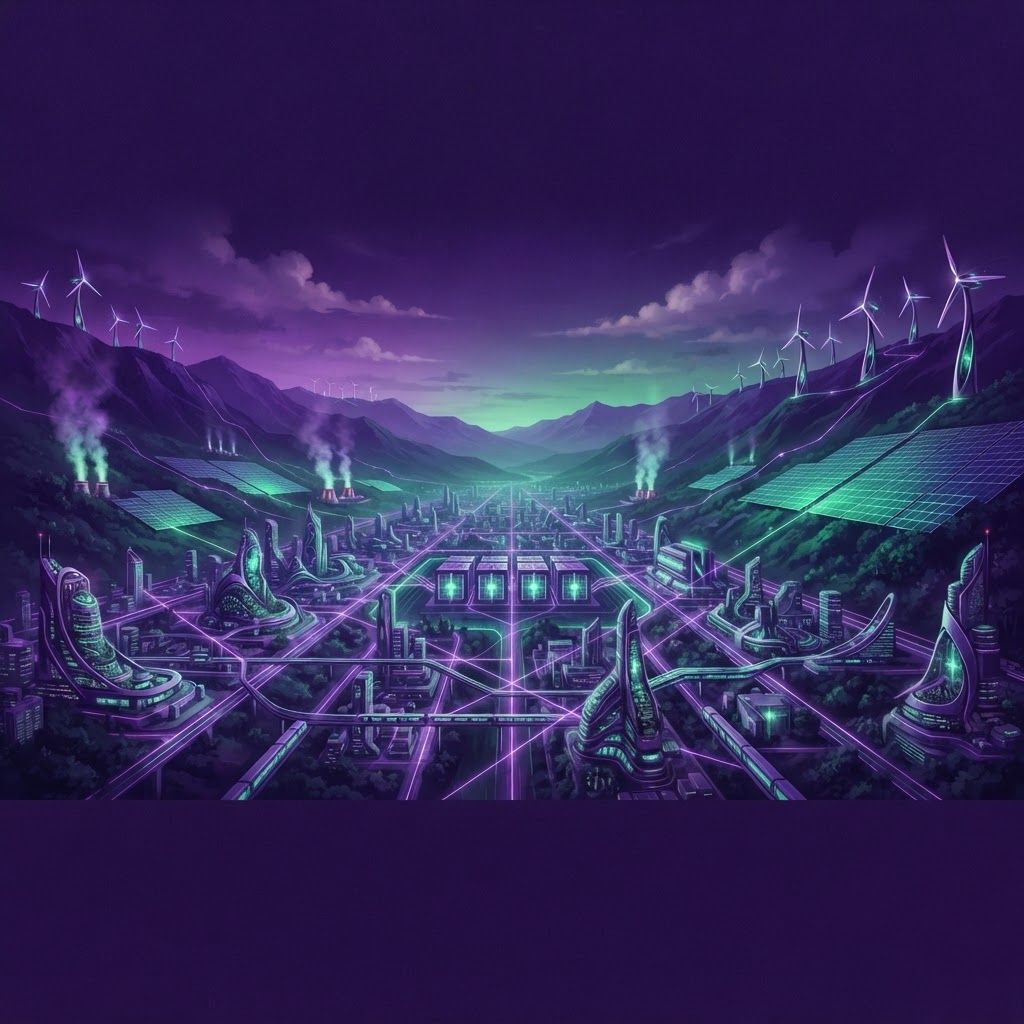
Utah's Renewable Energy Position
Salt Lake City sits at the center of a renewable energy market shaped by unusual geographic advantages. Utah receives among the highest levels of solar irradiance in the United States, with clear skies and high elevation improving photovoltaic output. The state also holds significant geothermal resources, with active generation in the southwest, and substantial wind potential along ridgelines and in the western desert. Crucially, Utah has transmission infrastructure connecting to California and the broader Western Interconnection, which allows generation built here to serve load centers elsewhere.
Policy has reinforced these fundamentals. Salt Lake City adopted community renewable energy goals, and Utah legislation created a framework allowing municipalities to pursue net-100 percent renewable electricity in partnership with the incumbent utility. Large corporate power purchase commitments from data centers and manufacturers have added demand that developers can finance against.
Segments of the Renewable Market
Utility-scale development involves siting, permitting, interconnection, and construction of large solar, wind, geothermal, or storage facilities selling into wholesale markets or under long-term contracts. Commercial and industrial installation serves businesses seeking on-site generation to reduce demand charges and hedge energy costs. Residential installation is the most visible segment, driven by rooftop solar and increasingly paired battery storage. Engineering and consulting firms provide resource assessment, interconnection studies, and environmental review. Finally, storage and grid services have emerged as a distinct business as intermittent generation share rises.
The Leading Renewable Energy Companies
1. Rocky Mountain Power
As the incumbent utility serving Salt Lake City, its generation portfolio decisions and renewable procurement programs shape the market more than any single developer. Its subscriber programs and integrated resource planning determine how much new capacity gets contracted and where.
2. Enyo Renewable Energy
A Salt Lake City-based developer focused on utility-scale solar and wind projects across the Mountain West, active in early-stage siting and development through construction financing.
3. sPower legacy operations, now part of larger renewable platforms
Originally headquartered in Salt Lake City, this developer built one of the larger independent solar and wind portfolios in the country and left behind significant local development expertise that continues to circulate through the regional market.
4. Cyrq Energy
A Salt Lake City company specializing in geothermal power generation, operating plants that provide baseload renewable output. Geothermal is strategically valuable precisely because it runs continuously, unlike solar and wind.
5. Enel Green Power operations in Utah
This global renewable developer operates geothermal and solar assets in the state, contributing utility-scale capacity and long-term operations employment.
6. Intermountain Wind and Solar
A long-established Utah installer serving residential and commercial customers across the Wasatch Front with solar, battery storage, and electric vehicle charging integration.
7. Creative Energies
An employee-owned solar company operating in Utah and neighboring states, known for commercial, agricultural, and off-grid installations in addition to standard residential work.
8. Gardner Energy
A Utah-based provider handling commercial and utility-scale solar engineering, procurement, and construction, with experience on municipal and institutional projects across the valley.
9. Blue Raven Solar
Founded in Utah, this residential solar company grew into a multi-state installer and remains a significant employer in the local clean energy workforce.
10. Engineering and advisory firms with Salt Lake City renewable practices
Consultancies handling resource assessment, interconnection queue strategy, environmental permitting, and grid studies are essential to project viability. Their work determines whether a promising site can actually reach commercial operation.
How to Evaluate a Renewable Energy Partner
For commercial property owners, the decision hinges on production modeling honesty. Request a proposal with clearly stated assumptions about degradation, soiling losses, shading, inverter efficiency, and utility rate escalation. Optimistic assumptions inflate projected savings and are the most common source of disappointment.
Examine warranty structure carefully. Panels, inverters, and workmanship carry separate warranties with different terms, and the installer's own solvency determines whether a workmanship warranty means anything in a decade. Ask how long the company has operated in Utah specifically.
Understand interconnection and net metering economics. Utah's export compensation structure has changed over time, and the value of exported generation differs substantially from retail rates. A credible proposal models self-consumption and export separately rather than assuming full retail credit.
For developers seeking partners on utility-scale work, the practical filters are interconnection queue position, land control documentation, transmission capacity analysis, and permitting track record with the relevant county.
Trends Shaping the Market
Battery storage has shifted from optional to expected, both for residential resilience and for utility-scale projects that need to shift output into evening peak. Data center load growth along the Wasatch Front is creating large, creditworthy offtake demand that accelerates development. Geothermal is receiving renewed attention because enhanced techniques may unlock resources beyond conventional hydrothermal sites, and Utah's geology positions it well. Transmission constraints, rather than generation cost, are now the binding limitation on how quickly new capacity comes online. Finally, air quality concerns specific to the Salt Lake Valley, where winter inversions trap pollutants, give clean energy adoption a public health dimension that resonates locally in a way abstract climate arguments sometimes do not.
Final Thoughts
Salt Lake City's renewable energy sector combines strong natural resources, a supportive municipal framework, and a developer and installer base with real operating history. Whether you are a homeowner evaluating rooftop solar or a corporation negotiating a power purchase agreement, the decisive factors are transparent production assumptions, credible warranty backing, and a partner with demonstrated experience in Utah's specific regulatory and interconnection environment.