
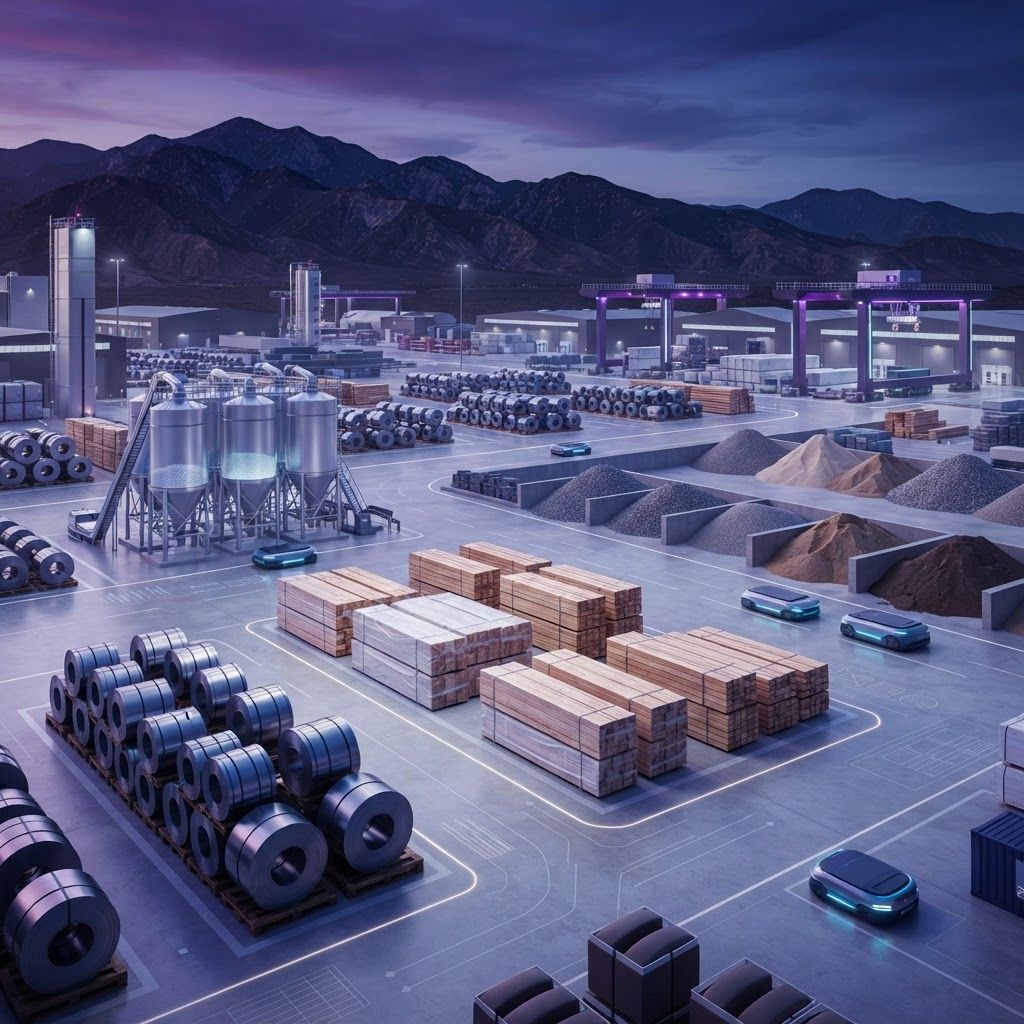
San Bernardino as an Industrial Supply Hub
Few American cities are better positioned to distribute raw materials than San Bernardino. The city anchors the eastern end of a manufacturing and logistics belt that stretches from the Los Angeles basin through Ontario and Fontana into the high desert. Rail service, extensive freeway access and comparatively affordable industrial land have drawn steel service centers, plastics distributors, chemical blenders, building-material yards and aggregate producers into the surrounding area. For a fabricator in San Bernardino, the practical result is that most common industrial inputs can be sourced and delivered within a single business day.
That density matters more than it once did. Supply-chain disruption over the past several years taught manufacturers that lead time and supplier proximity are strategic variables, not just line items. Companies that once ordered steel or resin from distant mills on long lead times have shifted toward regional service centers that hold inventory locally, accepting slightly higher unit prices in exchange for predictability.
Leading Raw Material Suppliers in the Region
1. Ryerson. One of the largest metals service centers in North America, Ryerson supplies carbon steel, stainless steel, aluminum and alloy products in sheet, plate, bar, tube and structural form. Its appeal to Inland Empire fabricators lies in value-added processing — shearing, sawing, plasma and laser cutting, and precision plate work — which lets a shop receive material close to net shape and reduce internal handling.
2. Reliance and its family of metal service companies. Reliance operates through a network of specialized subsidiaries covering everything from aluminum extrusion to specialty alloys. For buyers, the advantage is metallurgical depth: unusual grades, tight tolerance requirements and certified mill test reports are routine rather than exceptional. Aerospace and defense subcontractors in Southern California rely heavily on this tier of supplier for traceable material.
3. Alro Steel and comparable regional service centers. Mid-sized service centers fill an important niche between national distributors and small local yards. They typically carry a broad but practical inventory of common grades and sizes, offer same-week delivery, and are willing to sell smaller quantities than a mill-direct arrangement would permit. Job shops and maintenance departments find this flexibility indispensable.
4. Curbell Plastics. On the polymer side, Curbell Plastics is a well-regarded distributor of engineering plastics — acrylic, polycarbonate, UHMW, acetal, PTFE and high-performance sheet and rod. Its technical support is a genuine differentiator: material selection for chemical resistance, wear or FDA compliance is a nontrivial engineering question, and distributors with applications expertise prevent costly specification errors.
5. Piedmont Plastics. Another major plastics distributor with West Coast coverage, Piedmont offers extensive sheet, film and fabrication services including cut-to-size, routing and thermoforming support. Sign makers, point-of-purchase display producers and equipment guarding fabricators across the Inland Empire are core customers.
6. Univar Solutions. Chemical distribution requires infrastructure that few companies can replicate: permitted storage, blending capability, hazardous-materials transport and regulatory documentation. Univar Solutions is among the most established chemical distributors serving California industry, supplying solvents, acids, caustics, surfactants and specialty ingredients to food processors, water treatment operators, coatings manufacturers and cleaning-product blenders.
7. Brenntag. Brenntag competes in the same chemical distribution space with strong coverage of both industrial and life-science grades. Its value to regional manufacturers includes repackaging services, so a small blender can buy a drum or tote rather than a tanker load, and technical formulation assistance that helps customers reformulate as regulations on volatile organic compounds tighten in California.
8. Ganahl Lumber and regional building-material yards. For construction and millwork, established Southern California lumber yards supply dimensional lumber, engineered wood, panel products, moulding and hardware. Compared with big-box retail, professional yards offer better grade selection, jobsite delivery scheduling, contractor credit terms and staff who can read a plan set and produce an accurate material takeoff.
9. Robertson's and regional aggregate and ready-mix producers. Concrete, sand, gravel and base material are inherently local commodities because freight dominates delivered cost. Regional producers operating pits and batch plants near San Bernardino serve highway projects, warehouse slabs, residential foundations and municipal infrastructure. Their differentiators are plant proximity, mix-design capability and the ability to deliver large continuous pours on schedule.
10. Specialty and secondary-market suppliers. Rounding out the ecosystem are smaller operators that solve specific problems: scrap and remnant dealers selling drops at a fraction of mill price, recycled plastics processors supplying regrind, industrial textile and foam converters, and importers of fasteners and hardware. For prototyping, low-margin production or cost-driven projects, these suppliers can be decisive.
Trends Affecting Raw Material Procurement
Three forces are reshaping this market. First, nearshoring and domestic manufacturing investment have increased demand for regional material availability, particularly in electric-vehicle components, battery assembly, medical devices and packaging. Second, environmental regulation in California continues to tighten around emissions, volatile compounds and waste handling, which pushes buyers toward suppliers with strong compliance systems and low-VOC or recycled alternatives. Third, digital ordering has finally reached industrial distribution: real-time inventory visibility, online certification retrieval and automated reordering are now competitive expectations rather than luxuries.
Price volatility remains the persistent challenge. Metal, resin and energy costs can move sharply within a quarter, and fabricators bidding fixed-price work carry that risk. Sophisticated buyers manage it through indexed contracts, blanket orders with release schedules, and dual sourcing on critical inputs.
How to Evaluate a Raw Material Supplier
Begin with technical capability. Does the supplier carry the exact grades, tempers and tolerances your process requires, and can it furnish certified documentation? A slightly cheaper substitute grade that fails in service is never economical. Next, examine inventory depth and replenishment behavior — ask specifically how often the supplier stocks out on your top five items.
Then assess processing services. Outsourcing cutting, slitting or forming to a distributor frequently reduces total cost by eliminating scrap, handling and machine time in your own shop. Consider logistics as well: delivery frequency, minimum order quantities, will-call availability and the practicalities of receiving at your dock. Finally, evaluate the commercial relationship. Credit terms, consignment programs, price protection during volatile periods and a responsive inside salesperson often deliver more value over a year than a two percent unit discount.
Final Thoughts
San Bernardino's raw material supply base is deep, competitive and unusually well-connected to national and international sources. That gives local manufacturers real leverage, but only if procurement is treated as a strategic function rather than a purchasing chore. Map your critical inputs, understand where each supplier genuinely excels, and build a small portfolio of partners that covers technical depth, local responsiveness and cost-driven alternatives. Done well, supplier strategy becomes one of the most reliable margin levers available to an Inland Empire manufacturer.