
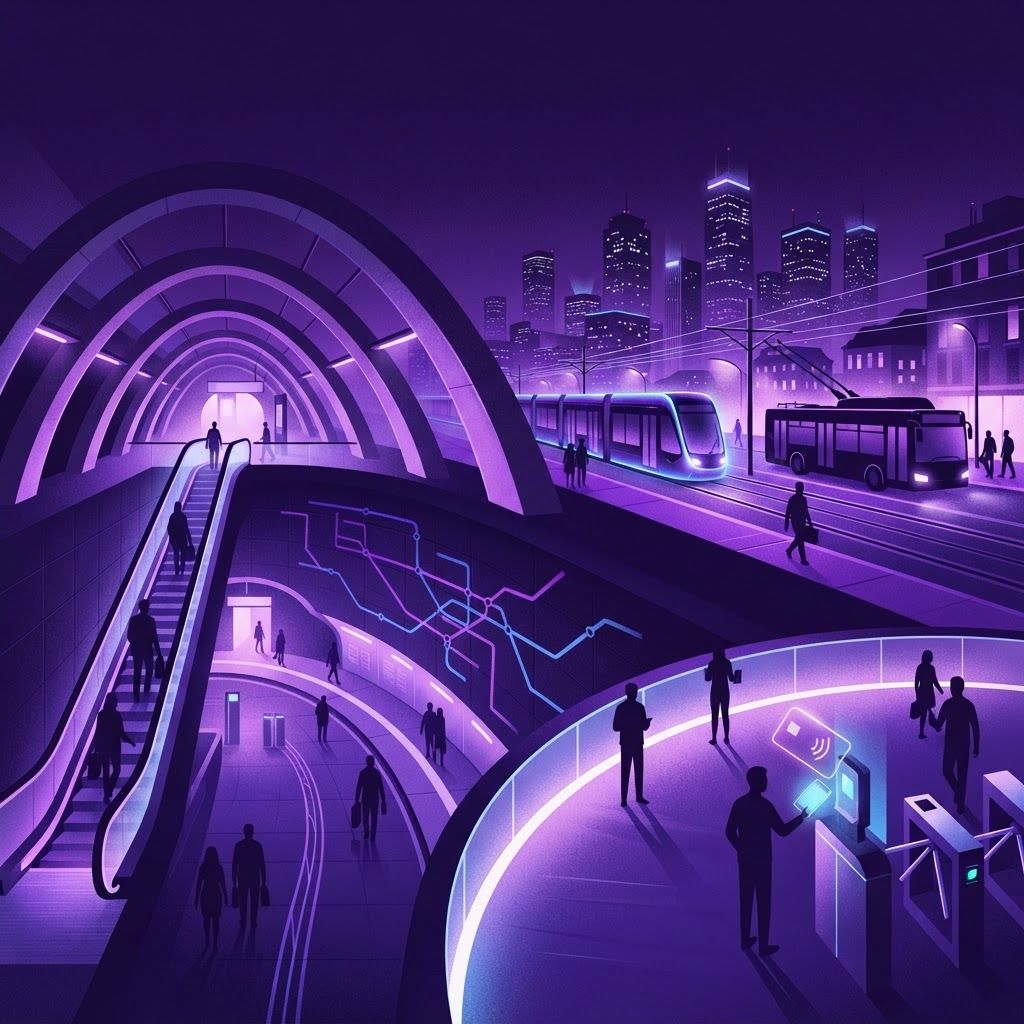
A City That Works Best Without a Car
St. Petersburg is unusually well suited to public transport. The centre is compact and walkable, the metro is fast and deep, surface transport fills the gaps, and suburban rail reaches the palace towns. Driving, by contrast, means dealing with congestion on the main radial avenues, scarce parking in the historic core and bridge openings at night. For most journeys, transit is simply the better option.
The system is also affordable and increasingly easy to use, with contactless bank card payment accepted across most services and a unified transport card available for regular travel.
Ten Transit Services and Operators to Know
Petersburg Metro is the backbone. Its stations rank among the deepest in the world, with escalator descents that become a memorable part of the journey, and several stations are genuine works of architecture with marble, mosaic and sculptural detail. Trains run frequently and reliably across the main lines, making it the fastest way to cross the city.
Gorelektrotrans operates the tram and trolleybus network, an electric surface system with deep historical roots in the city. Trams are slower than the metro but far more scenic, and several routes function almost as sightseeing services through residential and industrial districts.
Passazhiravtotrans runs the municipal bus network, covering areas the metro does not reach and providing essential links across bridges and along the embankments where rail infrastructure is absent.
Commercial minibus operators historically supplemented the network with frequent fixed-route services, and the reformed bus network has absorbed much of this demand into regulated routes with published timetables and unified fares.
Chizhik-format modern light rail operates on upgraded tram corridors with dedicated track, low-floor vehicles, level boarding and higher speeds, demonstrating what surface transit can be when given priority.
Northwest suburban rail services run the elektrichka network to Peterhof, Pushkin, Pavlovsk, Gatchina, Vyborg and Sestroretsk, and for palace day trips they are usually faster and more predictable than road transport.
Aeroexpress-style airport bus links connect Pulkovo Airport with the nearest metro terminus, providing a cheap and frequent alternative to taxis, particularly useful during peak traffic.
River and canal water transport operates seasonally, with scheduled boat services and water taxis along the Neva and the canal network. In summer this is both a practical way to move through the centre and the most flattering perspective on the city's architecture.
Meteor hydrofoils run high-speed services to Peterhof across the Gulf, cutting the journey to roughly half an hour and delivering passengers directly to the Lower Park, which makes them the most enjoyable route to the fountains.
Bicycle sharing and micromobility services complete the network, offering docked and dockless options that work well for short central trips and for connecting between transit stops on the embankments.
How to Use the System Efficiently
Pay contactlessly wherever possible, as bank card and mobile payment acceptance now covers the metro turnstiles and most surface vehicles, removing the need to buy tokens or paper tickets. For longer stays, a stored-value transport card offers lower per-trip fares across modes.
Plan around the metro for speed and use trams or buses for short hops the metro handles awkwardly. Because stations are deep, the walk and escalator time is significant, so for journeys of one or two stops surface transport is often faster overall.
Check bridge opening schedules if you are out late, since the Neva bridges raise overnight to allow ship passage and can leave you stranded on the wrong bank for hours. Night bus routes exist but run infrequently.
Practical Tips for Visitors
Station names are signed in Cyrillic with Latin transliteration on newer signage, and counting stops on the line map is a reliable strategy. Metro entrances often have heavy doors and steep escalators, so allow extra time with luggage or reduced mobility.
Avoid the peak commuter windows on the main lines if you can, and expect crowding at interchange stations. Validate your fare correctly on surface transport, as inspections do occur.
Where the System Is Heading
Investment continues in metro extensions toward growing residential districts, tram corridor modernisation with dedicated right of way, and fleet renewal that is steadily replacing older vehicles with low-floor, air-conditioned models. Digital tools for real-time arrival information have improved noticeably, making surface transport more predictable than it once was.
Final Thoughts
Public transport in St. Petersburg is fast, inexpensive and often beautiful. Combining the metro for distance, trams and buses for local links, suburban rail for palace excursions and boats for summer sightseeing gives you complete coverage of the city without ever needing a car, and it turns getting around into part of the experience rather than an obstacle to it.