
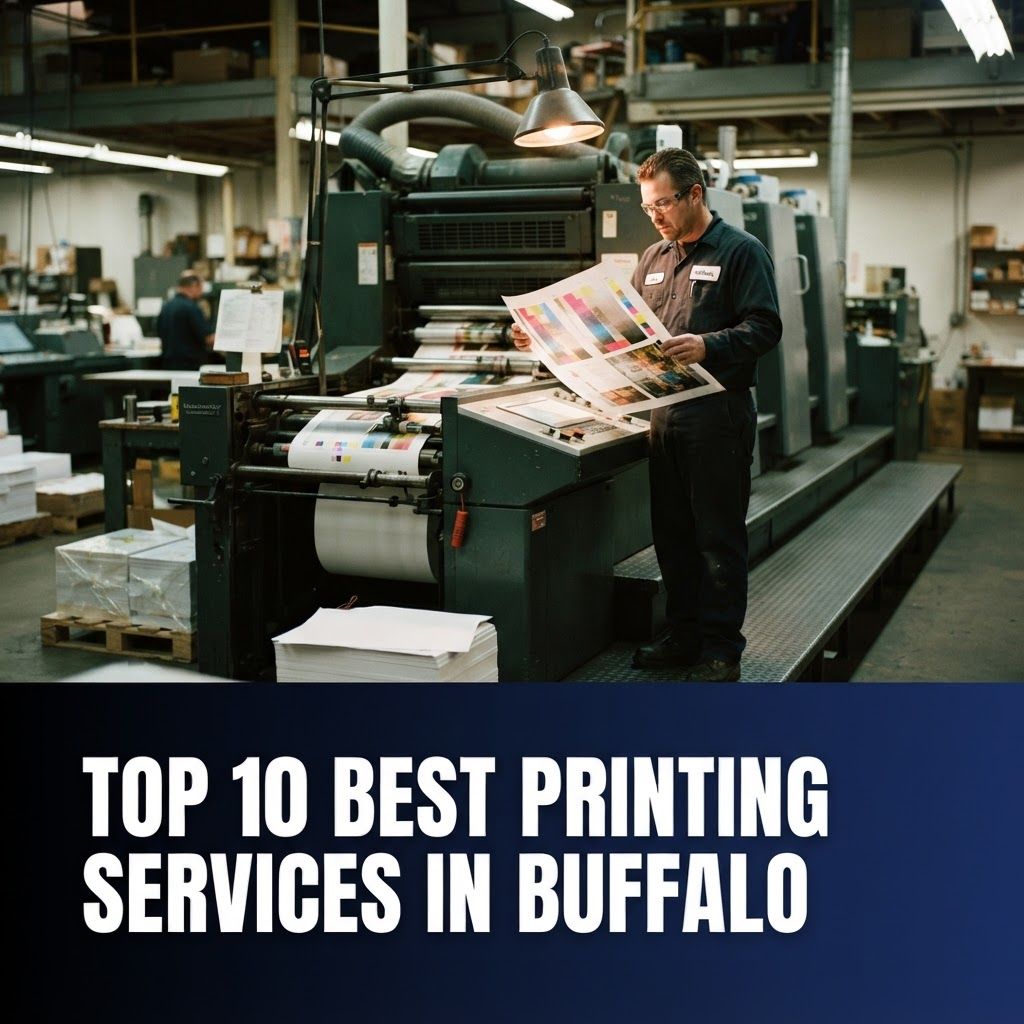
A Print Industry Rooted in Manufacturing History
Buffalo's printing sector grew alongside its manufacturing economy, and that heritage still shapes the market. Commercial printers here developed capabilities serving industrial clients — technical manuals, labels, packaging, point-of-purchase displays — rather than the publishing-oriented work that defined print in other cities. The result is a regional industry with unusual strength in specialty substrates, finishing, and packaging alongside conventional commercial printing.
The industry has consolidated substantially over the past two decades as digital communication displaced volume in categories like direct mail catalogs and business forms. The printers that thrived did so by specializing, investing in equipment competitors could not match, or expanding into fulfillment, signage, and branded merchandise. Buyers benefit from that specialization but need to understand it to route work correctly.
Understanding Print Technologies
Offset lithography remains the most economical method for larger quantities, typically above one to two thousand pieces depending on complexity. It delivers superior color fidelity, supports a wide range of paper stocks, and accommodates specialty inks, metallics, and precise Pantone matching. The setup cost — plates and makeready — makes it uneconomical for short runs.
Digital printing, whether toner or inkjet, has no plate cost and therefore excels at short runs, variable data, and fast turnaround. Quality on modern digital presses is excellent for most commercial applications, though very large solid color areas and certain specialty finishes still favor offset. Variable data printing enables genuinely personalized direct mail where each piece carries different names, offers, or imagery.
Large-format printing covers banners, trade show graphics, vehicle wraps, window films, wall murals, and rigid signage. This is a distinct discipline with its own substrates, inks, laminates, and installation requirements, and specialists in this area usually do not also run commercial sheetfed work.
Screen printing serves apparel, promotional products, and industrial applications requiring durable ink deposits. Flexographic printing handles labels and flexible packaging. Pad printing decorates irregular objects. Each is a separate operation with different vendor sets.
Services Beyond the Press
Prepress and design support ranges from basic file preflighting to full creative services. Buyers supplying their own files should understand bleed, trim, color space, resolution, and font handling requirements, because most print problems originate in file preparation rather than on press.
Bindery and finishing determine how a printed piece feels and functions. Options include saddle stitching, perfect binding, wire-o and spiral binding, die cutting, embossing and debossing, foil stamping, spot and flood coatings, soft-touch laminates, scoring, perforating, and specialty folds. Finishing frequently costs more than printing on premium pieces, and it is where much of the perceived quality lives.
Mailing and fulfillment services add addressing, presorting for postal discounts, inkjet imaging, inserting, and postal documentation. Printers with in-house mailing operations can save clients meaningful postage through proper presorting and address hygiene. Warehousing and pick-and-pack fulfillment support clients who need inventory managed and distributed on demand.
Promotional products and branded apparel have become standard offerings, letting clients source print, signage, and merchandise from one vendor with consistent brand color management across all of it.
Printing Companies and Related Firms in the Region
Buffalo has a substantial base of printing companies. Great Lakes Integrated operates as a commercial printing and marketing services provider serving regional and national clients. Flower City Group, with Upstate New York operations, provides commercial printing, packaging, and fulfillment. Complemar and similar operations handle fulfillment-oriented work.
Regional commercial printers and print shops across Erie and Niagara counties serve business clients with sheetfed offset, digital printing, and finishing. FedEx Office and similar retail locations handle walk-in and quick-turn needs. Sign and graphics franchises including FASTSIGNS and Signarama operate locations in the Buffalo area serving signage, vehicle graphics, and trade show display needs.
The region also hosts packaging converters and label producers serving food processing, industrial, and consumer products manufacturers — a natural fit given Western New York's food and beverage manufacturing base. Apparel decorators and screen printers serve the substantial local market for team, corporate, and event apparel.
How to Specify a Print Job
Vague specifications produce inconsistent quotes and disappointing results. A complete specification includes quantity, finished flat and folded dimensions, page count, ink coverage and number of colors, paper stock by name and weight, coating or finishing requirements, bindery instructions, packaging preferences, delivery locations, and required in-hands date.
Provide the same specification to every printer you solicit. Quotes that vary by fifty percent usually reflect different assumptions rather than different efficiency, and normalizing the spec eliminates most of that variance.
Request paper samples and, for significant projects, a physical proof. Digital proofs shown on a monitor cannot represent how ink interacts with a specific uncoated stock, and approving color on screen frequently leads to disappointment when the job arrives.
Evaluating a Printing Partner
Ask what equipment the printer owns versus brokers. Brokering is legitimate and often sensible, but you should know whether your job will run in-house where the printer controls quality or be placed with a subcontractor. Tour the facility for substantial projects — organization, equipment condition, and how work in progress is handled tell you a great deal.
Discuss color management specifically. Does the printer follow standardized process control? Can they hold brand colors consistently across offset, digital, and large-format output? Brand consistency across media is a genuine technical achievement, not a given.
Confirm sustainability credentials if they matter to your organization. Forest certification chain of custody, vegetable-based inks, waste reduction practices, and recycled stock availability vary by printer and are increasingly relevant to corporate reporting requirements.
Where Print Is Heading
Print volumes have stabilized in categories where physical delivery outperforms digital: packaging, direct mail with strong personalization, signage, and premium brand collateral. Web-to-print portals have become standard for multi-location organizations needing controlled ordering of business cards, forms, and marketing materials.
Sustainability pressure continues to reshape substrate and packaging choices, particularly the shift away from plastic components toward paper-based alternatives. Automation in prepress and finishing is reducing turnaround times, and short-run economics keep improving as digital press quality rises.
Practical Advice for Buyers
Build relationships with two or three printers rather than bidding every job to the lowest quote. Printers who understand your brand standards, file conventions, and deadlines deliver fewer errors and often better pricing over time. Plan ahead when possible — rush charges and expedited freight consume budget that better paper or finishing could have used. And for anything representing your brand at a high-stakes moment, invest in the proof. It is the cheapest insurance in the entire process.