
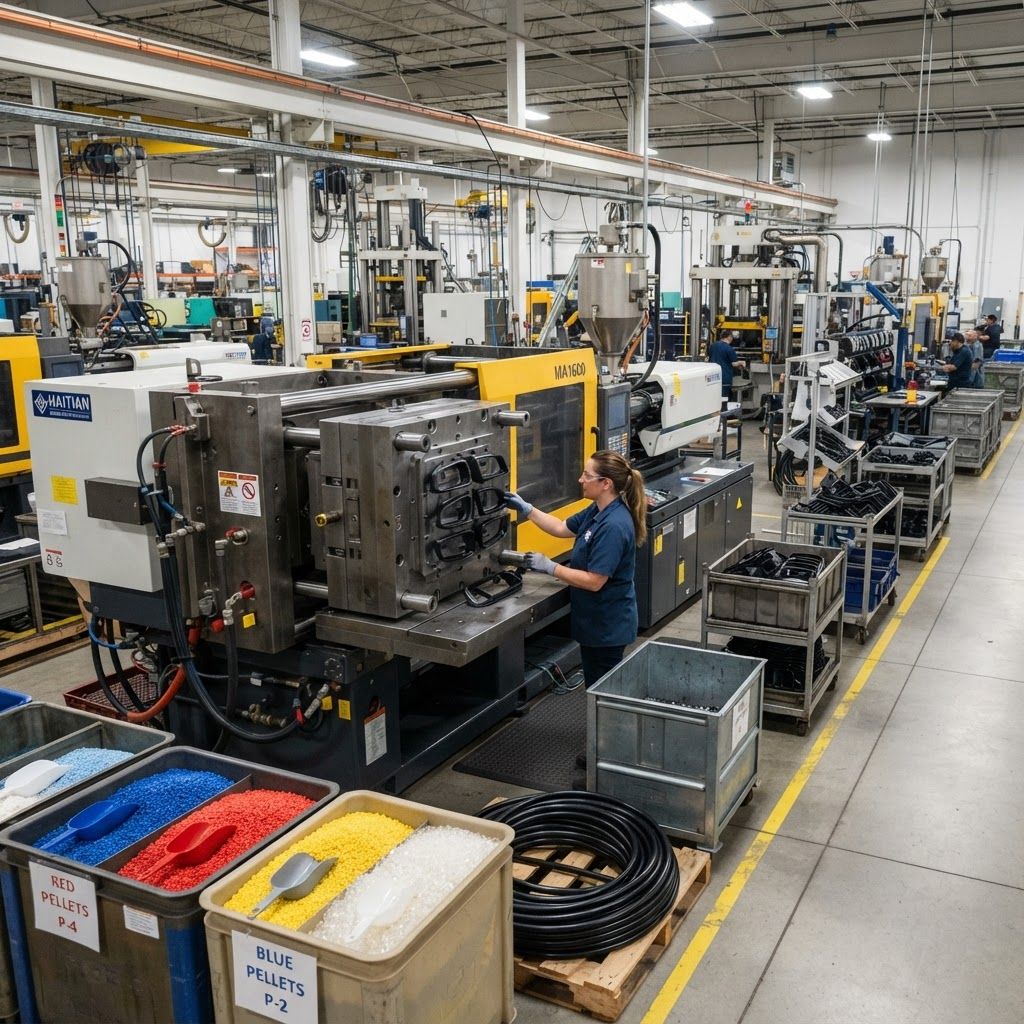
Why Plastics Manufacturing Matters Locally
Plastic is one of those industries most people never think about until they need a specific part. Irrigation fittings, sprayer tanks, grain handling liners, medical device housings, food-safe containers, signage, protective guards and countless custom components all come from plastics processors. In a region built on agriculture, energy and food production, that demand is constant, and Lubbock has developed a solid base of molders, extruders, fabricators and recyclers to meet it.
The local advantage is responsiveness. Plastics processing is tooling-dependent and freight-sensitive, so having a molder or fabricator nearby shortens development cycles and reduces shipping cost on bulky parts. It also makes engineering collaboration practical, which matters because material selection and part geometry determine most of a plastic product's success or failure.
The Top 10 Best Plastic Manufacturers in Lubbock
1. Caprock Injection Molding
A custom injection molder running small to mid-size presses for technical and consumer components. Services include design-for-manufacturability review, tooling coordination, molding, insert work and assembly, with a focus on dimensional consistency across production runs.
2. Llano Plastics Extrusion
Producers of profiles, tubing, pipe and sheet in a range of thermoplastics. Their capability to run custom profile dies makes them a practical partner for equipment manufacturers who need proprietary shapes rather than standard stock.
3. Hub City Rotational Molding
Manufacturers of large hollow parts including agricultural tanks, water storage vessels, containers and equipment housings. Rotomolding produces seamless, impact-resistant parts well suited to outdoor use in harsh sun.
4. South Plains Thermoforming
Vacuum and pressure forming of trays, covers, panels and packaging. Lower tooling cost makes thermoforming attractive for moderate volumes and for large panels that would be impractical to injection mold.
5. Red Raider Plastic Fabrication
A machining and fabrication shop cutting, bending, welding and bonding acrylic, polycarbonate, high-density polyethylene and engineering plastics. They produce guards, enclosures, displays, tanks and prototype parts without tooling investment.
6. Panhandle Agricultural Plastics
Specialists in irrigation components, drip tubing, fittings, mulch film and crop protection products. Materials are selected for ultraviolet stability and chemical compatibility with common agricultural inputs.
7. Yellowhouse Medical Plastics
Contract manufacturing for medical and laboratory plastic components, with cleanroom-conscious handling, documented material traceability and validation support appropriate to regulated products.
8. Texas Plains Packaging Products
Producers of bottles, closures, food-contact containers and shipping components. They support private label programs and provide guidance on regulatory requirements for food and beverage packaging.
9. Monarch Polymer Compounding
Compounders producing custom resin blends with additives for ultraviolet resistance, flame retardance, color and impact modification. In-house testing helps customers match material performance to application demands.
10. Cotton Belt Plastics Recycling
Collection, sorting, grinding and reprocessing of post-industrial plastic into reusable regrind and pellets. Their work reduces landfill volume while giving local manufacturers access to lower-cost material streams.
Trends in the Plastics Industry
Circularity is the dominant theme. Brand owners increasingly require recycled content, design for recyclability and reduced material use, which pushes processors to invest in reprocessing capability and in thinner-wall designs that maintain strength. Bio-based and compostable polymers continue to develop, though performance and cost constraints keep them concentrated in specific applications.
On the technical side, automation and in-mold sensing have improved consistency and reduced scrap rates. Additive manufacturing has also changed prototyping economics, letting engineers validate fit and function before committing to steel tooling, which lowers the risk of expensive tool modifications later.
How to Choose a Plastics Manufacturer
Match the process to the part. Injection molding suits high volumes and tight tolerances, rotomolding suits large hollow parts, thermoforming suits moderate-volume panels, and fabrication suits low volumes and prototypes. Choosing the wrong process is the most common and costly mistake buyers make.
- Discuss material selection openly, including ultraviolet and chemical exposure.
- Clarify tooling ownership, storage and maintenance responsibility.
- Ask about quality inspection methods and dimensional reporting.
- Request sample parts and test them in real operating conditions.
- Confirm regrind policies and recycled content options if relevant.
Final Thoughts
Plastics manufacturing in Lubbock is built around solving practical regional problems, from irrigation hardware to food packaging to medical components. That applied orientation, combined with the freight and collaboration advantages of local production, makes the city a strong sourcing option for both custom and volume parts. Define your performance requirements, involve the processor early in design, and evaluate quality systems carefully. Good plastics engineering is largely invisible when it works, and expensive when it does not.