
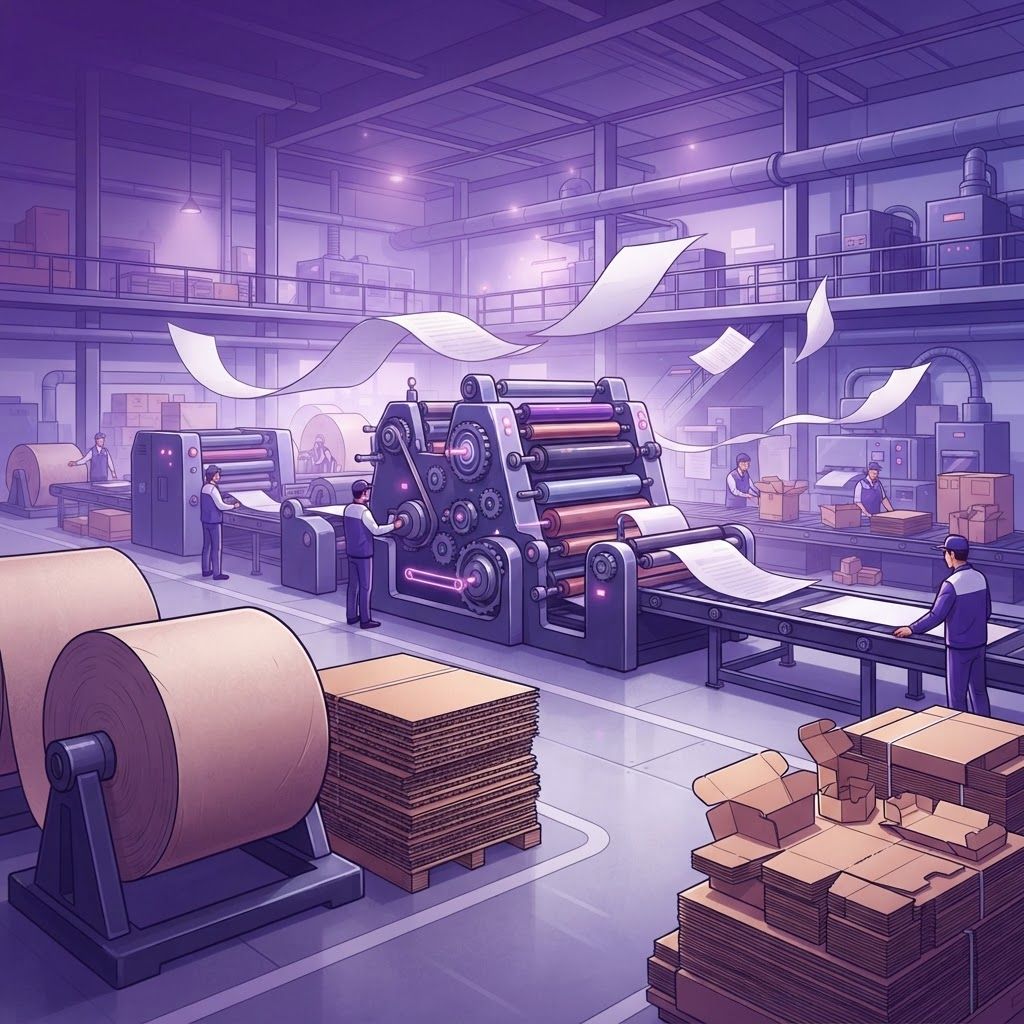
Why Paper Converting Thrives in Hialeah
Paper goods manufacturing is a proximity business. Corrugated boxes and cartons are bulky and relatively low in value per cubic foot, which means shipping empty packaging long distances quickly erodes any savings on unit price. That economic reality is exactly why Hialeah supports a dense cluster of converters: their customers are minutes away in the produce houses, seafood processors, distribution warehouses, bakeries and export consolidators that fill the surrounding industrial corridors.
The city's role as a gateway for Latin American and Caribbean trade adds another layer of demand. Export shipments face longer transit times, more handling and higher humidity than domestic freight, so packaging specifications tend to be more demanding. Local converters have built expertise around moisture resistance, stacking strength and palletization efficiency because their customers cannot afford crushed loads arriving at a port.
The Main Product Categories
Understanding the categories helps narrow the supplier search. Corrugated packaging covers regular slotted containers, die-cut trays, wax-alternative coated produce boxes and heavy-duty export crates. Folding cartons are printed paperboard boxes used for retail products, bakery items and pharmaceuticals. Labels and flexible printing supply pressure-sensitive labels, shrink sleeves and tags. Food-service disposables include cups, clamshells, bags and tray liners. Tissue and away-from-home paper covers towels, napkins and bath tissue converted from parent rolls. Specialty and protective converting produces edge protectors, honeycomb, partitions and custom inserts.
Most Hialeah manufacturers concentrate in one or two of these categories, and a converter that claims mastery of all of them usually brokers part of the work. Knowing where your primary volume sits helps you find the shop that owns the right equipment.
Ten Paper Goods Manufacturers Serving Hialeah
Biscayne Corrugated Container Company manufactures shipping boxes and die-cut corrugated packaging with in-house structural design. Its team produces sample boxes for physical testing before a production run is committed, which reduces costly redesigns after the first truckload.
Flagler Carton and Print specializes in folding cartons with high-resolution offset printing, foil stamping and specialty coatings. Retail and cosmetic brands use the company when shelf presentation matters as much as protection.
Everglade Produce Packaging focuses on agricultural and seafood packaging engineered for cold, wet conditions. Its coated and moisture-resistant corrugated products are designed to hold stacking strength through refrigerated distribution.
Tropic Label Solutions prints pressure-sensitive labels, shrink sleeves and variable-data labels for food, beverage and industrial customers. Short-run digital printing lets smaller brands order realistic quantities and update artwork frequently.
Miami Tissue Converting Works converts parent rolls into towels, napkins and bath tissue for the away-from-home market, supplying hospitality, healthcare and janitorial distributors across the region.
Palm Coast Food Service Paper manufactures and converts cups, bags, clamshells and wraps for restaurants, caterers and ghost kitchens, with growing emphasis on compostable and recyclable substrates.
Hialeah Protective Packaging Industries produces partitions, edge protectors, honeycomb panels and custom inserts that keep fragile goods immobilized in transit. Its engineering approach favors paper-based protection over plastic foams.
Okeechobee Point of Purchase Displays designs and builds retail displays, counter units and floor stands from corrugated and paperboard substrates, handling structural design, printing and assembly kitting.
Sunstate Paper Distribution and Converting combines stock distribution with light converting, allowing customers to source standard sizes immediately while custom items are produced. The hybrid model suits businesses with unpredictable demand.
Coral Way Specialty Envelopes and Stationery manufactures envelopes, presentation folders and printed business papers for professional services, financial firms and institutional mailers requiring consistent quality across repeat orders.
How to Specify Packaging That Performs
Start with the failure you are trying to prevent. Boxes fail in predictable ways: crushed from vertical stacking, punctured from rough handling, or weakened by absorbed moisture. Tell the converter your actual conditions, including pallet stack height, storage duration, refrigeration, transit mode and whether the load is broken down and rebuilt along the way. That information determines board grade, flute profile and coating far more reliably than a size specification alone.
Then request physical samples and test them with your real product. Load a pallet, run it through your normal handling, and inspect the bottom layer. Many companies discover only after a full production run that they specified board that was heavier than necessary or, worse, lighter than the load required.
Palletization deserves specific attention. A box dimension change of a fraction of an inch can allow an additional column per pallet layer, reducing freight cost on every future shipment. Good converters run pallet-pattern optimization as part of the design process rather than as a paid extra.
Print, Branding and Compliance
Packaging carries brand identity as well as product. Confirm which print method the converter uses, because flexographic printing on corrugated has different capabilities than offset litho-lamination or digital printing. If tight color matching matters, request a press proof on your actual substrate rather than approving a digital proof on paper stock. Food-contact packaging adds compliance requirements, so verify that substrates, inks and coatings are approved for direct or indirect food contact as applicable, and that the plant maintains appropriate sanitation and pest-control programs.
Sustainability Trends in Paper Packaging
Paper has gained ground as brands move away from plastics. Three shifts are visible locally. First, recyclable coated corrugated is displacing traditional wax boxes in produce and seafood, because wax-coated boxes cannot be recycled. Second, paper-based void fill and honeycomb are replacing plastic foams in protective applications. Third, customers increasingly ask for recycled content percentages and certified fiber sourcing documentation. Ask converters what recycled content they can provide without compromising the strength your load requires, since higher recycled content sometimes requires a heavier board to hit the same performance.
Managing Cost, Minimums and Lead Time
Custom die-cut packaging carries a one-time die charge and a print-plate charge, both of which favor larger runs. If your volume is modest, ask whether a stock size with a printed label achieves the same result at lower total cost. For growing businesses, negotiating a blanket order with scheduled releases often secures volume pricing without forcing you to warehouse a year of inventory. Confirm lead times for reorders separately from first orders, since repeat runs on existing tooling are typically much faster.
Final Thoughts
Hialeah's paper goods manufacturers provide a rare combination of structural engineering capability, print quality and same-day logistics for South Florida shippers. Choose a converter whose equipment matches your primary category, describe your real distribution conditions rather than just box dimensions, test samples with your own product, and revisit pallet efficiency at least once a year. Packaging is one of the few line items where a thoughtful specification reduces both material and freight spend simultaneously.