
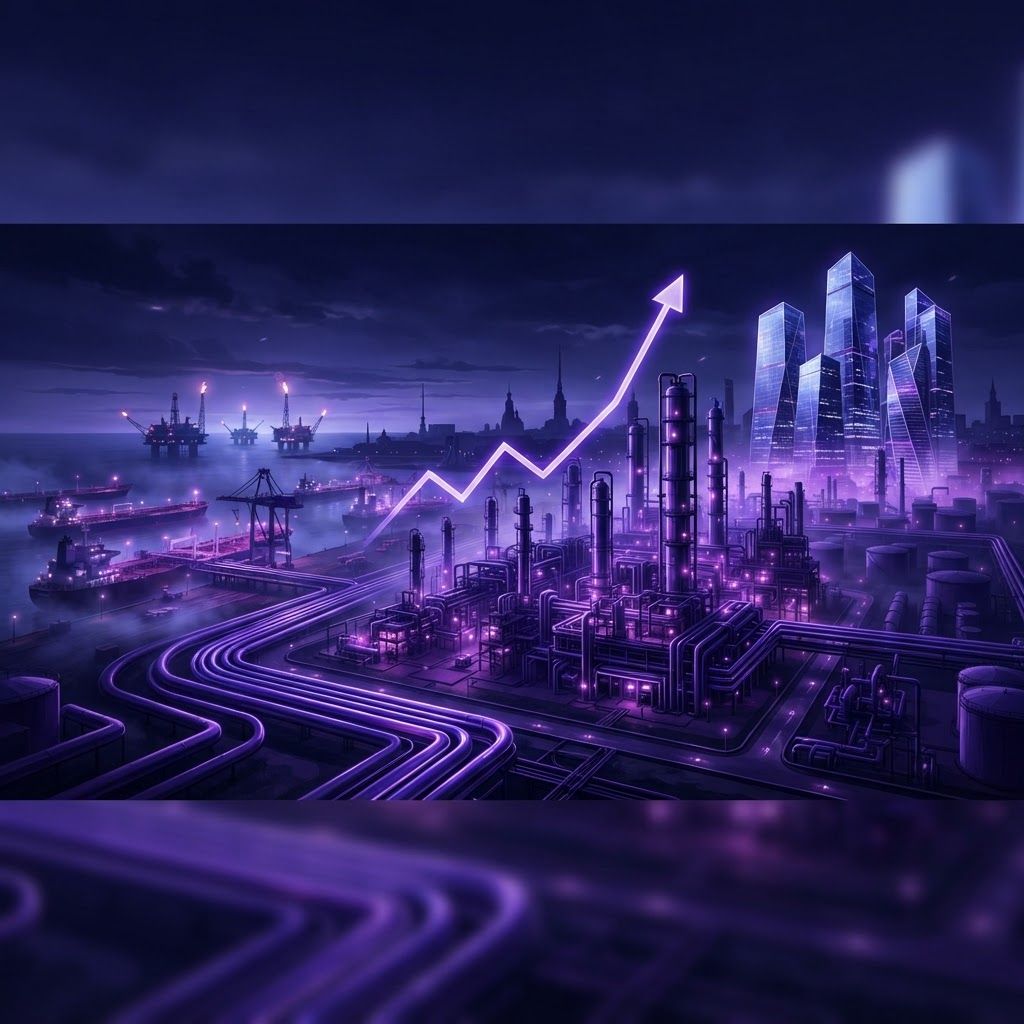
A Corporate and Logistics Capital for Hydrocarbons
St. Petersburg's role in the oil and gas industry is distinctive. The city sits far from major hydrocarbon fields, yet it has become one of the most important centres for the sector's corporate headquarters, engineering design, equipment manufacturing, trading and export logistics. Several of the industry's largest organisations maintain major offices in the city, and its Baltic port facilities handle substantial volumes of petroleum products and liquefied gas.
Three factors explain this concentration. First, the port: deep-water access to the Baltic makes the region a natural export gateway. Second, engineering heritage: the city's design institutes and machine-building plants have supplied drilling equipment, pumps, compressors, turbines and process systems for generations. Third, talent: technical universities produce petroleum, chemical and mechanical engineers in volume, alongside the finance, legal and trading professionals that a headquarters function requires.
Segments of the Local Industry
The sector divides into several activities visible in the city. Corporate and commercial functions include headquarters management, trading, finance and procurement. Engineering and design covers project institutes producing documentation for refineries, pipelines, terminals and offshore facilities. Equipment manufacturing supplies pumps, valves, compressors, turbines, drilling components and process modules. Marine and offshore engineering — a particular regional strength — encompasses platform design, ice-class vessel construction and subsea systems. Logistics and terminals handle storage, blending, loading and shipping of crude and refined products. Finally, an extensive services layer provides inspection, certification, environmental monitoring, laboratory analysis, digital field management and industrial safety consulting.
Ten Organisations Connected to the Sector
Gazprom maintains a major corporate presence in St. Petersburg, and the group's activities span gas production, processing, transportation and marketing on a global scale.
Gazprom Neft is headquartered in the city and operates across exploration, production, refining and retail fuel distribution, with substantial investment in offshore and Arctic technology.
Transneft, through its regional operations, is central to pipeline transportation and product movement toward Baltic export terminals.
Lukoil maintains significant regional operations including fuel distribution and terminal infrastructure serving the north-west market.
Sovcomflot is a leading marine transportation organisation with strong St. Petersburg ties, specialising in tanker and gas carrier operations including ice-class vessels.
Petersburg Oil Terminal operates port storage and transhipment facilities handling petroleum products for export and domestic distribution.
Kirov Plant represents the city's heavy machine-building capability, supplying equipment and components used in energy and industrial applications.
Power Machines manufactures turbines, generators and heavy power equipment applied in refinery, compressor station and gas processing installations.
Neftegazgeofizika North-West illustrates the regional services layer, providing well logging, geophysical survey and reservoir data services to producers.
Baltic Process Engineering represents the design and EPC segment, delivering process engineering, modular systems and construction management for downstream facilities.
Careers and Skills in Demand
The sector remains a major employer of technical specialists. Process, mechanical, instrumentation and control engineers are consistently sought, as are marine and structural engineers for offshore work. Increasingly valuable are hybrid profiles: engineers with data analysis skills for predictive maintenance and production optimisation, specialists in industrial cybersecurity for operational technology networks, and environmental engineers handling emissions monitoring and remediation. Commercial roles in trading, contract management and logistics planning are also substantial.
Training standards are high. Industrial safety certification, hazardous area competency and quality management familiarity are near-universal requirements, and many employers run structured graduate programmes in partnership with local universities.
Technology and Transition Pressures
Digitalisation is the most visible operational trend. Sensor networks, digital twins of processing units, predictive maintenance analytics and remote operations centres have moved from pilot projects to routine practice, driven by clear reliability and cost benefits. Engineering design has similarly shifted to fully modelled three-dimensional documentation with clash detection and construction sequencing built in.
The energy transition presents a more complex picture. Established hydrocarbon organisations are investing in emissions reduction, flare gas utilisation, methane leak detection, energy efficiency at refineries and, in some cases, hydrogen and petrochemical diversification. For engineering and service companies in St. Petersburg, this creates genuine opportunity: the skills required for pipeline integrity, cryogenic handling, process safety and offshore construction transfer directly to gas processing, carbon handling and future hydrogen infrastructure.
Choosing a Supplier or Partner
Buyers in this sector prioritise verifiable competence. Look for demonstrable experience on comparable facilities, valid certifications, documented quality and safety systems, and references from operators rather than intermediaries. For equipment, examine material traceability, testing protocols and spare parts availability. For engineering services, review the firm's design tools, discipline coverage and record of delivering documentation that passed regulatory review without extensive rework.
Final Thoughts
St. Petersburg's oil and gas presence is built on headquarters functions, engineering depth, heavy equipment manufacturing and Baltic export logistics rather than extraction. The organisations listed here reflect that mix across production groups, transportation, terminals, marine operations, machine building and technical services. As the sector modernises, the city's combination of engineering tradition and technical talent positions it well — both for conventional hydrocarbon work and for the adjacent gas, petrochemical and low-carbon infrastructure that follows it.