
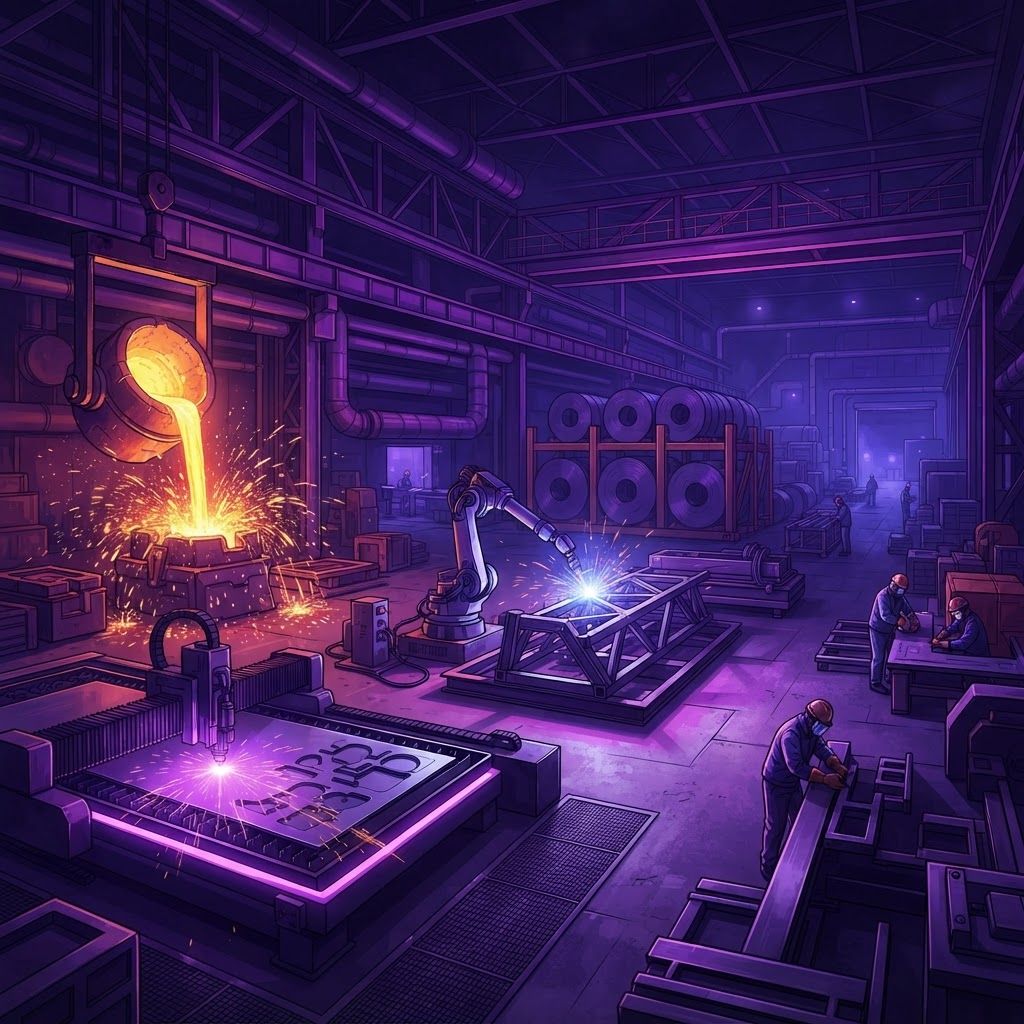
Metalworking as Toledo's Industrial Foundation
If you trace almost any Toledo manufactured product back far enough, you arrive at metal being cut, formed, joined, or machined. The region's metalworking capacity was built to serve automotive assembly, glass equipment, agricultural machinery, and rail, and it survived deindustrialization by becoming more capable rather than simply cheaper. Today the fabricators in and around Toledo run equipment and quality systems that would have been unimaginable in a job shop a generation ago.
Access to steel and aluminum service centers throughout the Great Lakes region keeps material lead times short, and the concentration of specialized processes means a complex assembly can move through cutting, forming, welding, machining, plating, and painting without leaving the metropolitan area. That geographic compression is a genuine competitive advantage in an era when freight cost and transit risk factor heavily into sourcing decisions.
Ten Metalworks Companies and Capability Categories
1. Precision Sheet Metal Fabricators
Fiber laser cutting, CNC turret punching, press brake forming, and robotic welding produce enclosures, brackets, panels, and chassis. The best shops invest in offline programming and automated material handling, which shortens quoting cycles and improves consistency across repeat orders.
2. Heavy Plate and Structural Fabricators
Thick plate cutting, rolling, and heavy welding produce frames, tanks, hoppers, and machine bases. Certified welding procedures and qualified welders are essential here, and reputable shops maintain documented weld maps and inspection records.
3. CNC Machining Shops
Multi-axis milling and turning centers produce close-tolerance components from steel, stainless, aluminum, and exotic alloys. Differentiators include in-process probing, coordinate measuring machine inspection, and the ability to hold tolerance on long production runs without operator intervention.
4. Stamping and Tool and Die Operations
Progressive and transfer die stamping serves high volume automotive and appliance work. The associated tool and die shops are strategically important, since die maintenance and quick repair determine whether a production line keeps running.
5. Metal Spinning and Roll Forming Specialists
Cylindrical and conical parts, custom profiles, and long continuous shapes come from these specialized processes, which often produce parts more economically than machining or stamping at moderate volumes.
6. Foundries and Casting Suppliers
Gray iron, ductile iron, and aluminum casting operations in the broader region supply machine bases, housings, and pump bodies. Casting plus local machining is a common and efficient regional pairing.
7. Welding and Weldment Assembly Providers
Beyond individual welds, these firms build complete weldments with fixturing, stress relief, and post-weld machining to hold assembly tolerances that raw welding cannot achieve alone.
8. Metal Finishing and Coating Companies
Powder coating, e-coating, plating, anodizing, passivation, and industrial painting protect finished parts. Finishers with in-house pretreatment control and cure monitoring deliver coatings that survive salt exposure typical of Midwest winters.
9. Laser and Waterjet Cutting Services
High speed fiber lasers handle most sheet and plate work, while waterjet cutting handles thick, heat-sensitive, or non-metallic materials without a heat-affected zone. Many shops offer both and select the process to match the part.
10. Metal Service Centers and Processors
Service centers stock coil, sheet, plate, bar, and structural shapes, and provide slitting, shearing, and blanking. Their inventory depth allows fabricators to start jobs immediately rather than waiting on mill rolling schedules.
Evaluating a Metal Fabricator
Begin with the equipment list, but read it critically. Laser wattage, press brake tonnage and bed length, machining envelope, and welding process availability determine whether your part can actually be produced in-house rather than subcontracted with added cost and schedule risk.
Quality capability is the second filter. Ask about inspection equipment, first article procedures, material certifications, and traceability. For welded structures, request documentation of welder qualification and welding procedure specifications. For machined parts, ask how the shop validates measurement systems.
Engineering support separates good fabricators from order takers. A shop that reviews your drawings and suggests bend relief adjustments, tolerance relaxation where it does not matter, material substitution, or part consolidation will reduce your cost more than a competitive bid ever will.
Trends in Metal Fabrication
Automation is advancing quickly. Robotic welding cells with offline programming now handle small batch work that previously required manual welding, and automated bending cells reduce dependence on scarce press brake operators. Cobots are appearing for machine tending and part loading in shops too small for traditional robotic installations.
Digital quoting and manufacturing execution systems have compressed lead times. Shops that can return an accurate quote in hours, then track jobs through the floor with real-time visibility, win work from competitors relying on spreadsheets and experience alone.
Sustainability considerations are entering the conversation as well. Scrap segregation and recycling have long been standard in metalworking, but customers now also ask about energy intensity, coating chemistry, and the embodied carbon of steel and aluminum sourced for their parts.
Design for Fabrication
Cost in metalworking is driven by setups, tooling, and secondary operations rather than material alone. Standardizing hole sizes, using consistent bend radii, avoiding unnecessarily tight tolerances, and designing self-fixturing weld joints all reduce price without reducing function. Involving the fabricator during design review typically identifies savings that redesign after quoting cannot recover.
Conclusion
Toledo's metalworks companies offer a rare combination of process breadth, technical rigor, and geographic proximity. From a single prototype bracket to a fully finished production weldment, the regional fabrication base can support the work, and the shops that pair modern equipment with genuine engineering collaboration are the ones worth building a long-term relationship around.