
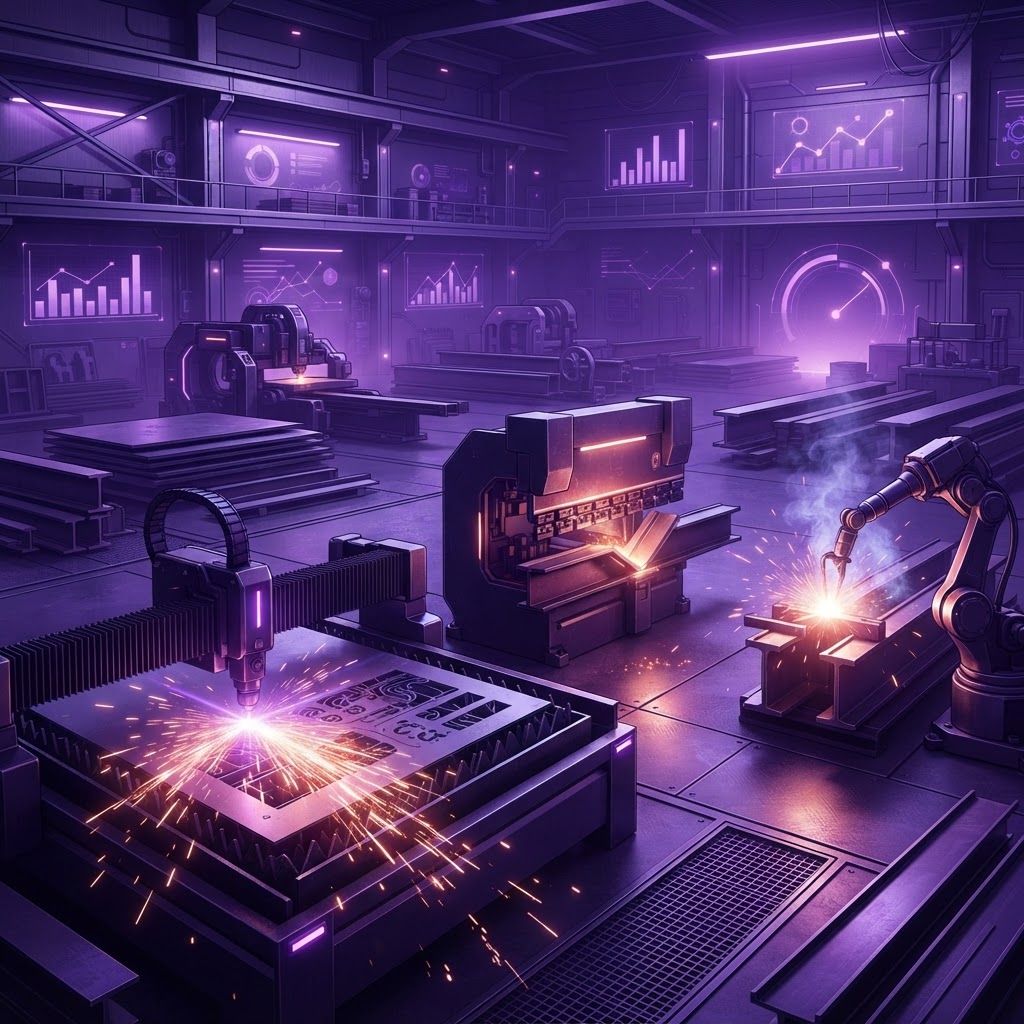
Metal Fabrication in the Valley
Metalworking is among the most versatile manufacturing disciplines, and Tempe supports an unusually broad range of it. Structural steel fabricators supply the region's construction boom. Precision sheet metal shops serve electronics and semiconductor customers. Architectural metal studios produce railings, gates, and decorative screens suited to desert design. Finishing operations apply coatings engineered to survive relentless sun.
What connects these businesses is a shared dependence on skilled labor and capital equipment. Laser cutters, press brakes, welding cells, and coordinate measuring machines represent substantial investment, and the people who operate them well take years to develop. That combination is why metalwork quality varies so much between shops that appear similar on paper.
Structural Steel and Heavy Fabrication
Rio Salado Steel Fabricators produces structural steel for commercial construction, including beams, columns, and connection assemblies, coordinating closely with erectors and structural engineers.
Valley Heavy Metal Works handles large-format fabrication including tanks, frames, and industrial structures, with cranes and floor space that smaller shops cannot match.
Desert Iron and Steel Company combines fabrication with steel supply, serving contractors who prefer a single source for both material and fabricated assemblies.
Precision Sheet Metal and Machining
Papago Sheet Metal Technologies produces precision enclosures, chassis, and brackets using laser cutting, CNC punching, and press brake forming, serving electronics and instrumentation customers with tight tolerance requirements.
Sonoran Precision Metalcraft combines sheet metal fabrication with machining and welding, delivering completed assemblies rather than loose components.
Copper State Laser Cutting operates as a service bureau, providing fast-turnaround cutting for other fabricators, designers, and manufacturers who need parts without maintaining equipment.
Architectural and Ornamental Metal
Mill Avenue Architectural Metals designs and fabricates railings, gates, canopies, and decorative screens, working with architects on custom installations that define building character.
Tempe Ornamental Ironworks produces security doors, gates, and fencing, combining functional requirements with the design sensibility that residential clients expect.
Finishing and Treatment
Arizona Powder Coating Services applies powder coatings and specialty finishes with formulations selected for ultraviolet stability, an essential consideration for any metal exposed outdoors here.
Broadway Metal Finishing provides anodizing, passivation, plating, and polishing services, supporting manufacturers whose components require corrosion protection or specific surface properties.
Trends in the Metalworking Industry
Automation has spread well beyond high-volume production. Automated bending cells, robotic welding, and nesting software that maximizes material yield now appear in shops of modest size, driven by both labor scarcity and consistency requirements.
Fiber laser technology has largely displaced older cutting methods, delivering faster processing, cleaner edges, and lower operating cost. Shops that have not upgraded find themselves uncompetitive on both price and lead time.
Design software integration has streamlined the path from model to part. Customers submitting three-dimensional models receive quotes faster and encounter fewer interpretation errors than those working from two-dimensional drawings.
Material cost volatility remains a persistent challenge. Steel and aluminum pricing shifts create quoting difficulty, and experienced buyers now expect quotes with defined validity periods rather than treating that as a red flag.
How to Specify Metal Work Effectively
Provide complete drawings with tolerances that reflect actual requirements. Specifying tight tolerances on every dimension when only a few matter increases cost substantially without improving function. Call out critical dimensions explicitly and allow standard tolerance elsewhere.
Specify material grade precisely. Steel and aluminum come in many grades with different strength, formability, and corrosion characteristics. Ambiguity here produces parts that meet the drawing but fail in service.
Define welding requirements clearly. Weld type, size, and inspection level should be specified rather than left to interpretation, particularly for structural or pressure-containing work where certification matters.
Address finish explicitly, including surface preparation, coating type, thickness, and color. Powder coating over inadequately prepared surfaces fails regardless of coating quality, and preparation is invisible in the finished part.
Discuss quantity honestly. Setup cost dominates small orders, and a shop quoting one piece will price very differently from one quoting fifty. Sharing realistic projections helps the fabricator structure pricing sensibly.
Finally, visit the shop. Weld quality, organization, and equipment condition tell you more in twenty minutes than any capability statement.
Coordinating Fabrication with Installation
Fabricated metal rarely exists in isolation. Structural steel meets concrete foundations, railings attach to finished surfaces, and enclosures house components supplied by others. Coordination failures at these interfaces cause more field problems than fabrication errors do.
Field measurement is the most common source of trouble. Drawings represent design intent, while buildings are constructed with real tolerances. Experienced fabricators field-verify critical dimensions before cutting, particularly for railings, stairs, and anything fitting into an existing opening. Skipping verification to save a site visit routinely costs more in rework than the visit would have.
Connection detailing deserves early attention as well. Deciding whether a joint will be welded in place or bolted affects fabrication, shipping, site labor, and finish. Welding in the field means touching up coatings on site, which rarely matches shop-applied finish quality.
Finally, plan for sequencing. Fabricated assemblies that arrive before the site can receive them create storage and damage problems, while late arrivals stall trades that follow. A fabricator who asks about your schedule is thinking beyond the shop floor.
Final Thoughts
Tempe's metalworks companies range from heavy structural fabricators to precision shops holding tolerances measured in thousandths. The common requirement for buyers is clear specification. Metal fabrication delivers exactly what is documented, so investing time in complete drawings, honest tolerances, and explicit finish requirements produces parts that fit, function, and last in one of the most demanding climates in the country.