
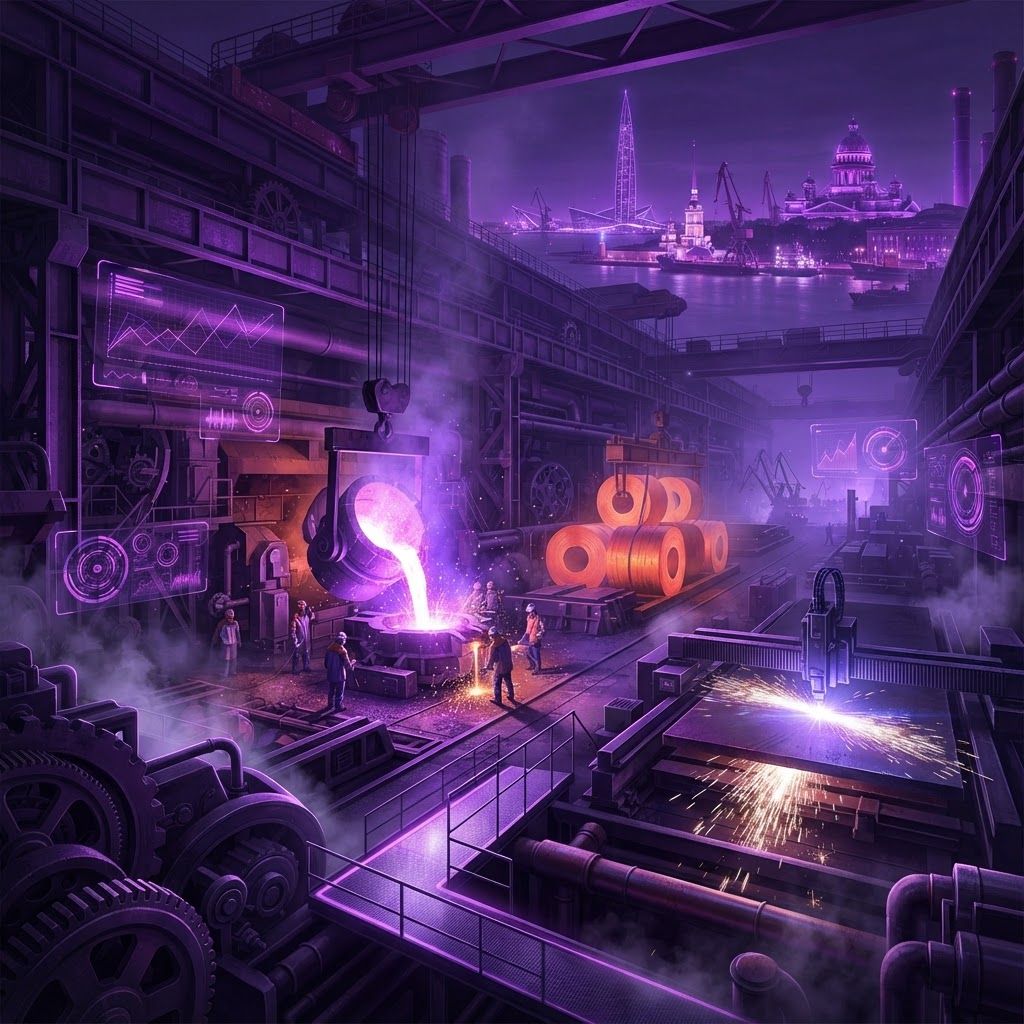
Three Centuries of Metalworking Heritage
Metalworking is arguably the industry that built St. Petersburg. Founded as a shipbuilding and naval city, it developed foundries, forges and machine works from its earliest decades, and by the nineteenth century it was the empire's leading centre for locomotives, turbines, artillery and ships. That legacy did not disappear with industrial restructuring. Instead, it left behind an unusually dense concentration of engineering talent, vocational training institutions, heavy machine tools and specialised know-how that newer manufacturing regions cannot easily replicate.
Today the sector spans an enormous range. At one end sit giant plants producing turbines, reactor components and ship hulls. At the other sit small precision shops running CNC machining centres, laser cutters and press brakes for local manufacturers. Between them are structural steel fabricators, foundries, surface treatment specialists and metal service centres. Buyers who understand this stratification find partners much faster.
1. Kirov Plant
One of the most historically significant industrial complexes in the country, the Kirov Plant remains a diversified heavy engineering group. Its capabilities cover large castings and forgings, heavy machining, gearboxes, tracked vehicle components and specialised industrial equipment. Its differentiator is sheer capability envelope: very large workpieces, deep metallurgical expertise and integrated engineering that few competitors can match. For projects involving multi-tonne components or bespoke heavy machinery, it is a natural first call.
2. Power Machines
Power Machines is a cornerstone of the region's energy engineering sector, producing steam and gas turbines, generators and boiler equipment. Its metalworking strength lies in precision manufacture of very large rotating components, where balance, metallurgy and dimensional accuracy have no margin for error. The company's value to the wider supply chain is also indirect: it sustains a network of qualified local subcontractors in machining, welding and heat treatment.
3. Admiralty Shipyards
Shipbuilding demands metalworking at extreme scale and under strict quality regimes. Admiralty Shipyards combines heavy plate cutting and forming, complex welded assemblies, pipework fabrication and rigorous non-destructive testing. Its differentiator is process discipline: marine and defence certification requirements enforce documentation and traceability standards that raise the capability of everyone who supplies it. Companies needing certified welding to demanding standards often look to shipyard-adjacent suppliers for that reason.
4. Baltic Shipyard
Another pillar of the city's maritime engineering, Baltic Shipyard is known for large and technically complex vessels, including specialised icebreaking and nuclear-powered ships. Its metalworking distinction is handling thick, high-strength and low-temperature-rated steels, together with the welding procedures and post-weld treatments those alloys require. That expertise transfers into demanding industrial fabrication work for the energy and mining sectors.
5. Izhorskiye Zavody
Located in Kolpino, this heavy machine-building enterprise specialises in large pressure vessels, reactor components, rolling mill equipment and mining machinery. Its core strengths are heavy forging, thick-wall welding and very large diameter machining. For clients in chemicals, oil refining and power generation, the ability to fabricate and certify code-compliant pressure equipment locally is a substantial logistical and commercial advantage.
6. Neva Precision Machining
Representing the region's precision subcontracting tier, companies of this type run multi-axis CNC turning and milling centres for prototype and series production. Their differentiators are tolerance capability, in-house metrology with coordinate measuring machines, quick-turn prototyping and quality systems aligned to industrial or automotive expectations. They serve equipment builders, instrument makers and medical device firms that need dozens or hundreds of parts rather than thousands.
7. Petersburg Steel Fabrication
Structural steel fabricators translate engineering drawings into buildings, bridges, industrial platforms and port infrastructure. Their value comes from detailing capability, automated beam and plate processing lines, certified welders, shot blasting and painting facilities, and coordinated delivery sequencing to match erection programmes. In a city with continuous commercial construction and port expansion, this segment is consistently busy.
8. Ladoga Foundry Works
Foundries remain essential to metalworking despite decades of substitution by fabrication. Regional foundries produce grey and ductile iron, steel and non-ferrous castings for pumps, valves, machinery and rail components. Their differentiators are pattern-making support, casting simulation to avoid porosity defects, machining of the finished casting and metallurgical laboratory verification. For complex geometries produced repeatedly, casting still beats machining on cost.
9. Gulf Metal Service Centre
Service centres sit between mills and manufacturers, stocking plate, sheet, coil, tube and structural sections and providing cutting, slitting, bending and light fabrication. Their contribution is inventory and speed: a manufacturer can order a handful of cut blanks instead of a mill quantity of coil. The best of them offer laser and plasma cutting, tight tolerance shearing and next-day delivery, effectively acting as an outsourced first production stage.
10. Vyborg Surface Treatment and Finishing
Metalwork is rarely finished when the metal is formed. Galvanizing, powder coating, anodising, electroplating and industrial painting determine how long a component survives St. Petersburg's damp, salt-laden winters. Specialists in this field differentiate through pre-treatment quality, coating thickness control, adhesion testing and capacity for large or awkward workpieces. Contractors quickly learn that corrosion protection quality, not steel grade, usually determines service life.
Trends Driving the Sector Forward
Automation is the clearest trend. Fibre laser cutting has largely displaced older plasma and oxy-fuel systems for thin and medium plate, robotic welding cells are spreading beyond the largest plants, and automated bending has improved repeatability. Digital manufacturing follows closely: model-based definition, nesting software and machine monitoring reduce scrap and improve quoting accuracy.
Import substitution has also reshaped priorities. Demand has grown for locally manufactured spare parts, reverse-engineered components and refurbishment of existing equipment, which favours shops with strong engineering and measurement capability rather than pure volume producers. Additive manufacturing is emerging in tooling and complex prototypes, while energy costs are pushing investment in more efficient furnaces and induction heating. Finally, welder and machinist shortages are real, making training programmes a genuine competitive differentiator.
Choosing the Right Metalworking Partner
Match the shop to the job. Sending a simple bracket to a heavy engineering plant wastes money, and sending a multi-tonne pressure vessel to a small machining shop wastes time. Define your part envelope, tolerance requirements, material grade and annual volume first.
Then examine four areas. Certification and welding procedure qualifications determine whether the work will be accepted by your inspector or client. Measurement capability tells you whether declared tolerances are verified or merely intended. Capacity and scheduling reveal whether your order will be a priority or filler work. Finally, engineering support matters: a partner who suggests a design change that halves machining time delivers more value than one who simply quotes the drawing. Always request sample parts or a first-article inspection report before committing to a production run.
Final Thoughts
St. Petersburg's metalworking industry combines historical depth with modern capability, offering everything from reactor vessels and turbine rotors to precision aerospace-grade machining and rapid sheet metal fabrication. The ten companies profiled illustrate that spectrum. For buyers, the opportunity is significant: within a single metropolitan region it is possible to source castings, machining, fabrication, welding and finishing from experienced partners, shortening supply chains and keeping engineering conversations close at hand.