
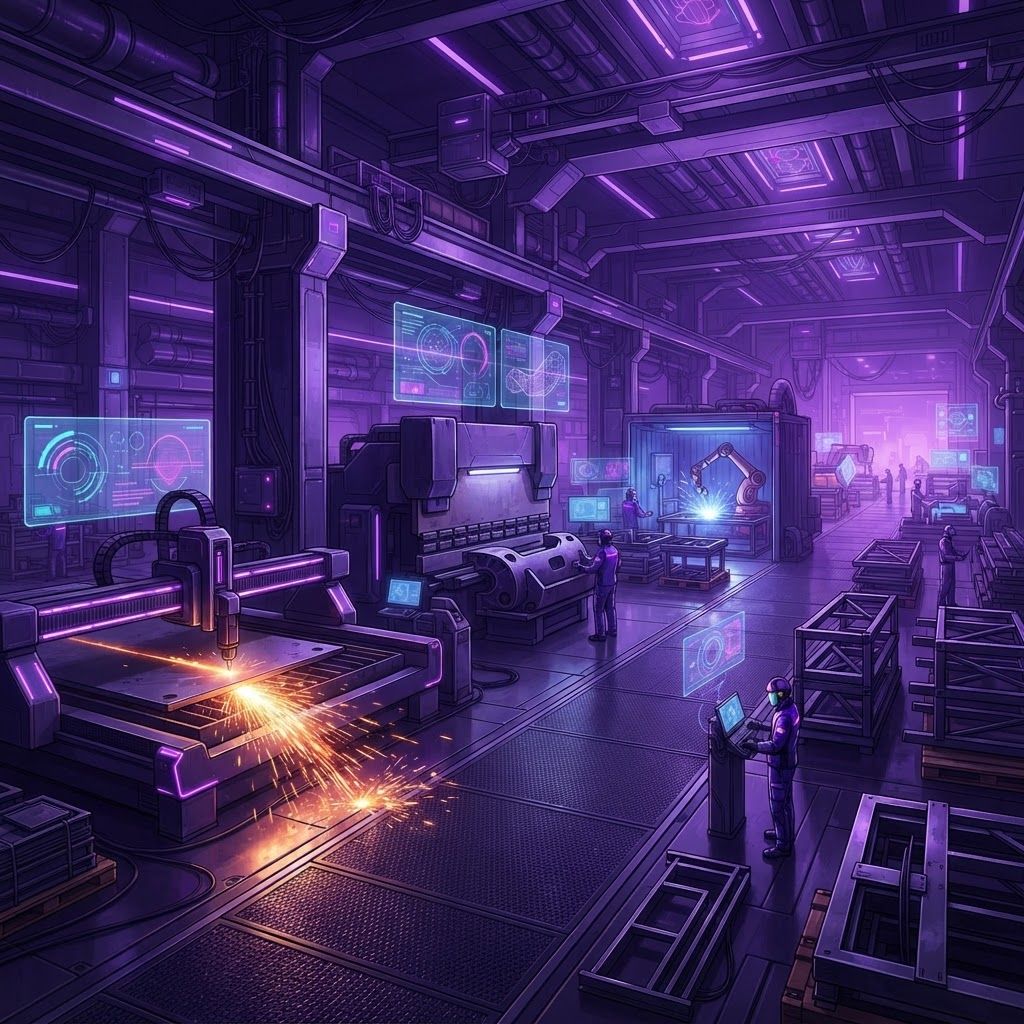
The Metalworking Backbone of the Inland Empire
Metalworking is foundational infrastructure for every other industry. The steel frame of a distribution center, the sheet metal ductwork in its mechanical system, the machined shaft in a conveyor drive and the welded railing on its mezzanine all come from metalworks companies. San Bernardino hosts a dense and capable cluster of them, sustained by the region's continuous construction activity, its manufacturing base and the maintenance needs of thousands of industrial facilities.
The field divides into distinct disciplines that are easy to conflate but require different equipment and expertise. Structural steel fabricators produce beams, columns and connections for buildings. Sheet metal shops form and assemble thinner gauge material into ductwork, enclosures and panels. Precision machine shops remove material to close tolerances on lathes and milling centers. Welding and fabrication shops build custom weldments, frames, tanks and repairs. Architectural metalworkers produce railings, stairs, gates, screens and decorative elements where appearance is paramount. Some companies span several of these; the best are honest about where their genuine strength lies.
How to Evaluate a Metalworks Company
Certification is the appropriate starting point for structural and safety-related work. Welding procedures should be qualified, welders should hold current certification for the processes and positions involved, and fabricators of structural steel for buildings should hold recognized shop certification. For public works and permitted structures these are not optional; inspectors will verify them.
Equipment tells you what a shop can actually do. For machining, ask about the number of axes, work envelope, achievable tolerance and whether the shop has a coordinate measuring machine to verify it. For fabrication, ask about cutting capability, whether laser, plasma or waterjet, along with press brake tonnage and length, and rolling capacity. For structural work, ask about drilling lines, coping capability and lifting capacity. A shop that must subcontract a critical operation loses schedule control.
Engineering and detailing capability is the third consideration. Shops with in-house detailers can convert design drawings into shop and erection drawings efficiently, and those with engineering staff can design connections and assist with problem solving. Fourth, evaluate finishing: galvanizing, powder coating, painting and passivation each require specific facilities, and coordination of these steps often determines the schedule.
Ten Notable Metalworks Companies in the Region
Inland Structural Steel fabricates and erects structural steel for industrial, commercial and institutional buildings, with detailing staff and certified welding procedures for permitted construction.
Arrowhead Precision Machining operates multi-axis machining centers and lathes producing close-tolerance components for aerospace, industrial equipment and defense customers, with inspection to match.
Cajon Sheet Metal Works fabricates ductwork, enclosures, panels, hoods and custom sheet assemblies, combining laser cutting and press brake forming with a well-equipped assembly department.
Summit Welding and Fabrication builds custom weldments, frames, tanks, platforms and heavy assemblies, and provides mobile welding crews for field repairs at industrial sites.
Valley Architectural Metals produces railings, stairs, gates, sunshades, decorative screens and cladding where finish quality and design intent matter as much as structural performance.
Foothill Laser and Waterjet Cutting offers precision cutting services in a broad range of materials and thicknesses, serving other fabricators as well as end customers needing parts cut to file.
Mojave Heavy Plate Fabrication specializes in thick plate work, rolling, forming and welding for mining, aggregate, energy and heavy equipment applications.
Redlands Metal Finishing provides powder coating, industrial painting, sandblasting and passivation, handling both production volumes and large one-off fabrications.
Pacific Crest Steel Service Center stocks and processes structural shapes, plate, tube, bar and sheet, offering cut-to-length and first-stage processing that saves fabricators time.
Sierra Verde Metal Recycling collects and processes ferrous and nonferrous scrap from the region's industrial base, closing the material loop and providing shops a route to recover value from offcuts.
Trends in Metalworking
Automation has advanced steadily. Fiber laser cutting, robotic welding cells and automated press brakes have raised throughput and consistency while reducing dependence on scarce skilled labor. Shops that invested in these technologies compete effectively against far lower-wage regions.
Digital workflow is the second trend. Building information modeling and three-dimensional design now feed directly into fabrication, with model-driven detailing reducing errors and allowing clash detection before steel is cut. Customers increasingly expect to exchange models rather than paper drawings.
Workforce development is a persistent concern and an area of real activity, with regional training programs working to produce welders, machinists and fabricators as experienced tradespeople retire. Companies that operate apprenticeship programs have a durable advantage. Finally, material price volatility and tariff shifts have made procurement strategy a competitive factor, favoring shops with strong supplier relationships and inventory discipline.
Getting Good Results From a Metalworks Partner
Provide complete drawings with material specification, tolerances, weld symbols, finish requirements and any applicable code references. Vague drawings invite assumptions, and assumptions in metalwork are expensive. Specify tolerances only as tightly as function requires, since unnecessary precision inflates cost dramatically. Discuss the sequence of fabrication and finishing so that coating does not interfere with subsequent welding or assembly.
Visit the shop. Housekeeping, fixture organization, material identification and inspection practices reveal process discipline immediately. For structural work, verify certification currency and ask to see welding procedure specifications. Require documented inspection appropriate to the application, whether visual, dye penetrant or ultrasonic. And discuss field coordination for anything that must fit existing conditions, because field-measured dimensions are almost always necessary and rarely match drawings exactly.
Final Thoughts
San Bernardino's metalworks companies bring together traditional trade skill and modern digital fabrication in a way that serves the region's construction and manufacturing economy exceptionally well. Selecting the right partner requires distinguishing among the disciplines, verifying certification and equipment honestly, and providing documentation clear enough that skilled people can execute without guessing. Do that, and metal fabrication becomes one of the most dependable parts of any project.