
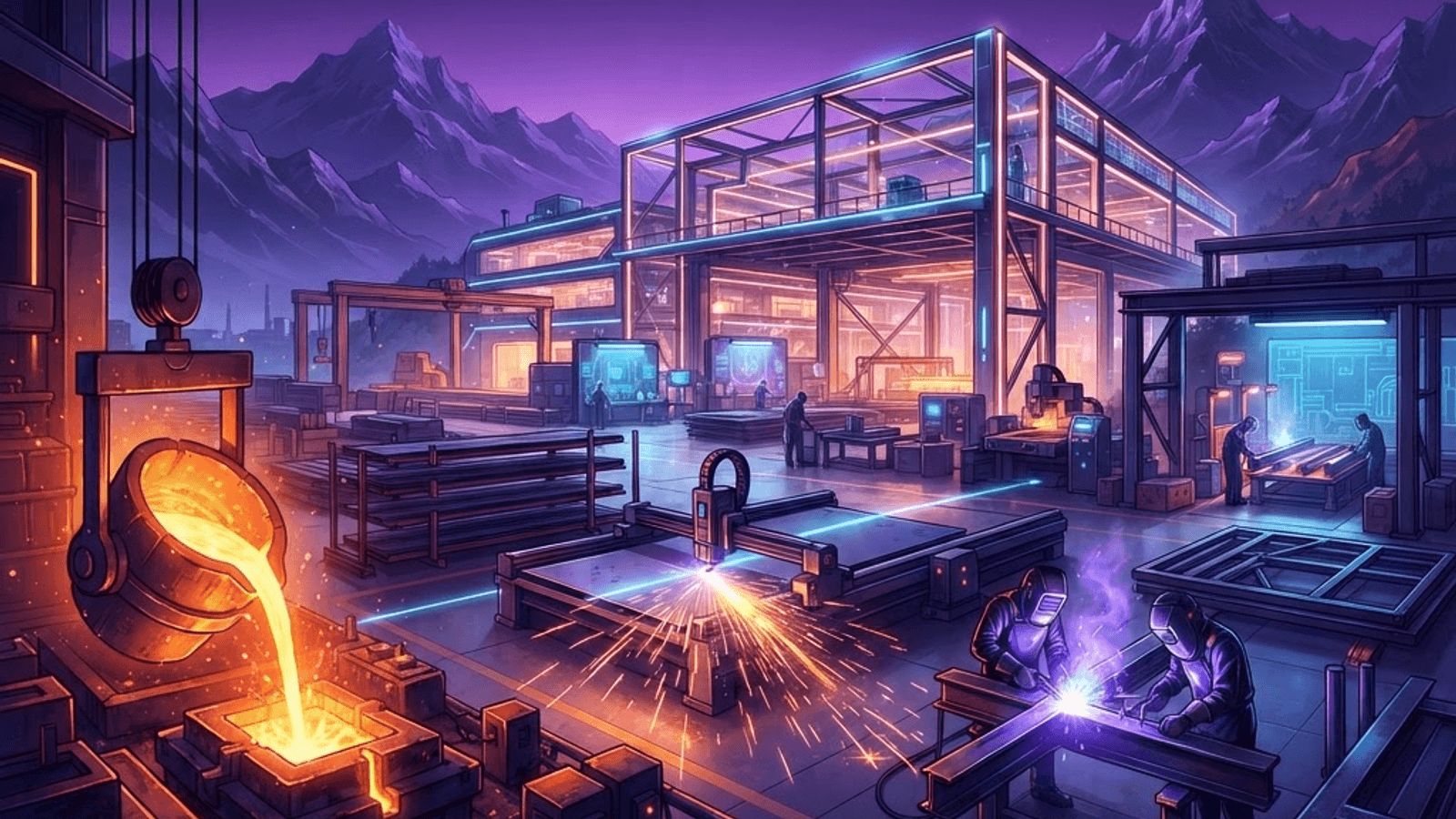
A Metalworking Legacy Rooted in Utah Mining
Metalworking in Salt Lake City traces directly to the mines. Copper, silver, lead and iron extraction demanded machine shops, foundries and fabricators, and those businesses became the foundation of an industrial base that still thrives. Today the valley supports structural steel fabrication for commercial construction, precision machining for aerospace and medical customers, sheet metal work for mechanical contractors, and architectural metalwork for designers.
The regional advantage is concentration. A designer can find laser cutting, press brake forming, welding, powder coating, plating and assembly within a short drive, allowing multi process projects to move quickly without long freight legs between operations. That density also encourages specialization, with individual shops developing genuine depth in specific alloys or processes.
Ten Metalworks Companies Serving Salt Lake City
1. SME Steel Contractors
A major structural steel fabricator and erector based in Utah, SME Steel has supplied steel for stadiums, hospitals, towers and infrastructure projects across the western United States. Its expertise in seismic bracing systems is particularly relevant given regional earthquake considerations, and its capacity allows it to handle projects of significant scale.
2. Wasatch Steel
A long established Salt Lake City metal supplier, Wasatch Steel provides plate, bar, tube, sheet and structural shapes along with cutting services. Contractors, fabricators, ranchers and hobbyists alike rely on it for both large orders and single pieces, a rare combination that has kept it a valley institution.
3. Metalcraft Technologies
Utah based precision sheet metal and aerospace component manufacturers like Metalcraft Technologies serve aviation and defense customers with formed, machined and assembled parts. Aerospace quality requirements demand rigorous documentation, first article inspection and process control that few general shops maintain.
4. Intermountain Precision Machining
Precision machine shops in the valley operate multi axis computer numerical control mills and lathes producing components to tight tolerances for medical, aerospace, semiconductor and industrial customers. Their competitive edge lies in programming skill, fixturing ingenuity and inspection capability using coordinate measuring machines.
5. Bonneville Sheet Metal Works
Sheet metal fabricators produce ductwork, enclosures, panels, chutes and custom formed components. Mechanical contractors across Salt Lake City depend on them for heating and ventilation fabrication, while manufacturers use them for equipment housings and guarding.
6. Great Salt Lake Welding and Fabrication
General fabrication shops handle structural weldments, tanks, frames, railings, stairs and repair work. Certified welders working to recognized structural and pressure standards give these shops the credentials required for permitted construction and industrial equipment work.
7. Alta Architectural Metals
Architectural metal specialists produce railings, canopies, storefront elements, decorative panels and feature stairs. This work sits at the intersection of engineering and craft, requiring finish quality suitable for public spaces along with structural compliance and coordination with architects.
8. Canyon Powder Coating and Finishing
Finishing operations apply powder coating, anodizing, plating, passivation and industrial painting. Finish quality determines both appearance and corrosion resistance, and in Utah where road salt and ultraviolet exposure are aggressive, proper pretreatment matters as much as the coating itself.
9. Silicon Slopes Laser and Waterjet Cutting
Cutting service providers operate fiber laser, plasma and waterjet systems capable of processing steel, stainless, aluminum, copper and even stone or composites. Fast quoting from digital files and rapid turnaround make them essential partners for prototyping and production alike.
10. Utah Foundry and Castings
Foundries and casting suppliers provide sand cast, investment cast and machined castings for mining, pump, valve and industrial equipment customers. Pattern making, alloy selection and heat treatment expertise determine whether a casting performs reliably under load and wear.
Trends in the Metalworking Industry
Automation continues to reshape production. Robotic welding cells, automated press brakes with tool changers, and lights out machining have increased throughput while addressing skilled labor shortages. Shops that invested early now compete effectively against lower cost regions.
Digital workflow integration is equally significant. Quoting software, nesting optimization and direct model to machine programming have shortened lead times dramatically. Customers increasingly submit three dimensional models rather than drawings, which reduces interpretation errors.
Additive manufacturing in metal has moved into production for specific applications, particularly complex aerospace and medical geometries impossible to machine conventionally. Meanwhile sustainability pressures have increased scrap recovery discipline and interest in lower emission finishing processes.
How to Choose a Metalworks Partner
Match capability to requirement precisely. A structural steel fabricator and a precision machine shop are entirely different businesses despite both working in metal. Identify whether your project is dominated by welding, forming, machining or finishing, then select accordingly.
Verify certifications relevant to your industry, including welding procedure qualifications, quality management systems and any aerospace or medical accreditations. Ask to see inspection equipment and documentation samples.
Discuss material sourcing and traceability, particularly for structural or safety critical work where mill certificates are required. Confirm capacity in terms of maximum part size, plate thickness, crane capacity and machine envelope before committing.
Finally, evaluate engineering collaboration. The best metalworks partners suggest design changes that reduce weld length, eliminate secondary operations or improve nesting efficiency, and those recommendations often save more than any price negotiation.
Final Thoughts
Metalworking remains a defining industry in Salt Lake City, blending heavy structural capability with precision manufacturing sophistication. The concentration of complementary shops in a compact geographic area allows complex projects to move efficiently from raw material to finished assembly. Selecting a partner whose specialization matches your project, and who brings engineering insight to the table, produces better outcomes than shopping on price alone.